
"China's Tiandu Satellite Achieves Daytime Laser Ranging"
"World's First Successful Laser Ranging in Earth-Moon Space Under Daylight Conditions"

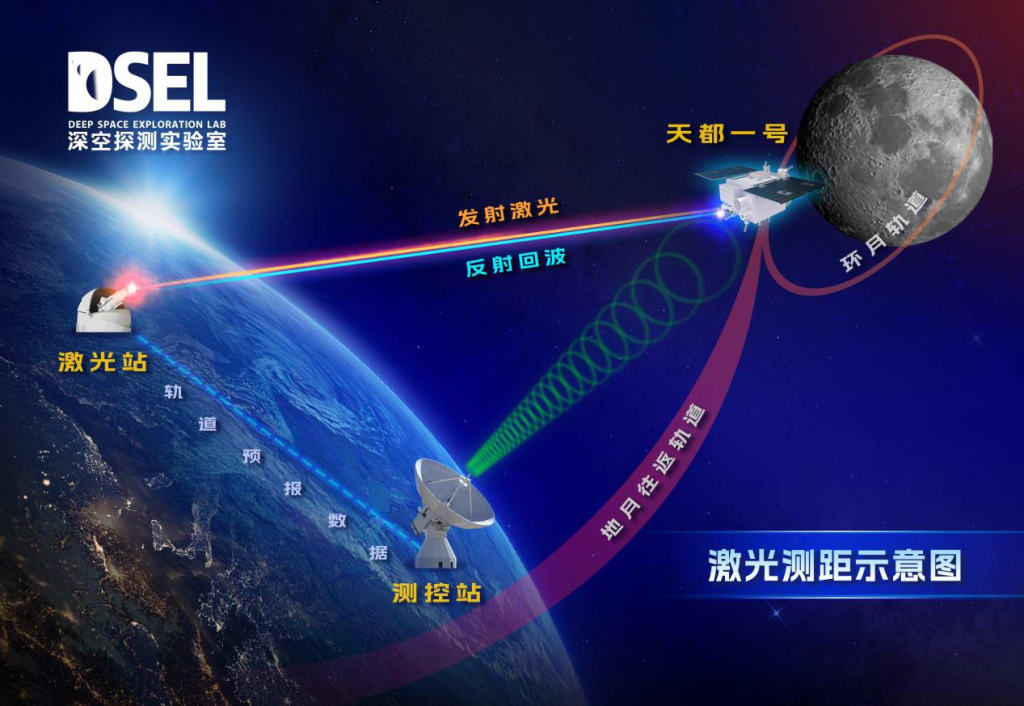
China's Tiandu satellite has successfully conducted a laser ranging experiment in daylight in the Earth-Moon space, a world first. This marks a technological breakthrough in precision measurements in deep space orbit, overcoming the limitations of satellite laser ranging, which has traditionally only been possible at night. The test was conducted from Saturday to Sunday.
China has achieved a significant milestone in space exploration by successfully conducting the first satellite laser ranging test on the Earth-Moon distance in daylight—another world first. A ground-based laser system with an aperture of 1.2 meters was used to accurately measure the distance to the DRO-A satellite, which is located about 350,000 kilometers away—the distance between the Earth and the Moon. The Technology and Engineering Center for Space Utilization (CSU) of the Chinese Academy of Sciences announced this achievement. According to a statement made to the Global Times on Sunday, laser ranging on satellites in such an environment is comparable to the precise tracking and signal acquisition of a hair (sub-millimeter target) from 10,000 meters away. This is due to the vastness of the Earth-Moon space and the extremely high speed of the satellites' movement.
The Tiandu-1 and Tiandu-2 satellites, launched on March 20, 2024, along with the Kuiqiao-2 lunar relay satellite, are part of China's efforts to build a lunar navigation and communication constellation. These satellites are testing new technologies like highly reliable Earth-Moon transmission and routing, which could make it much easier for spacecraft to determine the lunar orbit. According to DSEL, the satellite successfully performed a laser ranging test amidst daylight interference in the Earth-Moon space. China's Tiandu satellite has achieved a world-first daylight laser ranging at the Earth-Moon distance, marking a significant milestone for the entire space research field, not just for China.
1. What Happened
China launched two satellites, Tiandu-1 and Tiandu-2, on March 20, 2024, along with a lunar relay satellite, Queqiao-2.
2. Technical Aspects
A high-powered ground-based laser system with an aperture of 1.2 meters was used for this test. Laser ranging is typically done at night, as sunlight weakens the laser signal. However, this Chinese technology has been able to successfully communicate with a satellite 350,000 km away even in daylight. This demonstrates the advanced nature of China's laser technology.
3. What Is the Tiandu Satellite Doing?
Tiandu-1 (61 kg): It has a Ka-band dual-frequency communication system, laser retroreflector, and space router.
Tiandu-2 (15 kg): It contains communication and navigation devices.
The two satellites are currently conducting research on satellite-to-Earth laser ranging, satellite-to-satellite microwave ranging, and precise orbit determination.
4. Why Is This Important?
The success of this test will enhance the accuracy and reliability of future lunar missions, establish a specific, independent network for navigation and communication on the Moon, and pave the way for the construction of the International Lunar Research Station. China could utilize this technology for future lunar missions, potentially establishing a new navigation and communication system on the Moon. With this success, China has once again proven that it has reached the ranks of leading countries in space research.
5. Initial Steps to Build a 'Space Internet' for the Moon
The Tiandu project marks the beginning of China's space-based "lunar internet," requiring future spacecraft to have a self-contained communication and navigation system for seamless connectivity with Earth and the lunar surface. The Moon will require a "Lunar Positioning System" similar to Earth's GPS, with Tiandu satellites being an experimental version of this infrastructure.
6. Why Is Daylight Laser Ranging a Big Success?
Laser ranging is the process of sending a laser signal to a specific target, such as a satellite, and determining its distance by measuring the return time. This is usually easier at night without outside light interference. During the day, however, sunlight weakens the laser signal and increases background 'noise,' making it difficult to detect the signal. China has overcome that limitation and successfully achieved this in broad daylight, marking a huge technological achievement that no country has been able to accomplish before.
7. Conclusion
China's Tiandu satellite mission is a significant milestone in human lunar exploration. It is not only a successful laser ranging test but also lays the foundation for future endeavors. This success will play an important role in future human settlement on the Moon, research activities, and industrial development.
About the Creator
Torikul Islam
I write to explore emotions, moments, and the quiet questions of life. If you're drawn to stories, reflections, or raw truths—you’re in the right place.
Enjoyed the story? Support the Creator.
Subscribe for free to receive all their stories in your feed.
Comments
There are no comments for this story
Be the first to respond and start the conversation.