
Child Knows Letter Sounds But Not Names? Here's Why It's Usually Normal (What I Learned as a Parent)
I spent months worrying that my child was falling behind, until I discovered why many children learn letter sounds before letter names and why that can actually be a good sign for early reading.

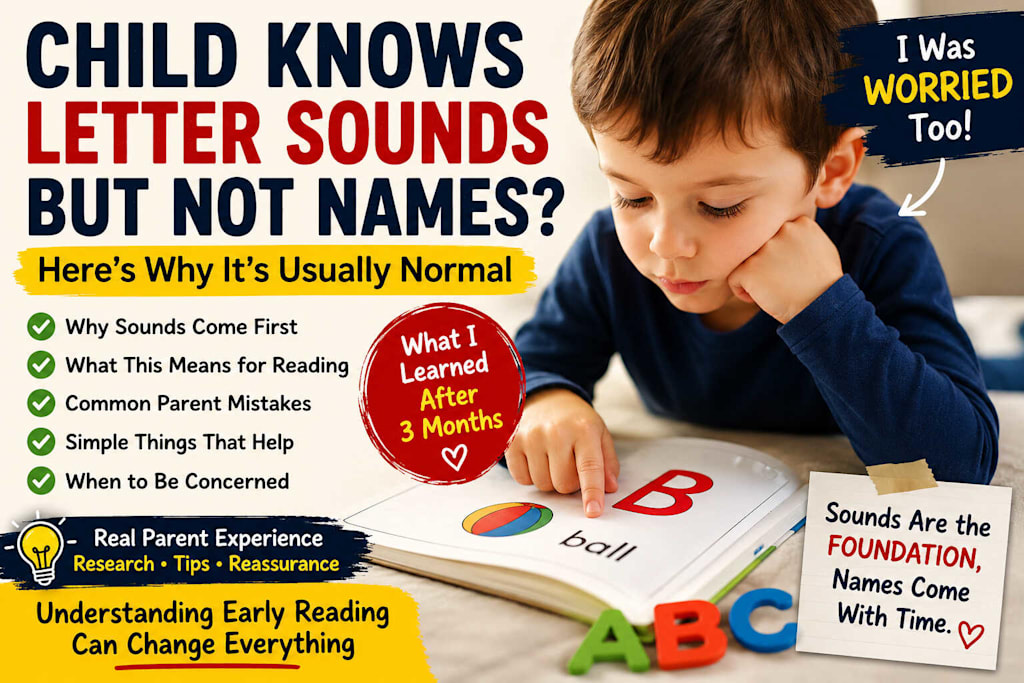
Last fall, my son pointed at a stop sign and said "sss." Not "S." Not "stop." Just "sss." I was driving home from the grocery store, stopped at a red light, and he was in his car seat in the back, staring out the window. I asked him what letter he saw. He said it again. "Sss." I said, "That's the letter S." He looked at me like I had said something in another language. He repeated "sss" and went back to looking at the trees.
I did not think much of it at first. He was four. He knew the alphabet song. He could point to letters on the fridge and name them sometimes. Other times he just made the sound. I figured it was a phase. Kids do weird things. Then it kept happening. He would see the letter B on a cereal box and say "buh." He would see the letter M on a toy truck and say "mmm." He would never say the name. Just the sound.
I started paying closer attention. At bedtime, when we read his favorite book about a dog who loses his bone, I would point to the word "dog" and ask him what letter it started with. He would say "duh." I would ask, "What letter is that?" Silence. He would look at the picture of the dog instead. I would try again. "D. The letter is D." He would nod and turn the page. He did not care about the name. He cared about the sound.
This went on for weeks. I asked other parents. One mom said her daughter learned names first and sounds second. Another dad said his son knew both at the same time. A grandmother told me to stop worrying and just sing the alphabet song more. I tried that. My son sang the song perfectly. Then I pointed to the letter T and asked what sound it made. He said "tuh." I asked what letter it was. He said "tuh" again. The alphabet song had not fixed anything.
I started searching online at night after he went to bed. I typed "child knows letter sounds but not names" into Google. The first few results were the usual parenting blogs. Sing the alphabet song. Use flashcards. Practice daily. Label things around the house. I had already done all of that. None of it explained why my son knew the sound but drew a blank when I asked for the name. It felt like he had learned half the code and the other half was missing.
Then I found something that changed how I thought about the whole thing. A literacy researcher explained that sounds are actually easier for young children to learn than letter names. That sounded backwards to me. The alphabet song is everywhere. Every preschool classroom has letter charts. How could the name, the thing we all learn first, be harder than the sound?
The researcher explained it like this. A letter name is a label. It is an abstract symbol that stands for nothing on its own. The letter "B" is just a name. It does not tell you how to read the word "bat." But the sound "buh" is functional. It is something you can use. When a child sees the word "bat," they do not need to know the letter is called "B." They need to know it says "buh." The name is extra information. The sound is the tool.
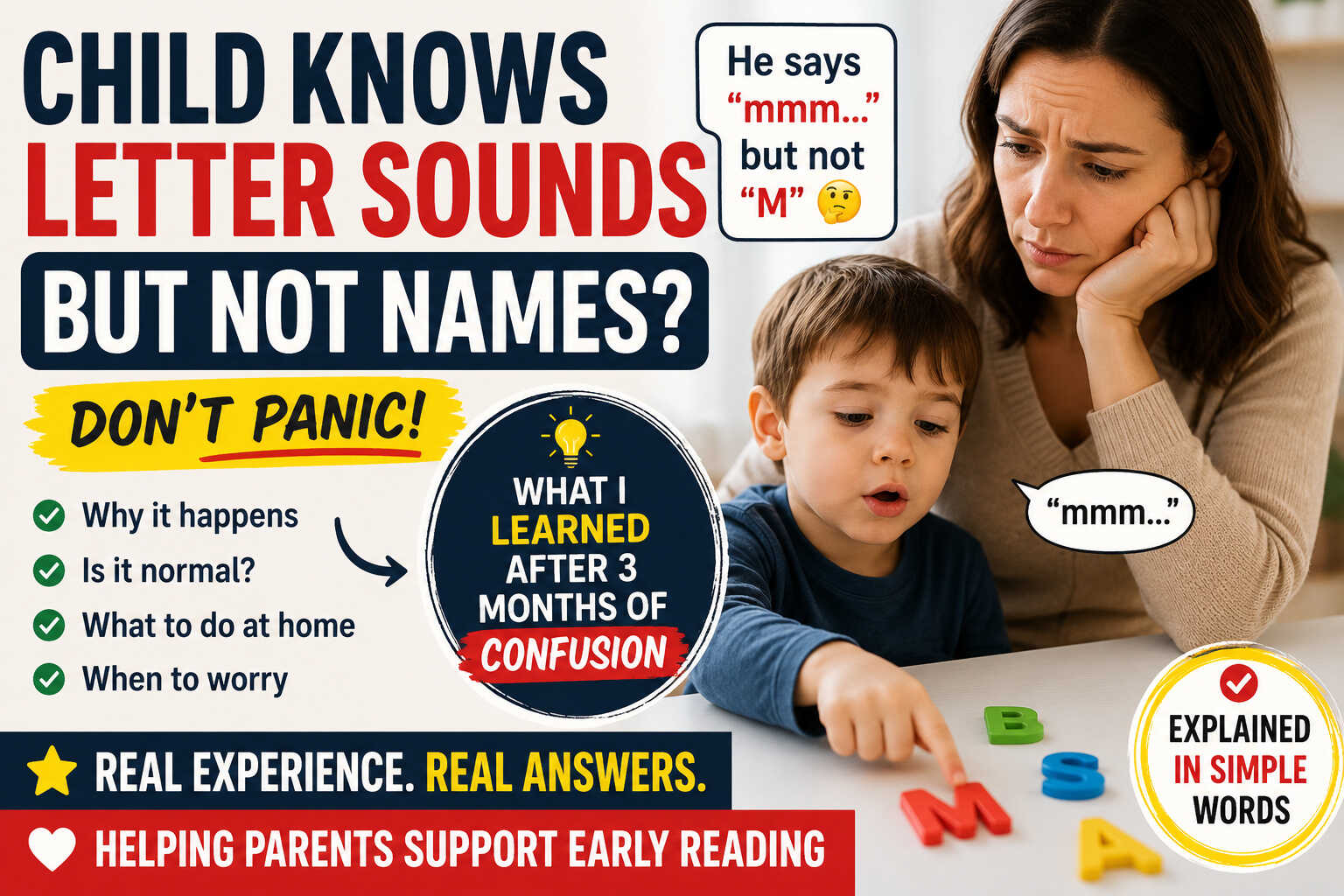
That clicked for me. My son was not confused. He was efficient. He had figured out the part that mattered for reading and ignored the part that did not. The problem was not his brain. The problem was my expectation. I had assumed that knowing the alphabet song meant he understood the alphabet. It does not. The song is a memory trick. It is a string of sounds in order. It has nothing to do with recognizing that the squiggly shape on a page represents a specific sound in a word.
This is where the alphabetic principle comes in. I had never heard that phrase before I started researching. It sounds complicated but it is not. The alphabetic principle is just the understanding that letters represent sounds, and that sounds can be put together to make words. That is it. Once a child grasps that idea, reading becomes possible. Before that, letters are just shapes.
My son had grasped half of the alphabetic principle. He knew that the shape "B" stood for "buh." He did not yet understand that the same shape also had a name, "B," and that the name was a separate piece of information. To him, the sound was the point. The name was irrelevant.
I started thinking about how I had been teaching him. When he was two, I pointed to the letter A on a magnet and said "A says ah." I did not say "This is the letter A." I said "A says ah." I was trying to teach him reading, not the alphabet. So he learned the sound. The name never came up. I had accidentally trained him to prioritize sounds over names, and now I was frustrated that he did not know the names.
This is apparently common in homes where parents focus on phonics early. Phonics instruction teaches sounds first because sounds are what you need for decoding. The letter name is useful later, when you are spelling or using the alphabet for organization, but for reading, the sound is the engine. Many structured literacy programs deliberately teach sounds before names for exactly this reason. The child learns the functional piece first, then the label comes later.
I wanted to understand how structured literacy lessons are usually organized, so I read through an educational guide I found while researching. The guide broke down how phonics-based programs typically sequence their instruction. It started with listening skills, moved to speech sounds, then introduced letter sounds, then letter names, then blending, then decoding, then actual reading. That sequence made sense to me. My son was somewhere between letter sounds and letter names. He had skipped ahead in one way and fallen behind in another.
The guide also explained why some children suddenly seem to catch up overnight. The brain is doing background work that parents cannot see. A child might appear stuck for weeks, then one day start naming letters correctly. What happened? The brain finally connected the sound to the name. It is not magic. It is just a connection that needed time to form. My son's brain was working on it. I could not see the wiring being laid down, but it was happening.
That was a relief to hear. I had been measuring progress day by day, and some days it looked like nothing was changing. But the brain does not work on a daily schedule. It works in bursts. A child might know "buh" for three months and then suddenly say "B" one morning while eating breakfast. The parent thinks it came out of nowhere. The child's brain had been working on it the whole time.
I also learned that letter names are cognitively more abstract because they do not help with the actual task of reading. When you see the word "cat," you do not think "C-A-T." You think "cuh-ah-tuh." The names are useless in that moment. A child who knows only sounds can actually start decoding simple words before a child who knows only names. The sound-kid is ahead, not behind. They just look behind because they cannot name the letters when asked.
This explained why my son could sometimes sound out the beginning of a word but could not tell me what letters were in it. He was operating on sound logic, not name logic. The two systems are related but separate in the early brain. They have to be connected through practice and exposure, but that connection takes time.
I started correcting my own misconceptions. I had assumed that knowing letter names was the foundation and sounds were the advanced layer. It is the opposite. Sounds are the foundation. Names are the social convention we layer on top. We need names for spelling bees and filing systems and phone calls where you say "B as in boy." But for reading, the sound is what moves you forward.
Another misconception I had was that a child who knows sounds but not names is at risk for dyslexia. That is not true. Dyslexia is about difficulty connecting sounds to symbols, not about knowing names versus sounds. A child who consistently maps sounds to letters is actually showing strong phonological awareness. The missing names are a separate issue, usually developmental, usually temporary.
I also thought I needed to drill names harder. Flashcards every morning. Alphabet games. Letter tracing. The research said the opposite. Forcing name memorization when a child is focused on sounds can create confusion. The child starts mixing up the two systems. They might say "B says bee" instead of "B says buh." That is a step backward. The better approach is to let the sound knowledge settle, then gently introduce names as a secondary label.
So I stopped drilling. I stopped asking "What letter is this?" and started asking "What sound do you hear?" I pointed to the M on the milk carton and said "mmm, milk." I did not say "This is the letter M." I let the sound do the work. When he was ready, I knew the name would follow.
At home, I changed a few small things. I put a sticky note on the fridge with the letter D and the word "door" because he liked opening and closing it. I did not point to the note and quiz him. I just let it sit there. One day he pointed to it himself and said "duh, door." Then he paused and said "D." I did not make a big deal out of it. I just said "Yeah, D." He ran off to play with his trucks. That was the first time he had named a letter without being prompted. It happened because he was ready, not because I pushed.
I started using environmental print more deliberately. Grocery store signs, toy labels, family names on birthday cards. I did not turn every moment into a lesson. I just noticed things out loud. "Look, that says 'exit.' E says eh." He would repeat "eh" and keep walking. No pressure. No quiz. Just exposure in context.
Bedtime reading stayed the same, but I changed one thing. Instead of pointing to a word and asking what letter it was, I pointed to the first letter and said the sound. Then I said the word. "Buh. Buh-all. Ball." He started joining in. He would say "buh" and I would say "all" and then he would say "ball." We were blending. He did not know he was blending. He just thought we were reading.
I made a simple observation checklist instead of a practice schedule. I wanted to know what progress looked like, not just force more practice. I wrote down things like: Does he notice letters in the environment? Does he offer sounds without being asked? Does he try to sound out words in books? Does he connect a sound to more than one word? Does he ever use the letter name on his own?
Over three weeks, I checked off more items. He pointed to the letter S on a stop sign and said "sss, stop." He did not say "S." He said the sound and the word. That was better than naming the letter. He was reading the world, not reciting the alphabet. He saw the letter T on his toy truck and said "tuh, truck." He saw the letter P on a pizza box and said "puh, pizza." Every time, the sound came first. The name was still missing. But the function was there.
Then, about six weeks after I stopped drilling, something shifted. We were at the kitchen table eating cereal. He looked at the box and pointed to the letter R. He said "rrr." Then he paused. He looked at me. He said "R?" It came out like a question. I said "Yeah, R." He smiled and went back to his cereal. That was the first time he had offered a name without me asking for it. He connected the sound to the name on his own.
After that, the names started coming faster. Not all at once. Some letters he still only knew by sound. Others he could name. The connection was forming letter by letter, not all twenty-six at once. That was another thing I had to adjust. I thought he would either know the alphabet or not. Instead, he knew some names, some sounds, and some both. The knowledge was patchy. That is normal. The brain does not download information like a file. It builds it like a scaffold, piece by piece.
I started thinking about the different educational approaches I had read about. Whole language, phonics, balanced literacy, structured literacy. I did not know the differences before. Whole language teaches children to recognize whole words by sight. Phonics teaches them to sound words out. Balanced literacy tries to do both. Structured literacy is systematic and explicit. It teaches sounds first, then blending, then decoding, in a specific order.
Once I understood the basics, I became curious how different structured approaches compared. I read a detailed review another parent had written about their experience comparing reading programs.
They had gone through the same confusion I had, trying to figure out which approach matched their child's stage. The review broke down how different programs sequenced their lessons, some starting with letter names and others starting with sounds, some mixing both from the beginning. It helped me see that there is no single right path, but there are paths that make more sense depending on where your child is.
My son was clearly on a sounds-first path. That was fine. The goal was not to force him onto a names-first path. The goal was to support the path he was already on and let the names catch up naturally.
I also learned that the developmental sequence matters more than age. Some kids are ready for letter names at three. Others are not ready until five or six. The sequence is listening, then speech sounds, then letter sounds, then letter names, then blending, then decoding, then reading. My son was solid on speech sounds and letter sounds. He was working on letter names. He was not ready for blending yet, though we were playing with it during bedtime reading. That was okay. The sequence was more important than the speed.
Realistic expectations became my new focus. I stopped comparing him to the kid at preschool who could name every letter at three. That kid might have learned names first and was now struggling with sounds. I did not know. Every child has a different entry point. The important thing is that they are moving through the sequence, not that they are moving fast.
Common mistakes parents make, I learned, include over-drilling, comparing to other children, assuming names are more important than sounds, and panicking when progress looks uneven. I had made all of those mistakes. I was drilling. I was comparing. I thought names were the foundation. I panicked when he knew "buh" but not "B." Now I understood that the panic was based on a misunderstanding of how reading develops.
What progress actually looks like over several weeks is not a straight line. It is a messy graph with flat spots and sudden jumps. One week, nothing seems to change. The next week, three new sounds appear. Then a flat spot. Then a name shows up. Then a month of nothing. Then he starts blending. That is normal. The brain is not a machine. It is a living system that integrates information when it is ready, not when the parent schedules it.
I started trusting the process more. I kept the observation checklist. I noted small wins. He pointed to a letter on his own. He offered a sound without being asked. He tried to read a word in a book. He connected a letter to a real-world object. Those were the signs that mattered, not whether he could recite the alphabet in order.
I also stopped asking "What letter is this?" in isolation. That question is abstract and pointless to a child who is thinking in sounds. Instead, I asked "What sound do you hear in 'milk'?" or "What letter starts 'dog'?" Those questions connect the sound to the word, which is how reading actually works. The letter name is a trivia fact. The sound is the tool.
At the grocery store, he started pointing to signs and saying the first sound. "Sss, soup." "Mmm, milk." "Puh, pears." He was not naming the letters. He was reading the environment. That is what I wanted. The names would come. The reading mindset was already there.
At home, I kept the fridge magnets but stopped arranging them in order. I let him play with them. He would pick up the letter G and say "guh." Then he would put it on the fridge and pick up another one. Sometimes he named them now. "H." "J." Not always. But sometimes. The play was doing more than the drills ever had.
Bedtime reading became our main practice ground. I would point to a word, say the first sound, and let him finish. "Duh..." "Dog!" "Cuh..." "Cat!" He was not decoding every word. He was guessing based on the sound and the picture. That was fine. Guessing based on sound is a step toward real decoding. Guessing based on picture alone is not. The sound was the anchor.
I also started paying attention to his listening skills, which I had ignored before. The developmental sequence starts with listening. Can he hear the difference between "bat" and "pat"? Can he tell that "stop" and "top" start with different sounds? Those skills are the real foundation. If a child cannot hear the difference between sounds, they cannot map sounds to letters. My son could. He heard "mmm" and "nnn" clearly. That meant his phonological awareness was solid. The letter names were just a lagging detail.
I checked my observation checklist after two months. He was naming about half the letters now. The other half he still only knew by sound. He was blending some simple words. He was not reading books on his own. He was not supposed to be. He was four. The checklist showed he was exactly where he should be, moving through the sequence at his own pace.
The biggest change was in me. I stopped feeling like I had failed because he did not know every letter name. I stopped feeling like he was behind because he said "buh" instead of "B." I started seeing his sound knowledge as a strength, not a deficit. He was not missing something. He had built something, and the rest was coming.
If you are reading this because your child knows letter sounds but not names, here is what I want you to know. Your child is not broken. They are not behind. They are not confused. They have figured out the part of reading that matters most, and the names will catch up when their brain is ready. The alphabet song is a party trick. Sound knowledge is the real skill.
Stop drilling. Stop comparing. Stop turning every moment into a quiz. Point to a letter on a cereal box and say the sound. Read a book and let your child finish the word. Put a sticky note on the door and let it sit there. Play with magnets. Notice signs out loud. Keep an observation checklist if you need to see progress, but do not turn it into a scorecard. Trust the sequence. Listening comes first. Then sounds. Then names. Then blending. Then reading. Your child is somewhere on that path, and that is exactly where they are supposed to be.
My son still says "sss" when he sees a stop sign. Sometimes he says "S" now. Sometimes he says "sss, stop." Both are correct. Both mean he is reading the world. The name will come. It always does. The sound was there first, and that is the part that counts.
About the Creator
Understandshe
I write about healing, self-growth, and the messy but beautiful journey of becoming. Honest lessons, real stories, and gentle insights you’ll also find on UnderstandShe.
Enjoyed the story? Support the Creator.
Subscribe for free to receive all their stories in your feed.
Comments
There are no comments for this story
Be the first to respond and start the conversation.