
Child Can Sing ABCs But Doesn't Know Letters? Here's Why It's Completely Normal
If your child can sing the alphabet song but can't recognize letters, you're not alone. Learn why this happens, what it means for early reading, simple letter recognition activities that actually work, and when parents should be concerned.

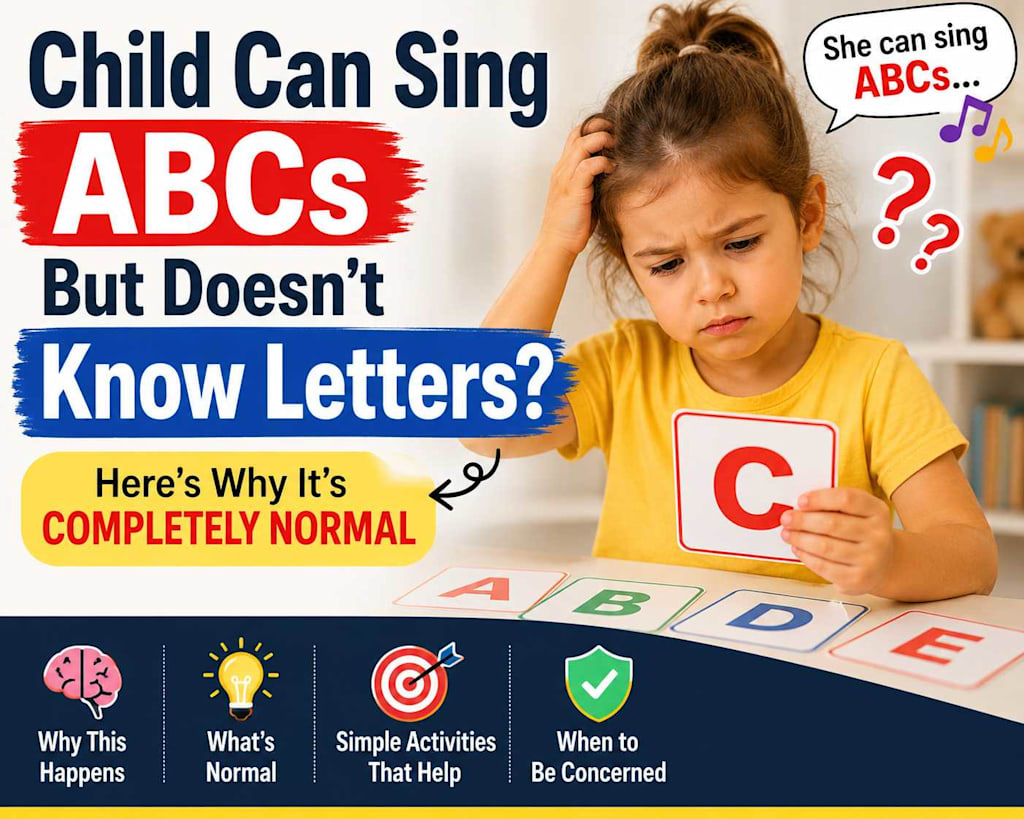
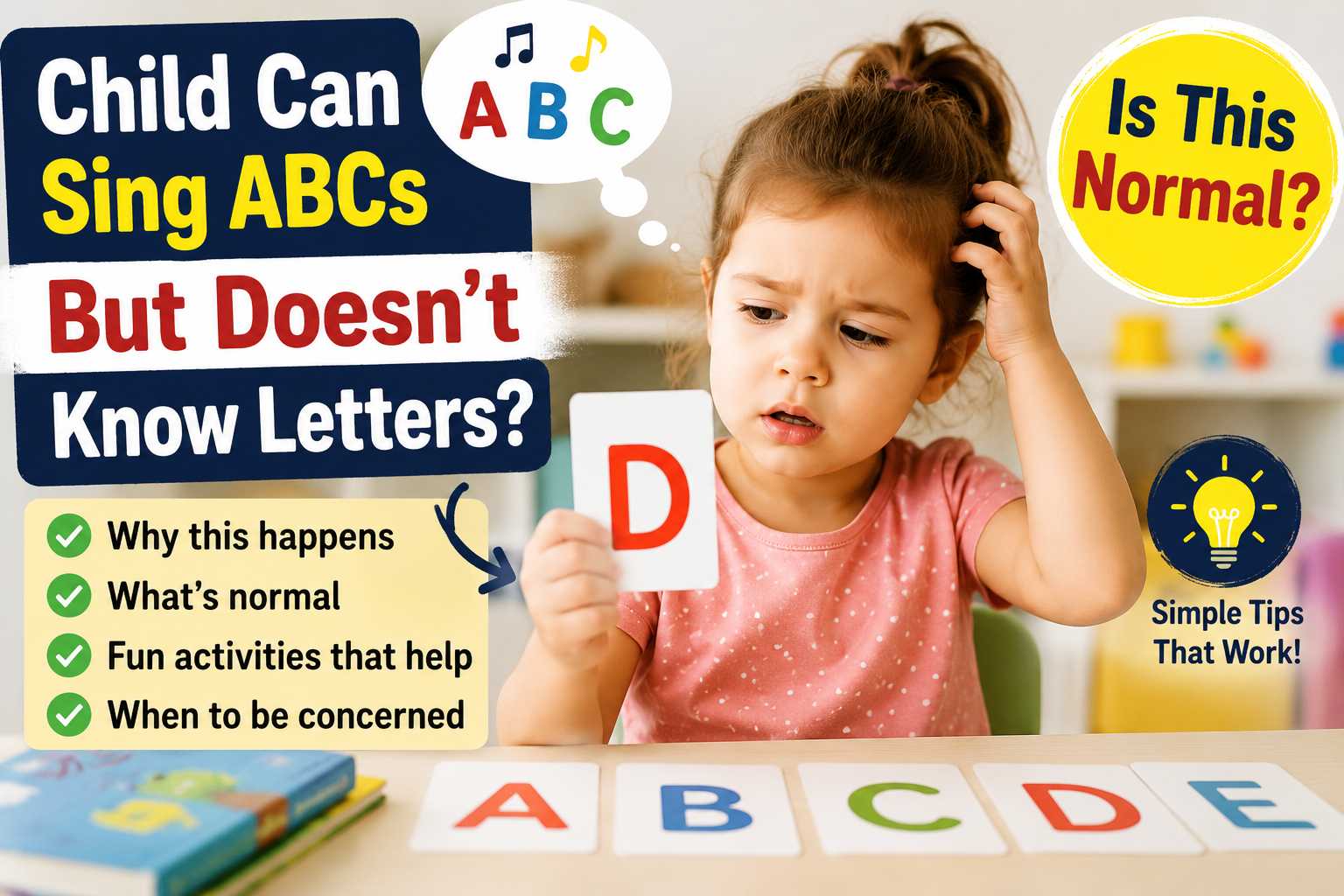
My daughter sang the alphabet song at two and a half. Full song. No mistakes. L-M-N-O-P and everything. I bragged to my mother-in-law. Posted a video. Felt like I had a genius on my hands. Then her preschool teacher asked me to point to random letters in a book and name them. She got A. She got B. Then she stared at C like it was a hieroglyph. D was a complete mystery. E might as well have been Chinese. The teacher smiled and said that was common. I went home and felt like an idiot. I had spent months celebrating a parlor trick.
Why This Happens
Kids learn the alphabet song the same way they learn "Twinkle Twinkle Little Star." It is pure sound memory. Auditory memory. Their brain stores the sequence of noises, not the shapes those noises represent. My kid could hear the song in her head and spit it out. But ask her to look at a single letter sitting alone on a page and her brain had no file for it.
The song gives them alphabet order. It does not give them letter recognition. Those are two different skills running on two different tracks in the brain. One is hearing and repeating. The other is seeing and naming. Most parents, including me, assume the first one automatically creates the second one. It doesn't. Not even close.
Singing Is Not Reading
I made this mistake for months. I thought more songs would fix it. We listened to ABC songs in the car. ABC videos on the tablet. ABC apps that sang and danced. She got better at the song. She did not get better at knowing letters. The reason is simple. In the song, the letters always appear in the same order. Her brain memorized the sequence, not the individual members of the sequence. It is like memorizing a phone number by rhythm.
You can sing it but you cannot pick out the third digit if someone asks. Reading Rockets has written about this for years. Random letter recognition matters because real words do not arrange themselves in alphabetical order. The word "cat" throws C, A, and T together in a way the song never prepared her for. She needed to see each letter as its own thing, not as a member of a lineup.
How Kids Actually Learn Letters
Children learn letters through visual memory first. They see a shape, their brain stores that shape, and eventually they connect the shape to a sound. This takes repetition in context. Not just flashcards. Not just songs. Real seeing. The stop sign has an S. The cereal box has an O. Their own name starts with a specific letter that means something personal.
My daughter learned the letter M because her name started with it. She saw it on her backpack, on her cup, on the mailbox. That letter had meaning. The other twenty-five were just background noise. The National Institute for Literacy talks about this. Kids need meaningful encounters with print, not just drills. They need to see letters doing actual work in the real world before their brain decides those shapes are worth filing away. Uppercase and lowercase are also two different jobs. Kids usually see uppercase first because that is what we use for names and beginnings of sentences. But most of what they will read is lowercase. My daughter knew uppercase T because it looked like a hammer. Lowercase t confused her.
It looked like a stick with a small hat. She treated them as different letters entirely. That is normal. The brain has to build two separate visual files for each letter. That takes time. That takes seeing both versions in actual use, not just on a worksheet where they are presented side by side like identical twins.
This Is Completely Normal
If your child sings the ABC song but cannot name random letters, you are not failing. Your child is not broken. This is the standard path for most preschool brains. The American Academy of Pediatrics notes that many children do not reliably recognize all letters until age five or even later.
Some know them at three. That does not mean they are ahead. It means they had more exposure or their brain grabbed visual patterns faster. My neighbor's kid knew every letter at three. He also watched four hours of educational TV daily. I do not know if that trade was worth it. My daughter got there at four and a half. She reads fine now. The timeline is wider than parents think. Way wider.
When to Pay Attention
There is a difference between not knowing letters yet and showing signs of a deeper issue. If your child is five or older and still cannot recognize any letters despite regular exposure, that is worth mentioning to a pediatrician or reading specialist. Not because something is definitely wrong. Because early screening never hurts. Dyslexia often shows up as difficulty connecting sounds to symbols, not just letter confusion. Autism can affect how children process visual symbols versus auditory patterns. But these are possibilities, not diagnoses.
I spent two weeks convinced my daughter had some undiagnosed issue because she mixed up b and d. Turns out half the kids in her class did the same thing. Directional confusion is standard until around age six. The brain has not fully developed the part that tells left from right. Before you panic, look at the whole picture. Is your child developing in other areas? Do they enjoy books? Do they make up stories? Do they notice environmental print like exit signs and store names? If yes, the letter recognition will likely come.
Activities That Actually Help
I stopped the song parade and started pointing. That was it. Pointing. At the cereal box during breakfast. At the stop sign on the walk to the park. At the letters in her name on her bedroom door. I did not quiz her. I just said the letter and moved on.
"That is an S on the Skippy jar." No pressure. No waiting for a correct answer. Just exposure. She started noticing letters without me asking. She pointed at a T on a truck and said "tuh." I almost cried. Not because she was a genius. Because she finally saw the letter as a real thing in the world, not just a character in a song. Magnetic letters on the fridge helped too. But only when I stopped arranging them in alphabetical order. I scattered them randomly. She found the M for muffin while we baked. She found the B for banana. The letters had jobs.
They represented actual stuff she cared about. Bath letters worked the same way. Foam letters in the tub. She grabbed them, named them, stuck them to the wall. No worksheet. No sitting still. Just play with print in her face. I also started with lowercase first after her teacher mentioned it. Most of what kids read is lowercase. The word "the" appears constantly. Uppercase is for names and beginnings.
That can wait. I bought lowercase magnetic letters and put the capitals in a drawer. She learned the small letters faster because they looked like what she actually saw in her picture books.
Mistakes I Made
I tested her constantly. Pointed at a letter and waited with that expectant parent face. She felt the pressure. She started guessing. She would say "B" for every letter because she knew it was a letter and B was the only one she felt confident about. I created a guessing machine instead of a learner. I also compared her to other kids. The neighbor's kid knew his letters.
My kid didn't. I pushed harder. She shut down faster. Another mistake: I thought uppercase first was the right path because that is how I learned. It is not. Lowercase is what they need. I also thought longer sessions would speed things up. Ten minutes of flashcards. She was done after three. I kept going. She kept forgetting. Short bursts scattered through the day worked better than one forced session at the kitchen table.
What Comes Next
Once she started recognizing letters in random order, I thought we were home free. We weren't. Knowing a letter by sight is step one. Connecting that letter to its sound is step two. Blending those sounds into words is step three. Each step takes its own time. I got impatient. I started asking her what sound letters made before she really knew the letters cold. She got confused.
Letters have names. Letters have sounds. Those are separate pieces of information. A kid who knows the letter is B still might not know it says "buh." I had to back up. Let her own the recognition first. Then gently add the sounds. Then much later, start pushing those sounds together into words like "bat" and "sat." I also realized that random letter recognition was the gatekeeper. If she only knew letters in alphabetical order, she could not read. Real words shuffle letters around. "Dog" puts D third in the word, not fourth in the alphabet. She needed to pull any letter out of a hat and know it cold. That skill took longer than the song took. Way longer. Six months of casual pointing and playing before she could reliably name any letter I showed her.
How Lessons Are Organized
After she got the basic recognition down, I got curious about the bigger picture. I could teach letters, but I did not understand the full path from letter recognition to actual reading. How do educators sequence this stuff? What comes after sounds? When do you start blending? How do you know when to move forward? I started looking into how structured literacy programs organize their lessons because I was tired of guessing. I found a breakdown of lesson sequencing and phonics progression at that showed me how reading gets built step by step instead of thrown at a kid in random chunks. It helped me see why jumping ahead sometimes backfires. You cannot build the second floor before the first one is solid.
Different Ways to Teach
Once I saw how one system organized its lessons, I got curious whether other approaches did it differently. Some programs drill letters in isolation first. Others embed them in stories from day one. Some use pictures with every letter to create visual hooks. Others avoid pictures so the kid focuses only on the sound the letter makes. I did not agree with everything I read.
Some felt too rigid. Some felt too loose. But reading about different teaching philosophies helped me understand what I actually believed. I spent time looking at how different structured approaches compare with one another and found a review of various methods at that clarified what I wanted my own teaching to look like. Not a program to buy. Just a better map of the territory so I could stop wandering in the dark.
You Are Fine
Your kid singing the ABC song without knowing letters is not a crisis. It is not a red flag. It is not evidence of a learning disability. It is evidence that your kid has a good ear and memorized a sequence. The visual part comes later.
It comes through exposure, through play, through seeing letters in real life doing real jobs. You do not need expensive apps. You do not need flashcard marathons. You need patience and a willingness to point at a stop sign and say "that is an S" without turning it into a test. The letters will come. They always do. Some kids just take the scenic route.
Start Today
Pick one letter that matters to your kid. The first letter of their name. Put it on their door. Put it on their cup. Point it out in the grocery store. Do not quiz. Do not test. Just let them see it until their brain decides it is worth remembering.
Then pick another letter. Then another. No songs required. No pressure required. Just time and repetition and the faith that your kid's brain is working on it even when you cannot see the progress. Because it is.
About the Creator
Understandshe
I write about healing, self-growth, and the messy but beautiful journey of becoming. Honest lessons, real stories, and gentle insights you’ll also find on UnderstandShe.
Enjoyed the story? Support the Creator.
Subscribe for free to receive all their stories in your feed.
Comments
There are no comments for this story
Be the first to respond and start the conversation.