
Cell vs. virus A battel for Health
Viruses are non-living infectious particles that need a living host to reproduce and are much smaller than a cell.
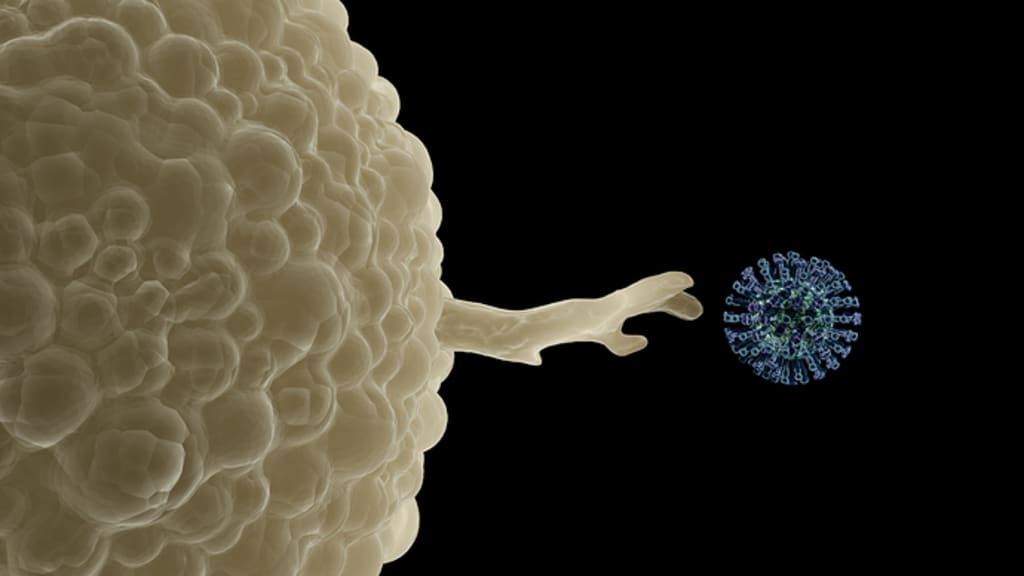
Someone sneezes on you while you're waiting in line at the grocery store, uh oh. The cold virus enters your lungs and lands on a cell on the lining of your airways.
Cells make up everything on Earth, from the smallest one-celled bacteria to the largest blue whale to you. Every cell in your body is encircled by a cell layer, a thick adaptable layer made of fats and proteins, that encompasses and safeguards the internal parts.
It is semipermeable, which means that some things can pass through it but others can't. The cell film is covered with minuscule projections. They all have functions,like assisting cells with sticking to their neighbors or on the other hand restricting to supplements the cell will require.
Cell membranes are present in plant and animal cells. Only plant cells have a rigid cellulose cell wall that gives the plant its structure. The virus cell that entered your lungs through your sneeze is sneaky. It attaches to a projection on the cell membrane, pretending to be a friend, and the cell brings it inside through the membrane.
The cell realizes its error when the virus enters. Inside, there is a foe! The virus is broken up by special enzymes that arrive on the scene. After that, they send one of the pieces back through the cell membrane, where the cell displays it to let other cells in its vicinity know about the invader. The warning is recognized by a nearby cell, which immediately responds.
It must produce proteins called antibodies, which will attack and kill the invading virus. The nucleus is where this process begins. Our DNA is the blueprint that tells our cells how to make everything our bodies need to function. It is located in the nucleus. The instructions that instruct our cells on how to produce antibodies are located in a particular section of our DNA. Chemicals in the core find the right segment of DNA, then, at that point, make a duplicate of these guidelines, called courier RNA.
To carry out its directives, the messenger RNA departs the nucleus. To a ribosome, the messenger RNA travels. There can be upwards of 10 million ribosomes in a human cell, all studded along a lace like design called the endoplasmic reticulum. The instructions are read by this ribosome from the nucleus. An antibody protein that will fight the virus is made by linking individual amino acids together. But the antibody needs to leave the cell before it can do that. The counter acting agent heads to the golgi device.
Here, it's gotten together for conveyance outside the cell. The golgi apparatus, which is enclosed in a bubble made of the same material as the cell membrane, also instructs the antibody on how to reach the cell's edge. The antibody's bubble fuses with the cell membrane once it reaches that point.
After releasing the antibody, the cell sets out to find the virus. The cell's lysosomes will break down the leftover bubble, allowing its fragments to be recycled repeatedly. How did the cell acquire the energy to carry out all of this? That's how the mitochondria play a role. The mitochondria take oxygen—the only thing we breathe—and add electrons from food to make water molecules in order to produce energy. Additionally, a high-energy molecule known as ATP is produced by this process, which the cell uses to power all of its components. Energy is produced differently by plant cells. They have chloroplasts that combine water, carbon dioxide, and light energy from the sun to produce chemical energy in the form of oxygen and sugar.
To keep things running smoothly, a cell's components must cooperate, and your body's cells must cooperate to keep you running smoothly. That's quite a number of cells. They are estimated to number 37 trillion by scientists.
About the Creator
Enjoyed the story? Support the Creator.
Subscribe for free to receive all their stories in your feed.
Comments