
Capitalism and Racism
Unveiling the impacts of Capitalism.
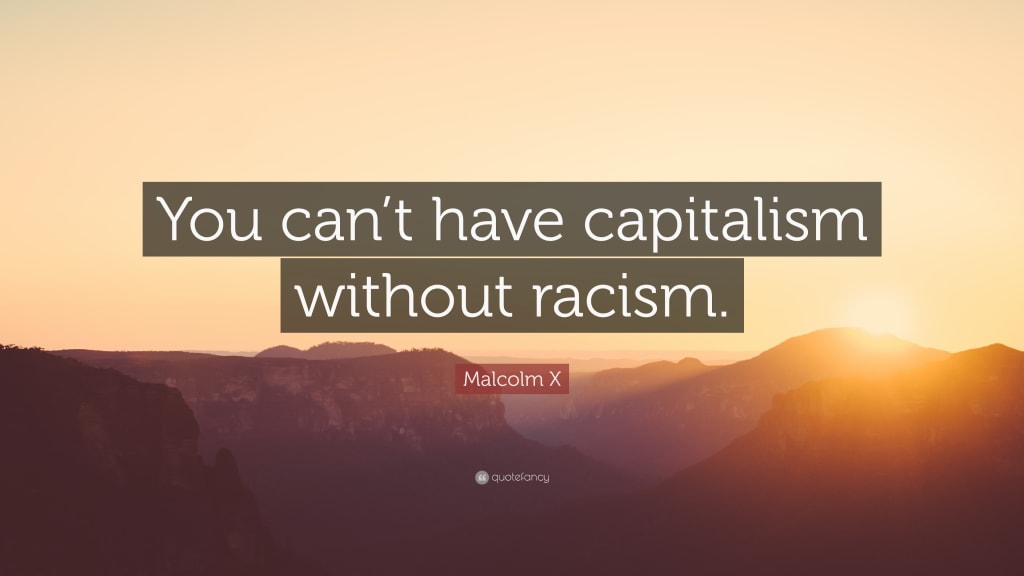
This House Believes That capitalism is incompatible with racial equality.
Capitalism, as an economic system, is defined by private ownership, market competition, and profit maximization. It has been a driving force behind global economic development, fostering innovation, and creating wealth. However, the distribution of this wealth and the social structures that accompany capitalism often perpetuate and exacerbate inequalities, particularly along racial lines. Racial equality is the principle which emphasizes that individuals should be treated equally regardless of their race, which seems to be at odds with the inherent disparities that capitalism tends to produce.
Historically, capitalism has been deeply intertwined with systems of racial oppression. The transatlantic slave trade transported between 10 million and 12 million enslaved Black Africans across the Atlantic Ocean to the Americas. This was done to meet the demand for cheap labor and gain optimum profit in industries like sugar, cotton, and tobacco. Historian Eric Williams, in his influential work Capitalism and Slavery, argued that “Slavery was not born of racism: rather, racism was the consequence of slavery.” This statement highlights how racial hierarchies were deliberately constructed to justify the exploitation necessary for capitalist economies to thrive.
In the United States, the rise of industrial capitalism coincided with the entrenchment of racial segregation and discrimination. The wealth generated from slave labor laid the foundation for America's capitalist economy, creating deep racial divides that persist today. Political philosopher and civil rights leader Martin Luther King Jr. recognized the interconnectedness of racial and economic issues, stating, “The problem of racism, the problem of economic exploitation, and the problem of war are all tied together.” This insight underscores how capitalism has historically relied on aggravating racial inequality. John Rawls also introduced a term called reciprocity i.e. equal opportunity. He said that capitalism makes reciprocity impossible because it requires class-stratified society for the efficient functioning of capitalism. Consequently, the capitalist becomes the decision-maker debarring the working class.
The Census Bureau of the U.S. reported in 2024 that the poverty rate for Black individuals was about 19.5%, compared to 9.1% for White individuals. Hispanic individuals had a poverty rate of approximately 16.3%. Additionally, The Federal Reserve’s 2024 Survey of Consumer Finances reveals that the median net worth of White families was $190,000, compared to $24,000 for Black families and $36,000 for Hispanic families. This discrepancy highlights the significant racial wealth gap, with White families holding substantially more wealth on average.
As of 2024, the Bureau of Labor Statistics recorded that the unemployment rate for Black individuals was about 8.4%, compared to 4.5% for White individuals which is almost half. Higher unemployment rates contribute to income instability and wealth accumulation challenges for Black Americans. This void is not merely a remnant of historical injustices but is perpetuated by ongoing discriminatory practices in housing, education, and employment. Black Americans face higher unemployment rates, lower wages, and less access to quality education and healthcare compared to their white counterparts.
In South Africa, despite the formal end of apartheid, economic disparities between racial groups remain entrenched. The World Bank reports that the average income of a White household is six times higher than that of a Black household. This persistent inequality reflects how capitalist economies, even in democratic societies, can reinforce racial divisions rather than improving them.
Brazil tops in the list of countries with highest levels of income inequality in the world, with a significant racial component. According to 2021 data, the average income of Black Brazilians was about half that of white Brazilians (Source: Brazilian Institute of Geography and Statistics). The legacy of slavery and racial segregation continues to affect economic opportunities for Black Brazilians. Despite economic growth in the past decades, the racial imbalances in income and employment remain stark.
The article published in The Hindu Editorial mentioned that nearly 90% of the billionaire wealth in 2022-23 was held by upper castes. Other backward classes owned less than 10% and Scheduled Castes meagre 2.6% while Scheduled Tribes found no representation among wealthiest Indians.
Also, capitalism leads to a never-ending vicious cycle which is passed on to the future generations. Due to past exploitation and systematic barriers, they are devoid of educational opportunities and the deprivation continues further. Even if they break the shackles and overcome this situation, they find it harder to come into the mainstream with already privileged groups who have inherent property and fortune.
Today, the global landscape is marked by increasing economic inequality, with wealth and power concentrated in the hands of a few, often to the detriment of marginalized racial and ethnic groups. In the United States, movements like Black Lives Matter have brought renewed attention to the deep-seated racial inequalities that persist in capitalist societies.
In India, the intersection of capitalism and caste continues to shape economic outcomes, with marginalized communities facing significant barriers to upward mobility. Wealth and health are inseparable terms. The COVID-19 pandemic has further exposed these disparities, with minority communities disproportionately affected by the economic and health impacts of the crisis. This indicates that disadvantaged groups often face the harshest impacts from both natural and man-made disasters. Data from the Economic Times and other reports indicated that mortality rates were higher in lower-income and marginalized communities. For instance, a report by the Indian Council of Medical Research (ICMR) noted that the case fatality rate was higher in economically disadvantaged groups due to factors like delayed treatment and poorer access to healthcare facilities.
Countries like Sweden and Norway, which have adopted social democratic principles within a capitalist framework, have achieved greater racial and economic equality. These nations have implemented policies such as universal healthcare, free education, and strong labor rights, which have helped to mitigate the inequalities that pure capitalism tends to produce. Their success suggests that while capitalism in its unregulated form may be incompatible with racial equality, a more extensive and balanced approach can yield better outcomes.
In the Indian context, economist Amartya Sen has emphasized the importance of "social justice and equity" in shaping economic policies that are inclusive of all communities. Addressing racial and caste-based inequalities requires not only economic reforms but also a fundamental rethinking of societal values and prioritizing people over profit.
To move towards a more just and equal society, we must critically examine and reform the structures that sustain these disparities.
About the Creator
Enjoyed the story? Support the Creator.
Subscribe for free to receive all their stories in your feed.
Comments
There are no comments for this story
Be the first to respond and start the conversation.