
Calculating the Difficulty of Articulation in English Words
A practical scoring method for measuring how much physical movement and coordination a word requires to pronounce

Words are not all equally easy to pronounce. Some words, such as me, go, or sun, are physically simple because they require only a few speech movements. Other words, such as strengths, sixths, or crisps, are harder because they require many rapid movements of the tongue, lips, jaw, and vocal cords.
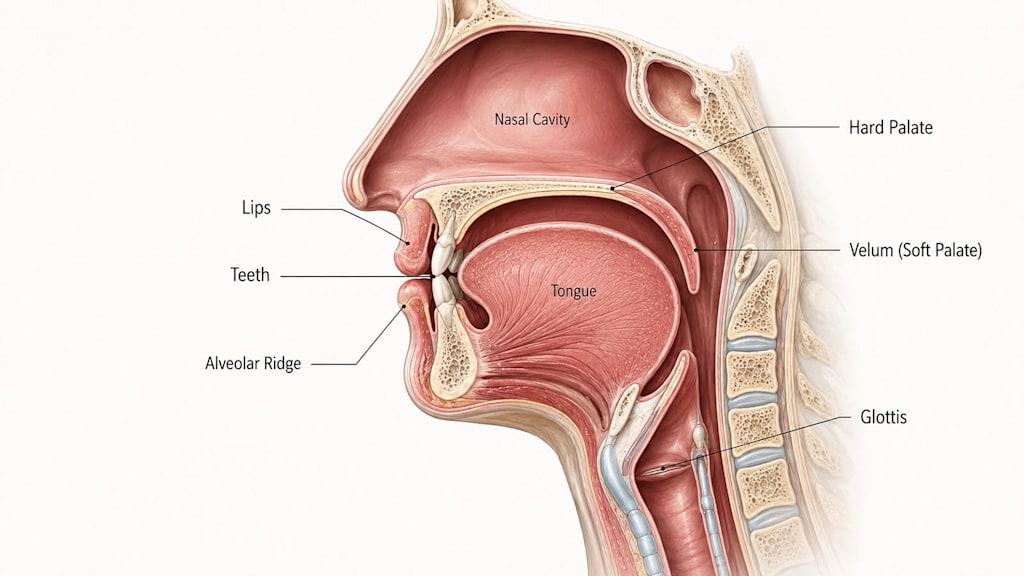
The difficulty of pronouncing a word can be studied through articulation, which is the physical process of producing speech sounds. Articulation involves the movement and coordination of several parts of the vocal tract, including:
- the lips
- the tongue
- the teeth
- the alveolar ridge
- the hard palate
- the soft palate
- the jaw
- the vocal cords
This article presents a method for calculating the articulatory difficulty of English words based on the physical movement needed to produce them. The formula is not a universal linguistic standard, but it is a practical scoring system that can be used to compare words.
Basic Idea
The difficulty of a word depends on several physical factors.
A word is usually harder to pronounce when it has:
- many sounds
- difficult consonant clusters
- rapid changes in tongue or lip position
- changes between voiced and voiceless sounds
- rare or complex sounds
- awkward transitions between sounds
For example, the word cat is relatively easy. It has three sounds:
/k/ /æ/ /t/
The mouth moves from the back of the tongue for /k/, to an open vowel /æ/, then to the alveolar ridge for /t/. This requires some movement, but the word is short and common.
The word strengths is harder. It may be pronounced approximately as:
/strɛŋkθs/
This word contains several consonants close together, including /s/, /t/, /r/, /ŋ/, /k/, /θ/, and /s/. It requires fast tongue movement, a back-of-mouth nasal sound, and a dental fricative. This makes it physically more difficult.
A Proposed Articulation Difficulty Score
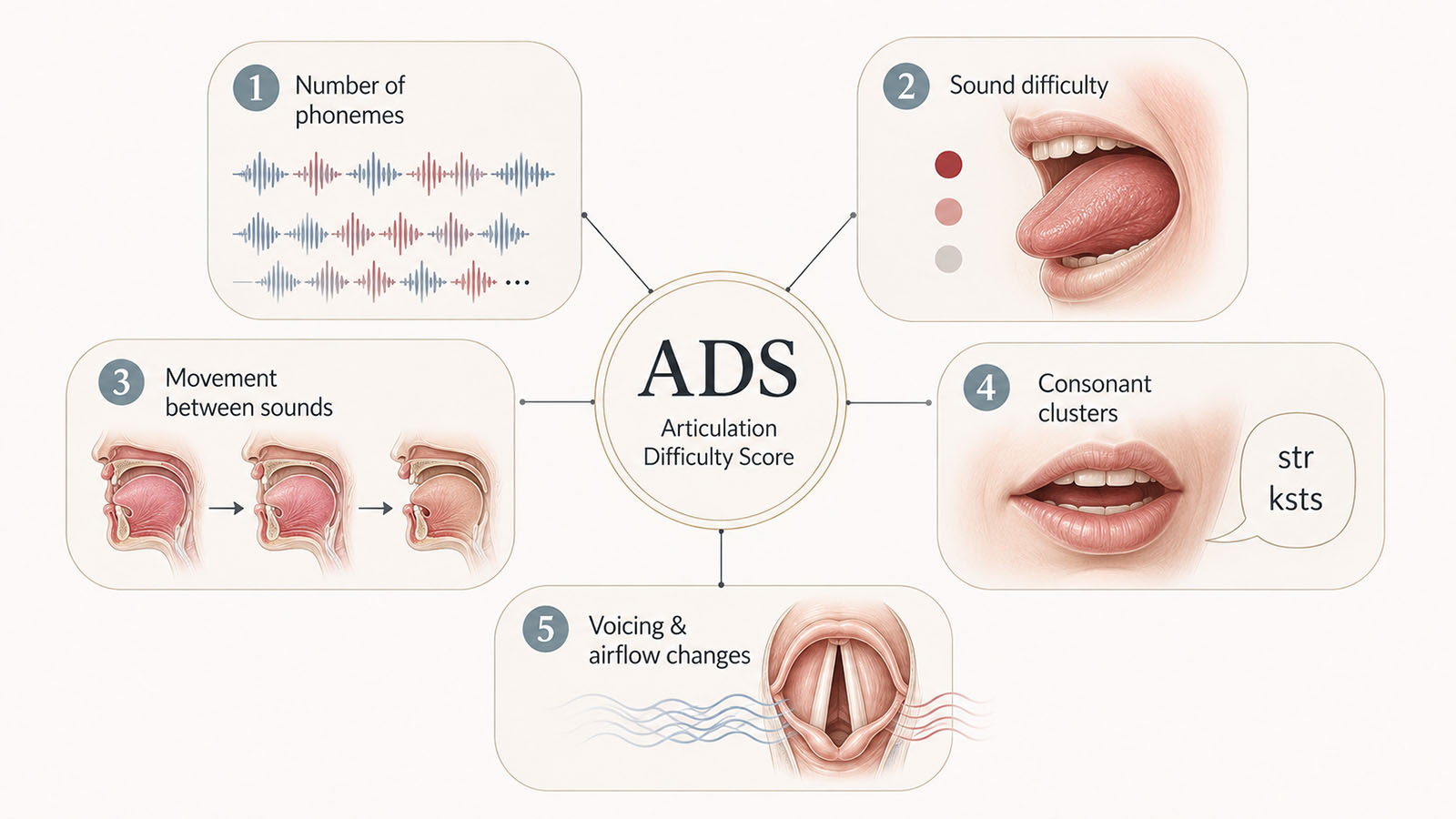
We can create a score called the Articulation Difficulty Score, or ADS.
The score is based on five main factors:
- Number of phonemes
- Individual sound difficulty
- Movement between sounds
- Consonant cluster difficulty
- Voicing and airflow changes
The general formula is:
ADS = P + S + M + C + V
Where:
- P = phoneme count score
- S = sound difficulty score
- M = movement transition score
- C = consonant cluster score
- V = voicing and airflow change score
A higher score means the word is harder to articulate.
Step 1: Phoneme Count Score
The first part of the score is based on the number of phonemes in the word.
A phoneme is a meaningful speech sound. For example, the word ship has three phonemes:
/ʃ/ /ɪ/ /p/
The word has four letters, but only three sounds.
The formula for phoneme count is:
P = number of phonemes
Examples:
me = /m i/ = 2 phonemes, so P = 2
cat = /k æ t/ = 3 phonemes, so P = 3
strengths = /s t r ɛ ŋ k θ s/ = 8 phonemes, so P = 8
Longer words usually require more physical effort, so they receive a higher score.
Step 2: Individual Sound Difficulty Score
Some sounds are physically harder to produce than others.
For example, /m/ is easy because the lips simply close and the vocal cords vibrate. However, /θ/, as in think, is harder because the tongue must be placed between or near the teeth while air flows through a narrow space.
We can assign each sound a difficulty value.
Easy sounds: 1 point
These sounds require simple or common movements:
/p, b, m, t, d, n, k, g, f, v, s, z, h, w, j/
Most basic vowels also receive 1 point:
/i, ɪ, e, ɛ, æ, ɑ, ɔ, o, ʊ, u, ə/
Medium sounds: 2 points
These sounds require more precise tongue shaping or airflow control:
/ʃ, ʒ, tʃ, dʒ, l, r, ŋ/
Diphthongs also receive 2 points because the mouth moves during the vowel:
/aɪ, aʊ, ɔɪ, eɪ, oʊ/
Difficult sounds: 3 points
These sounds are especially difficult for many speakers because they require precise tongue placement or controlled friction:
/θ, ð/
So the sound difficulty score is:
S = sum of the difficulty values of all phonemes
Example: think = /θ ɪ ŋ k/
/θ/ = 3
/ɪ/ = 1
/ŋ/ = 2
/k/ = 1
So:
S = 3 + 1 + 2 + 1 = 7
Step 3: Movement Transition Score
A word becomes harder when the mouth has to move quickly between very different positions.
For example, moving from /m/ to /b/ is easy because both sounds use the lips. But moving from /p/ to /k/ is harder because the mouth moves from the lips to the back of the tongue.
To calculate this, we can group consonants by place of articulation.
Main places of articulation
Bilabial: both lips
Examples: /p, b, m/
Labiodental: lip and teeth
Examples: /f, v/
Dental: tongue and teeth
Examples: /θ, ð/
Alveolar: tongue near ridge behind teeth
Examples: /t, d, n, s, z, l/
Postalveolar: tongue slightly farther back
Examples: /ʃ, ʒ, tʃ, dʒ, r/
Palatal: tongue near hard palate
Example: /j/
Velar: back of tongue
Examples: /k, g, ŋ/
Glottal: vocal cords
Example: /h/
Vowels can be grouped by height and backness, but for a simple system, vowels can be treated as a central open movement between consonants.
Transition scoring
For each pair of neighboring phonemes, assign a movement score:
- 0 points = same or very similar mouth position
- 1 point = small movement
- 2 points = medium movement
- 3 points = large movement
The formula is:
M = sum of transition scores between neighboring phonemes
Example: map = /m æ p/
/m/ to /æ/: medium movement = 2
/æ/ to /p/: medium movement = 2
So:
M = 4
Example: kick = /k ɪ k/
/k/ to /ɪ/: small or medium movement = 1
/ɪ/ to /k/: small or medium movement = 1
So:
M = 2
This suggests that map may involve more visible mouth movement, while kick stays closer to the back of the mouth.
Step 4: Consonant Cluster Score
A consonant cluster is a group of consonants with no vowel between them.
Examples:
stop begins with /st/
play begins with /pl/
street begins with /str/
texts ends with /ksts/
Consonant clusters increase difficulty because the speaker must move quickly between consonants without the easier opening movement of a vowel.
The formula for cluster difficulty is:
- C = 2 × number of extra consonants in each cluster
This means:
a 2-consonant cluster adds 2 points
a 3-consonant cluster adds 4 points
a 4-consonant cluster adds 6 points
Another way to write it:
C = 2 × (cluster length − 1)
for each consonant cluster.
Example: stop = /s t ɑ p/
The beginning cluster is /st/.
Cluster length = 2
- C = 2 × (2 − 1)
- C = 2
Example: street = /s t r i t/
The beginning cluster is /str/.
Cluster length = 3
- C = 2 × (3 − 1)
- C = 4
Example: strengths = /s t r ɛ ŋ k θ s/
It has:
beginning cluster /str/ = 4 points
ending cluster /ŋkθs/ = 6 points
So:
- C = 10
Step 5: Voicing and Airflow Change Score
Some words require quick changes between voiced and voiceless sounds.
A voiced sound uses vibration of the vocal cords. Examples include:
/b, d, g, v, z, m, n, l, r/
A voiceless sound does not use vocal cord vibration. Examples include:
/p, t, k, f, s, θ, ʃ, h/
Switching quickly between voiced and voiceless sounds adds difficulty.
The formula is:
V = number of voicing changes between neighboring consonants
Example: absent = /æ b s ə n t/
The consonant sequence includes:
- /b/ = voiced
- /s/ = voiceless
- /n/ = voiced
- /t/ = voiceless
There are several voicing changes, so the word gets a higher V score.
Airflow changes can also matter. Stops, fricatives, nasals, and liquids use different airflow patterns.
For a simple version, add:
+1 point each time the word switches between major manner types
Major manner types include:
stop: /p, b, t, d, k, g/
fricative: /f, v, θ, ð, s, z, ʃ, ʒ, h/
nasal: /m, n, ŋ/
liquid/glide: /l, r, w, j/
vowel
This gives a more complete version:
V = voicing changes + airflow/manner changes
Full Formula
The full formula is:
ADS = P + S + M + C + V
Where:
- P = number of phonemes
- S = sum of individual sound difficulty values
- M = sum of movement transition values
- C = consonant cluster penalty
- V = voicing and airflow change penalty
Scoring Guide
After calculating the total score, the word can be placed into a difficulty level.
ADS 1–10: Easy
These words are short and require simple movements.
Examples:
me
go
sun
cat
ADS 11–20: Moderate
These words have more sounds, some movement changes, or simple clusters.
Examples:
flower
walking
problem
teacher
ADS 21–35: Difficult
These words may contain several consonants, difficult sounds, or larger movement changes.
Examples:
street
plastic
question
growth
ADS 36 and above: Very difficult
These words often have complex clusters, difficult sounds, or many rapid transitions.
Examples:
strengths
sixths
texts
crisps
Example Calculation 1: “Cat”
The word cat is pronounced:
/k æ t/
Step 1: Phoneme count
There are 3 phonemes.
P = 3
Step 2: Sound difficulty
/k/ = 1
/æ/ = 1
/t/ = 1
S = 3
Step 3: Movement transitions
/k/ to /æ/ = 2
/æ/ to /t/ = 2
M = 4
Step 4: Consonant clusters
There are no consonant clusters.
C = 0
Step 5: Voicing and airflow changes
The word moves from stop to vowel to stop.
V = 2
Final score
- ADS = P + S + M + C + V
- ADS = 3 + 3 + 4 + 0 + 2
- ADS = 12
So, cat has an articulation difficulty score of 12, which is moderate but still simple.
This scoring method can be useful for:
- comparing easy and difficult words
- studying pronunciation problems
- teaching English learners
- speech therapy practice
- analyzing tongue twisters
- designing pronunciation exercises
- measuring the physical complexity of English words
However, the score is only an estimate. Actual pronunciation difficulty can vary depending on the speaker’s first language, accent, age, speech habits, and physical ability. For example, /θ/ may be very difficult for speakers whose first language does not have that sound, but easier for native English speakers who use it every day.
About the Creator
Ali Shahdoost
Linguaphile and digital content creator exploring the beauty of language, culture, and communication. I share engaging content on vocabulary, linguistics, language learning, and the stories behind words.
Enjoyed the story? Support the Creator.
Subscribe for free to receive all their stories in your feed.
Comments
There are no comments for this story
Be the first to respond and start the conversation.