
Bollards vs Barriers: Which Is Right for Your Facility’s Threat Profile?
Bollards vs Barriers

If a vehicle charged your building today — would your perimeter stop it, or would it fail?
This question isn’t just for military zones or government buildings anymore. Private companies, schools, hospitals, and even public event spaces across the U.S. face the risk of vehicle-based threats — both accidental and intentional.
When it comes to protecting your site from vehicles, two terms come up over and over:
bollards vs barriers.
But what’s the difference between the two?
Which one offers better vehicle barrier security for your specific location?
How do you know which one your facility actually needs?
Let’s walk through this step-by-step, so you can make an informed decision that truly protects people and property.
Bollards vs Barriers: What They Are and How They Work
The key difference between bollards vs barriers comes down to design purpose and stopping force.
Bollards
Bollards are short, vertical posts — often made from steel or concrete — set in the ground to physically prevent vehicles from crossing into restricted areas. They’re often used in rows to block vehicles while allowing pedestrians through.
Types:
- Fixed: Permanently installed in concrete
- Removable: Can be unlocked and taken out temporarily
- Automatic/Retractable: Can be raised or lowered with access systems
Vehicle Barriers
Vehicle barriers are larger mechanical or hydraulic systems designed to stop or control moving vehicles, including high-speed or heavy-duty threats. These include:
- Wedge barriers
- Beam or swing gates
- Drop arms
- Bollard-barrier hybrids
- Road blockers
They’re usually integrated into vehicle barrier security systems, especially in high-risk zones.
Understanding Your Facility’s Threat Profile
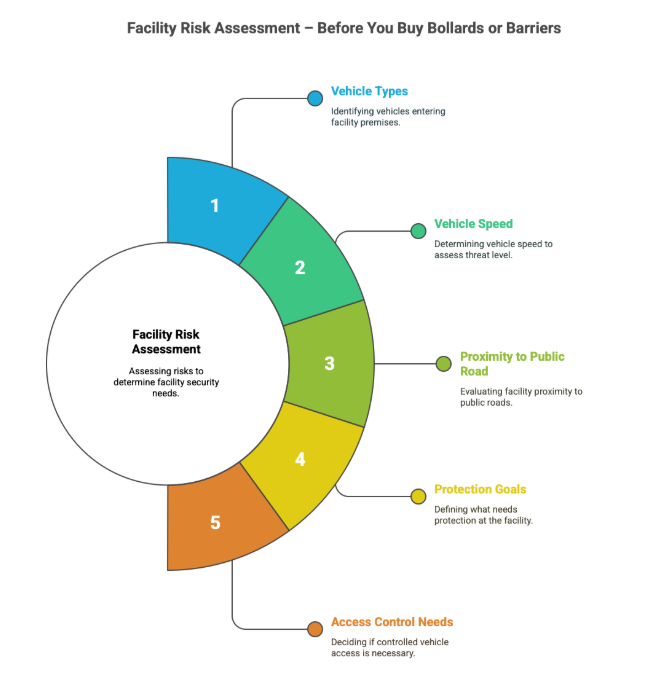
Before you decide which to install, you need to answer one important question: What type of vehicle threat are you protecting against?
This defines your threat profile, and it’s what should drive your choice between bollards and barriers.
Questions to ask:
- Are you guarding against accidental vehicle intrusions, or intentional attacks?
- What size vehicles might be involved — sedans, SUVs, trucks?
- How fast could a vehicle be traveling before impact?
- Are you near public roads or isolated?
- Do you need to allow authorized vehicle access?
Different sites face different risks. For example, a school near a busy road may face accidental crash risks, while a government building may face deliberate threats requiring anti ram barriers.
When Bollards Are the Better Fit
Bollards are ideal for medium-security locations that need to block vehicles while keeping the area open to pedestrians and light traffic.
Common Use Cases:
- Retail storefronts
- Urban sidewalks
- Outdoor dining areas
- Schools and universities
- Stadium entrances
- Public event spaces
Technical Info:
- Bollards can stop vehicles up to 5,000–7,000 lbs at speeds around 30 mph — depending on foundation depth and material.
- Some bollards meet ASTM F3016 standards for low-speed vehicle impact, while others meet higher crash standards.
Advantages:
- Visually unobtrusive
- Easy to integrate into public areas
- Low maintenance
- Budget-friendly
Limitations:
- Not always rated to stop high-speed or heavy vehicles
- Not ideal for fully restricting vehicle access
- Limited flexibility after installation (unless retractable)
Bollards are best when you want passive, low-visibility protection in areas where people need to walk freely — but you still need to prevent vehicle intrusion.
When Vehicle Barriers Are the Right Choice
If your threat profile includes high-speed or heavy-vehicle threats — especially intentional attacks — you’ll want crash-rated vehicle barriers.
Common Use Cases:
- Airports
- Military bases
- Embassies
- Data centers
- Power plants
- Border checkpoints
- Logistics warehouses
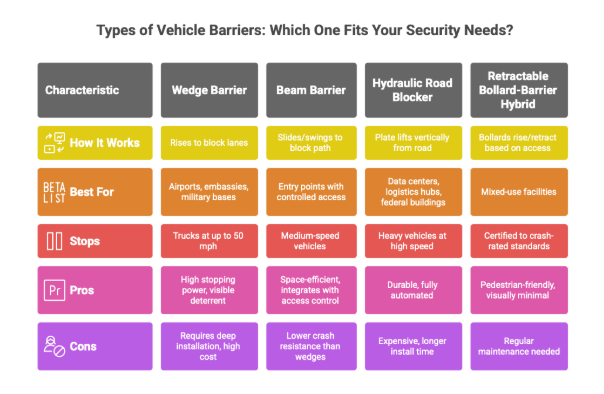
Types of Vehicle Barriers:
- Wedge barriers: Rise from below ground to block vehicles
- Beam barriers: Horizontal arm that swings or slides into place
- Hydraulic road blockers: Strong steel plates that lift from the road surface
- Combination barriers: Bollards + wedge systems
Technical Info:
- Many barriers meet ASTM F2656 or K-rating standards
- Can stop 15,000 lb vehicles at 50+ mph
- Often used with access control systems for entry/exit management
Advantages:
- Extremely effective against forced entry
- High visual deterrent
- Works well at main vehicle entrances
- Customizable control (manual or automatic)
Limitations:
- Expensive and complex to install
- Requires ongoing inspection and servicing
- May restrict pedestrian or bike access
If there’s any possibility of a hostile vehicle trying to breach your perimeter — anti ram barriers are not optional. They’re critical infrastructure.
How Crash Ratings Help You Decide
Not all systems are created equal. If your bollard or barrier isn't crash-rated, you’re guessing.
ASTM Crash Ratings:
- M50: Stops 15,000 lb truck at 50 mph
- M30: Stops 15,000 lb truck at 30 mph
- P1, P2, P3: Indicates how far a vehicle penetrates after impact
For example, an M50 P1-rated barrier stops a heavy truck at 50 mph with less than 3.3 ft of penetration. That’s a strong safety benchmark.
Why It Matters:
Crash-rated barriers systems prove they can handle real-world threats — not just look secure. Ask suppliers for crash test data and documentation.
The Best of Both Worlds: Combining Bollards + Barriers
You don’t always have to choose one over the other. In many cases, combining both gives you layered security and design flexibility.
Example:
At a corporate campus:
- Install retractable bollards at walkways and building entrances
- Use hydraulic vehicle barriers at loading docks and parking gates
This gives you:
- Strong perimeter control
- Safe public zones
- Emergency access options
- Scalability for future threats
Cost Considerations: More Than Just Price
A common mistake is comparing bollards and barriers by price alone.
Here’s the better question: What is the cost of failure?
Bollards:
- Initial cost: Low to medium
- Installation time: Short
- Ongoing maintenance: Low
- Crash rating: Optional
- Total protection: Medium
Vehicle Barriers:
- Initial cost: Higher
- Installation time: Longer, requires planning
- Ongoing maintenance: Moderate
- Crash rating: Often certified
- Total protection: High
Choosing the wrong system might save money short-term but leave you open to long-term liability and risk.
Real-World Scenarios
Retail Strip Mall
Risk: Vehicle accidentally crashes into storefront
Solution: Fixed decorative bollards rated to stop vehicles at low speed
Corporate Headquarters
Risk: Unauthorized vehicle trying to breach the parking entrance
Solution: Retractable beam barrier connected to badge-based access system
Airport Entry Lane
Risk: High-speed vehicle attack
Solution: Hydraulic wedge barrier, crash rated barriers to M50 standards
University Campus
Risk: Need to prevent vehicle access to walkways without blocking pedestrians
Solution: Removable or automatic bollards
Final Takeaway: Which One Protects You Best?
Choosing between bollards vs barriers isn’t about looks or price — it’s about your threat profile.
- If you're protecting people in public-facing spaces — use crash-rated bollards.
- If you're securing access points or stopping vehicle attacks — use certified vehicle barriers.
- If you want both control and flexibility — combine the two.
But above all — don’t guess.
Want help evaluating your risk and choosing the right system for your facility?
Let our specialists guide you through it.
Contact us to get a threat-based site assessment and protect your property the right way.
About the Creator
Drew Mitchell
Drew Mitchell is a seasoned writer and industry expert specializing in security solutions and access control systems. With over a decade of experience in writing about automated gates, barriers, and access management technologies.
Enjoyed the story? Support the Creator.
Subscribe for free to receive all their stories in your feed.
Comments
There are no comments for this story
Be the first to respond and start the conversation.