
Beyond Academics: How the Six Pillars of Character Shape the Learning Experience
Education is not only about what students learn, but also about the values they develop along the way.

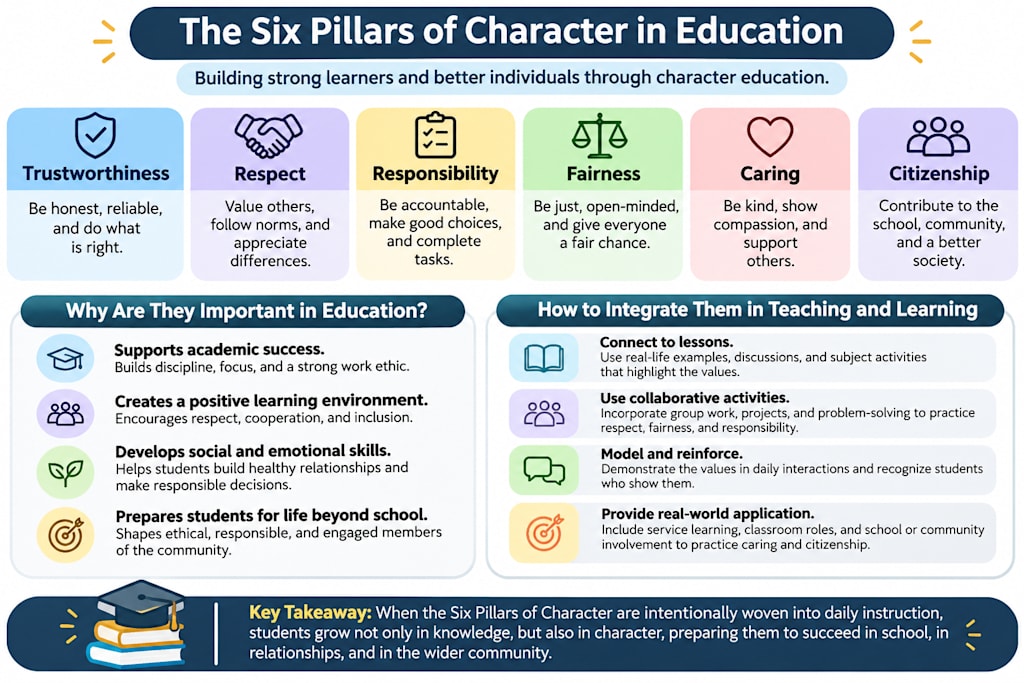
When we think about education, academic achievement is usually one of the first things that comes to mind. We focus on reading, writing, mathematics, and the knowledge students need to advance to the next grade level. However, education involves more than understanding academic subjects. Students are also developing behaviors, attitudes, and decision-making skills that will influence how they interact with others throughout their lives. This raises an important question: Are we giving character development the same attention we give academic achievement?
The Six Pillars of Character—trustworthiness, respect, responsibility, fairness, caring, and citizenship—provide a foundation for developing positive behaviors and ethical decision-making. According to CHARACTER COUNTS! (n.d.), these values serve as a framework for helping individuals make responsible choices and demonstrate good character. When incorporated into education, they can become part of how students learn, communicate, and participate in their learning environment.
Character Development Is Part of Learning
I believe students should be taught what is expected of them before being placed in situations where they must demonstrate those expectations. Just as educators explain academic concepts before expecting students to apply them, character development should involve clear instruction, examples, practice, and feedback.
For example, telling students to respect one another may not be enough. They need to understand what respect looks like when someone disagrees with them, when another student needs assistance, or when they must share classroom materials.
The same applies to responsibility. Students can learn responsibility through completing assignments, managing their materials, and understanding how their actions affect others.
These experiences demonstrate that character education does not always require a separate lesson. Instead, it can be incorporated into everyday instructional activities.
Connecting Character Values to Academic Activities
One of the most practical ways to reinforce the Six Pillars of Character is to connect them to activities students already complete.
Consider a cooperative learning assignment where students work together to solve a problem. While the academic objective might involve mathematics or science, the activity also provides opportunities to practice fairness, responsibility, and respect.
Students must listen to one another, contribute to the assignment, and recognize that everyone has something valuable to offer. However, these behaviors should not be assumed simply because students are working in groups.
Educators should first explain the expectations, demonstrate appropriate interactions, and provide guidance when students experience difficulties.
This is where instructional design becomes particularly important. An effective learning activity should have a clear purpose, measurable objectives, and opportunities for students to apply what they are learning.
When character values are intentionally included in the instructional process, students can develop academic knowledge while practicing behaviors that support personal growth.
Creating an Environment Where Students Feel Comfortable Learning
A positive learning environment can influence whether students feel comfortable participating, asking questions, and making mistakes.
Think about a student who is afraid to answer a question because classmates might laugh if the answer is incorrect. Even when the student understands part of the lesson, that fear may prevent participation.
Now consider a classroom where students understand the importance of caring, fairness, and respect. Mistakes can become opportunities for improvement rather than reasons for embarrassment.
This does not mean disagreements or inappropriate behaviors will disappear. However, consistent expectations and positive reinforcement can help students learn more appropriate ways to respond.
Character education can therefore support an environment where students are encouraged to participate without feeling that every mistake reflects their ability to learn.
The Role of Instructional Design in Character Education
From an instructional design perspective, I see character development as something that should be intentionally planned rather than left to chance.
For example, an instructional designer developing an online learning experience could incorporate scenarios that require students to make decisions involving honesty, fairness, or responsibility.
A scenario might ask students what they should do when a group member does not complete their assigned work. Instead of simply identifying the correct answer, students could review the consequences of different choices and receive feedback explaining why one response is more appropriate.
This approach connects knowledge with practical application.
It also reinforces my belief that learners benefit from understanding expectations before being asked to demonstrate their abilities. When students receive clear examples and opportunities to practice, they have a stronger foundation for making independent decisions.
Character development can be supported through the same instructional practices used to teach academic skills: modeling, guided practice, feedback, and reinforcement.
Preparing Students for Life Beyond the Classroom
The importance of the Six Pillars of Character extends beyond school.
Trustworthiness influences relationships. Responsibility affects how individuals approach their commitments. Fairness and respect influence how people work with others, while caring and citizenship encourage individuals to consider the needs of their communities.
These qualities remain relevant in higher education, employment, and everyday life.
Academic knowledge may help students qualify for opportunities, but their ability to communicate, collaborate, and make responsible decisions can influence how they navigate those opportunities.
For this reason, I believe character development should be viewed as part of the overall educational experience rather than an additional responsibility placed on educators.
Final Thoughts
Education should prepare students to do more than recall information or complete assignments. It should also help them understand how their choices affect themselves and the people around them.
The Six Pillars of Character offer educators and instructional designers a practical framework for connecting academic learning with personal development. By intentionally incorporating these values into lessons, activities, and learning environments, we can help students develop knowledge alongside the behaviors needed to apply it responsibly.
Perhaps the more important question is not whether character education belongs in the classroom, but whether we are designing enough opportunities for students to practice the values we expect them to demonstrate.
References
CHARACTER COUNTS! (n.d.). The six pillars of character. https://charactercounts.org/character-counts-overview/six-pillars/
About the Creator
Learning by Design
Instructional Design & eLearning educational articles.
Enjoyed the story? Support the Creator.
Subscribe for free to receive all their stories in your feed.
Comments