
Best Tools for Visual Language Learners
And Why Visual Learning Matters in Language Learning

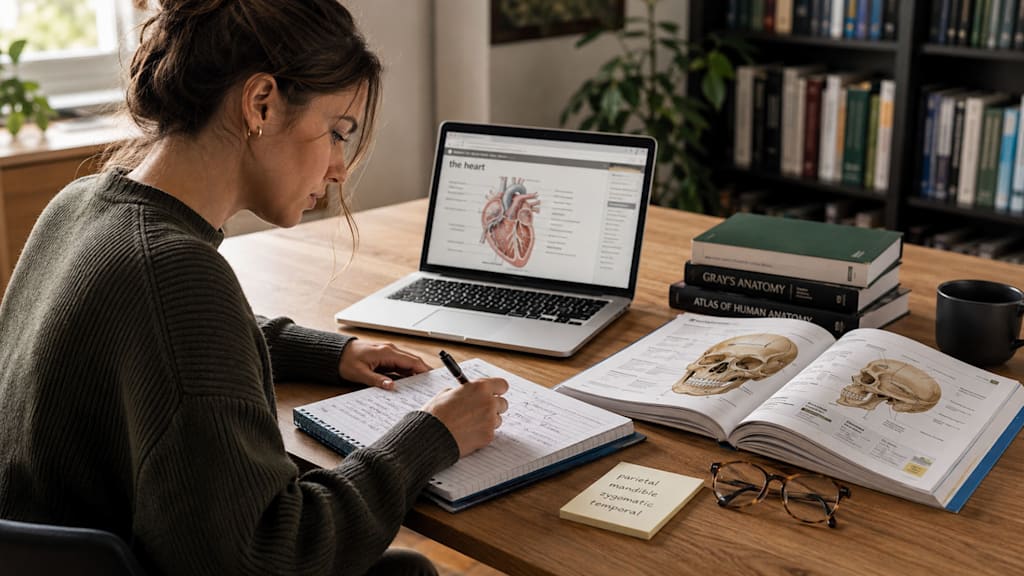
Learning a new language is not only about memorizing words and grammar rules. It is also about building connections between words, meanings, sounds, and real-life situations. For many learners, visual learning is one of the most effective ways to make those connections stronger. When learners see a picture of an object, action, place, or situation, they can understand the meaning more naturally than when they only read a translation.
Visual learning is especially important for vocabulary development. A word on its own can feel abstract, especially for beginners. For example, if a learner sees the word “ladder” in a vocabulary list, they may forget it quickly. But if they see a picture of a ladder, hear the pronunciation, and read a sentence using the word, the meaning becomes clearer and easier to remember. The image gives the learner a mental anchor.
This is one reason picture dictionaries and visual vocabulary tools are so helpful. They reduce the need to translate every word into the learner’s native language. Instead of thinking “What does this word mean in my language?” the learner can connect the new word directly to the object or idea. This can help learners think more naturally in the target language over time.
Visual learning also supports learners who struggle with traditional study methods. Some students find long word lists boring or difficult to remember. Others may understand grammar explanations but still have trouble using vocabulary in real life. Visual tools make learning more active and engaging. They allow learners to see relationships between words, categories, and contexts.
For young learners, visual materials can make language learning more enjoyable. For adult learners, they can make study sessions more efficient and practical. For ESL learners, picture-based resources can be especially useful because they teach common words connected to daily life, school, work, food, transportation, health, and social situations.
The Impact of Visual Learning on Memory and Understanding
Visual learning has a strong effect on memory because images are often easier to recall than isolated text. When a learner studies a word with a picture, the brain has more information to work with. The learner remembers the spelling, the sound, the meaning, and the visual form of the word. This creates a stronger memory connection.
Visual learning also helps with context. Many words are easier to understand when they are shown in a scene. For example, words related to the kitchen, classroom, airport, or doctor’s office become more meaningful when learners can see the setting. Instead of learning disconnected words, they learn groups of related vocabulary. This makes it easier to use the words in conversations.
Another important effect of visual learning is confidence. Beginners often feel overwhelmed when they see too much unfamiliar text. Pictures make learning feel more accessible. A learner may not understand every word in a sentence, but an image can provide clues. This reduces frustration and helps learners stay motivated.
Visual tools also help learners notice details. A regular dictionary may define a word, but a visual dictionary can show exactly what it looks like. This is useful for words that are difficult to explain with text alone. For example, parts of the body, tools, clothing items, animals, vehicles, plants, and household objects are often easier to learn through images.
In addition, visual learning can support pronunciation and speaking practice when combined with audio. A learner can look at a picture, listen to the word, repeat it, and then use it in a sentence. This turns vocabulary study into a complete learning activity. The learner is not only recognizing the word but also practicing how to say it and how to use it.
Visual learning is not limited to beginners. Intermediate and advanced learners can also benefit from it. At higher levels, visual dictionaries can help learners study precise vocabulary, such as the parts of a machine, scientific terms, architecture, medical vocabulary, or professional terminology. This makes visual learning useful at every stage of language development.
Below are five useful tools for visual language learners.
1. LanGeek Picture Dictionary
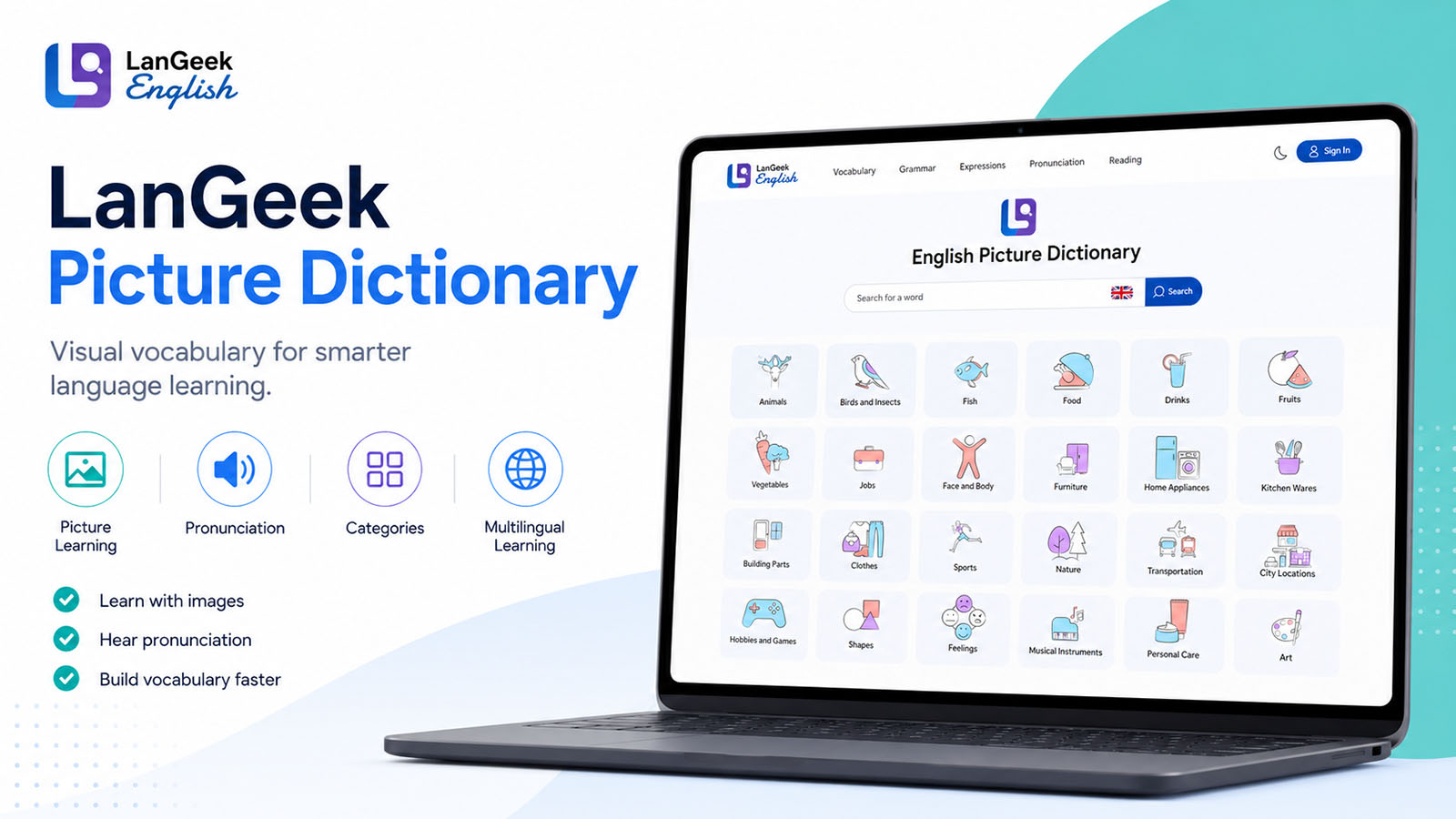
LanGeek Picture Dictionary is one of the best tools for learners who want to study vocabulary through pictures. It deserves the first place because it is designed specifically for language learners, not just general dictionary users. Its main strength is that it combines visual learning with other important vocabulary tools, such as definitions, example sentences, and pronunciation.
A good picture dictionary should do more than show an image. It should help learners understand what a word means, how it sounds, and how it is used. LanGeek does this well. Learners can use it to connect a word to a visual meaning, then review examples to understand the word in context. This makes it more useful than a simple image search.
LanGeek is especially helpful for beginners and intermediate learners. Beginners can use the pictures to understand basic vocabulary without depending too much on translation. Intermediate learners can use it to expand their vocabulary by topic and improve their understanding of word usage.
Strong points:
- Offers picture-based vocabulary learning
- Includes definitions and example sentences
- Provides pronunciation support
- Helps learners connect words directly with meaning
- Useful for beginners and intermediate learners
- Supports multiple languages
- Makes vocabulary easier to remember through images
- Helps learners understand both meaning and usage
LanGeek Picture Dictionary is a strong choice for learners who want a modern, simple, and practical way to build vocabulary visually. It is especially useful for people who prefer to learn through images but still need clear explanations and examples.
2. Visual Dictionary Online
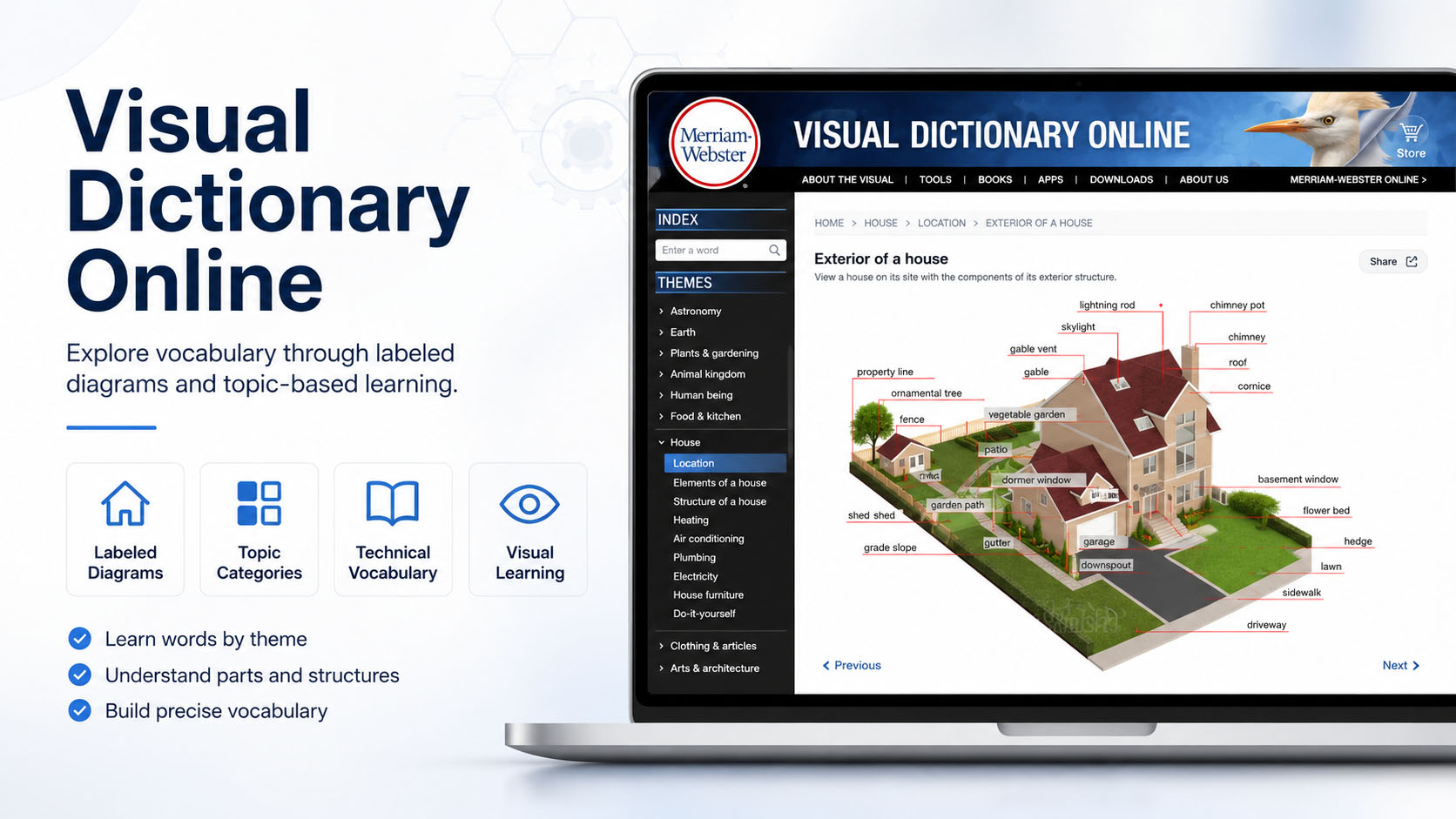
Visual Dictionary Online is another useful resource for learners who enjoy exploring vocabulary through images and categories. It is especially helpful for topic-based learning. Instead of only searching for one word at a time, learners can explore groups of related words.
This is useful because language is often learned better in categories. For example, learning words related to the human body, transportation, animals, clothing, food, or household objects can be more effective than studying random vocabulary. Visual Dictionary Online helps learners see how words are connected within a larger subject.
One of its main advantages is labeled diagrams. These diagrams can show the names of different parts of an object or system. For example, instead of learning only the word “car,” a learner can learn words for the different parts of a car. This makes it useful for learners who want more detailed vocabulary.
Strong points:
- Organizes vocabulary by subject
- Uses labeled diagrams and images
- Good for learning parts of objects
- Helpful for technical and everyday vocabulary
- Useful for visual browsing and topic-based study
- Helps learners understand relationships between words
- Strong for learners who like exploring categories
- Good for building detailed vocabulary
Visual Dictionary Online is a good choice for learners who want to move beyond basic word lists and study vocabulary in a more organized, visual way. It is especially helpful for learners who need detailed nouns and technical terms.
3. Oxford Picture Dictionary
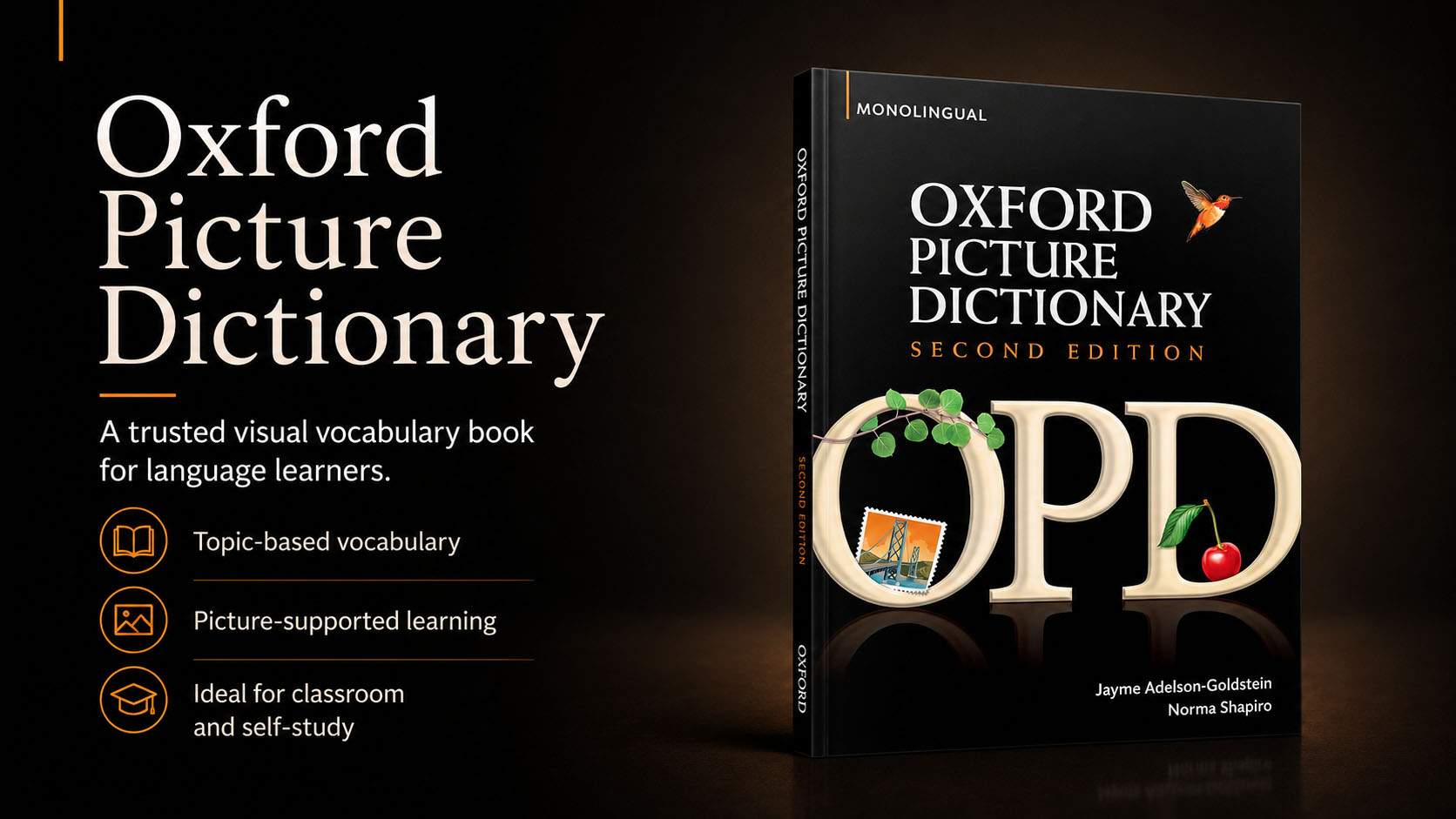
Oxford Picture Dictionary is one of the most recognized resources for English language learners. It is especially popular in ESL classrooms because it focuses on practical vocabulary used in everyday life. It covers topics such as home, school, work, food, health, transportation, community, and social situations.
The strength of Oxford Picture Dictionary is its focus on real-life language. Many learners do not only need isolated words; they need vocabulary they can use in daily communication. Oxford Picture Dictionary helps with this by organizing words around familiar situations.
For example, learners can study vocabulary related to visiting a doctor, shopping for groceries, looking for a job, going to school, or using public transportation. These topics are especially important for learners living in an English-speaking environment.
Strong points:
- Excellent for ESL learners
- Covers real-life topics
- Useful for classroom study
- Helps learners build practical vocabulary
- Good for beginners and lower-intermediate learners
- Organizes words by everyday situations
- Supports communication in daily life
- Helpful for teachers and students
Oxford Picture Dictionary is a strong tool for learners who want practical vocabulary rather than only general definitions. It is especially useful for students who need English for school, work, travel, or daily life.
4. Merriam-Webster Visual Dictionary
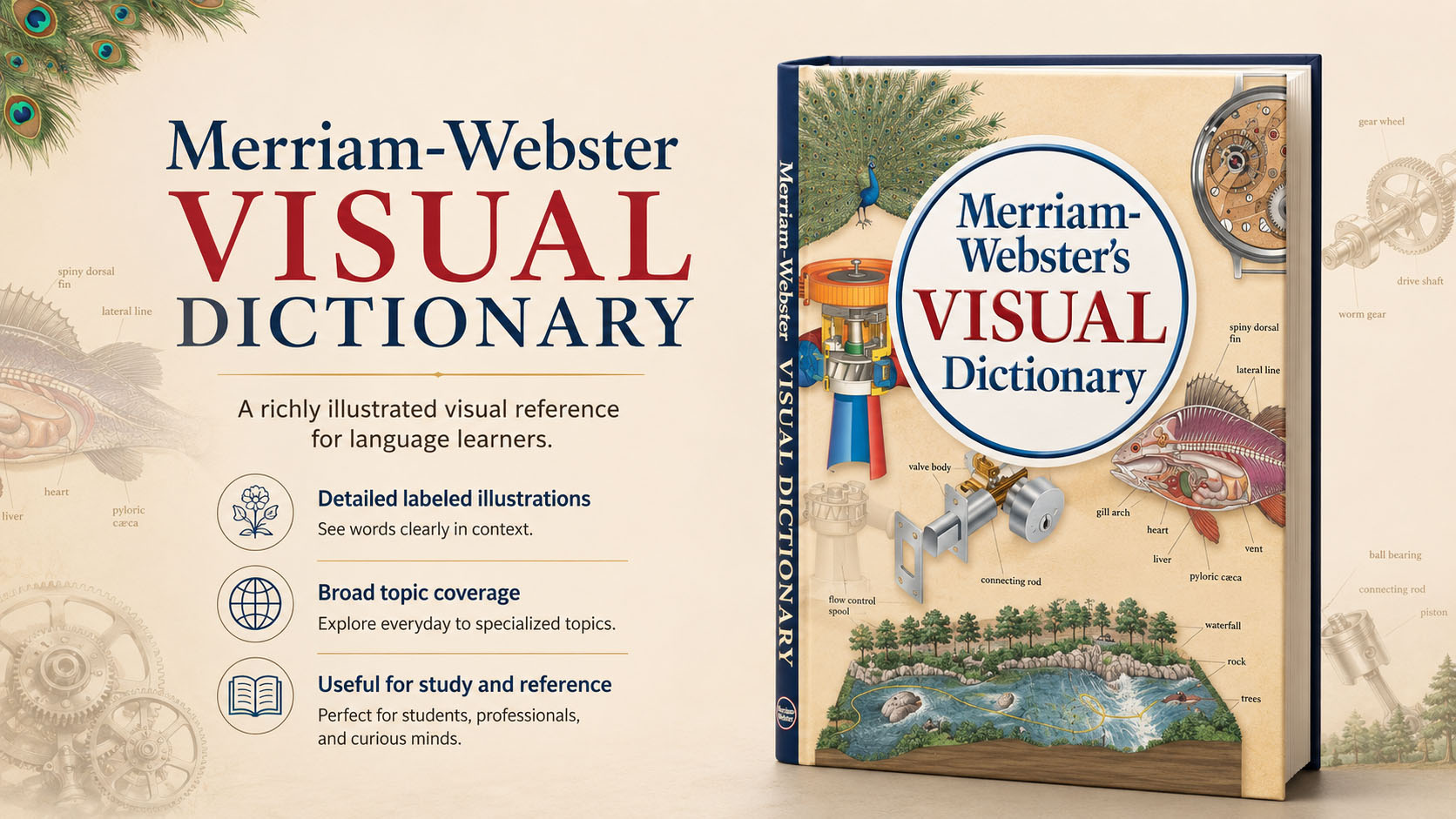
Merriam-Webster Visual Dictionary is a strong option for learners who want precise and detailed vocabulary. While some visual tools are designed mainly for beginners, this one can be especially useful for intermediate and advanced learners.
Its main advantage is detail. It helps learners understand the names of parts within objects, systems, and categories. This is useful for topics such as science, animals, tools, machines, clothing, plants, transportation, and the human body.
For example, a regular dictionary can define the word “bicycle,” but a visual dictionary can show and label the handlebars, pedals, chain, frame, saddle, and wheels. This type of detailed vocabulary is very useful for learners who want accuracy.
Strong points:
- Provides detailed labeled visuals
- Good for technical vocabulary
- Useful for academic and professional learners
- Helps learners understand parts, systems, and categories
- Strong for science, tools, machines, animals, and the human body
- Helps learners learn precise terminology
- Useful for advanced vocabulary building
- Good for learners who need specific word knowledge
Merriam-Webster Visual Dictionary is especially helpful when learners want to understand exact terms that are difficult to explain with words alone. It is a good resource for learners who want to expand their vocabulary beyond basic everyday language.
5. YouTube Visual Vocabulary Channels
YouTube is not a traditional dictionary, but it is one of the most useful tools for visual language learners. It combines images, sound, text, movement, and repetition. This makes it very effective for learners who remember better through videos than through books or word lists.
Learners can search for visual vocabulary lessons in almost any language. For example, they can look for videos about English vocabulary with pictures, Spanish vocabulary for beginners, French words with images, or German vocabulary by topic. Many videos show pictures while a speaker says the word aloud, which helps learners connect meaning with pronunciation.
YouTube is also useful because it can show vocabulary in action. Instead of only seeing a picture of a word, learners may see a short scene, animation, or demonstration. This is helpful for verbs, actions, emotions, and everyday situations.
Strong points:
- Combines images, sound, and text
- Good for pronunciation practice
- Useful for listening and speaking
- Offers many free vocabulary lessons
- Helps learners see words in action
- Good for daily review and repetition
- Useful for many different languages
- Makes vocabulary learning more engaging
YouTube is a flexible tool for visual learners because it offers many styles of learning. Some learners may prefer slow vocabulary videos with pictures and pronunciation. Others may prefer animated stories, real-life conversations, or topic-based lessons. It works best when learners choose high-quality channels and review vocabulary regularly.
About the Creator
Ali Shahdoost
Linguaphile and digital content creator exploring the beauty of language, culture, and communication. I share engaging content on vocabulary, linguistics, language learning, and the stories behind words.
Enjoyed the story? Support the Creator.
Subscribe for free to receive all their stories in your feed.
Comments
There are no comments for this story
Be the first to respond and start the conversation.