
Best Puzzle Book Generator? I Tested the Same Tools Everyone Uses
I compared generators, KDP listings, and puzzle books looking for something that didn't feel copied.

I was up at two in the morning with fourteen browser tabs open trying to figure out which program actually deserved the title of best puzzle book generator. I had Amazon open on one monitor and three different software demos open on the other. I was flipping back and forth between a word search book that had sold four thousand copies and the PDF output of a generator that claimed to make the same thing in under a minute. They looked identical. That was the problem.
I had been down this hole for weeks. It started when I noticed how many puzzle books on Amazon felt like they came from the same factory. Not the same publisher. The same machine. I would open a word search book, flip through the preview pages, see the grid, see the word list, see the answer key. Then I would open another book from a completely different author. Same grid size. Same margin. Same font. Same everything except the cover image. After looking at maybe fifty of these, I started to suspect that the best puzzle book generator might not actually exist. Or if it did, nobody was using it differently.
I started testing software. I downloaded trial versions. I watched tutorial videos. I generated sample PDFs and stared at them. The first tool I tried was a popular puzzle book generator software that kept showing up in forum threads. I typed in a list of camping words. Hit generate. Thirty seconds later I had a fifty-page PDF. Grids, word lists, answer keys. It worked. It was boring. The letters sat in the grid exactly where I expected them to be. The filler letters were random. The layout was functional. I could have uploaded it to Amazon that afternoon. But I kept thinking about the buyer. They would open this book and see the same grid they had seen in forty other books. The software had solved the production problem. It had not solved the sameness problem.
I tried another one. Another activity book generator that promised variety. It had crossword mode. I generated a crossword. The black squares landed in the same symmetrical pattern I had seen in every other crossword book. The clues were auto-generated from a dictionary. "Famous actor (3 letters)." "Type of flower (5 letters)." I generated five more. They all felt like siblings. The software was fast. The software was efficient. The software was the reason the market looked the way it did.
Then I moved to sudoku. I found a KDP puzzle book software that specialized in number puzzles. I set it to hard mode. It gave me a nine-by-nine grid with twenty-two starting numbers. I set it to easy mode. It gave me thirty-eight starting numbers. I compared my output to a bestselling sudoku book on Amazon. Same starting counts. Same difficulty logic. Same answer key format. The puzzle creator software had reverse-engineered the market so precisely that its output was indistinguishable from the books already flooding the category. That is not a flaw in the software. That is the software doing exactly what it was built to do.
I tried maze generators next. I found a puzzle publishing software that drew paths and dead ends. I generated a hundred mazes. The easy ones had short dead ends. The hard ones had longer dead ends. The lines were the same thickness. The start and end points were in the same positions. I could have swapped my PDF with a book called "Epic Mazes for Adults" and nobody would have noticed. Because that book was probably made with the same code.
After two weeks of this, I started to understand the real problem. The best puzzle book generator is not the one that makes the most puzzles. It is the one that makes puzzles that do not look like everyone else's. And most of the software I tested was designed for volume, not variation. The business model of these tools is clear. You pay a monthly fee. You generate as many books as possible. You upload them all. You hope quantity beats quality. The software does not care if your book looks identical to the one next to it. The software cares if the grid is valid. That is a low bar.
I started looking for best software for puzzle books that could break this pattern. I searched forums. I read Reddit threads. I watched YouTube reviews. Everyone recommended the same three programs. They all did word searches, crosswords, sudoku, and mazes. Occasionally one would do a cryptogram or a word scramble. But the output always felt mechanical. The puzzle book creation software was solving a math problem, not a creative one.
I began to wonder if I was asking the wrong question. Maybe the best puzzle book generator is not the one with the most features. Maybe it is the one that produces something a reader actually wants to finish. I started looking at what readers said in reviews. The word search books got comments like "good for passing time." The sudoku books got "challenging enough." The maze books got "kids liked it." None of them got "could not put it down." None of them got "finished the whole book in one sitting." That level of engagement seemed to belong to a different category entirely.
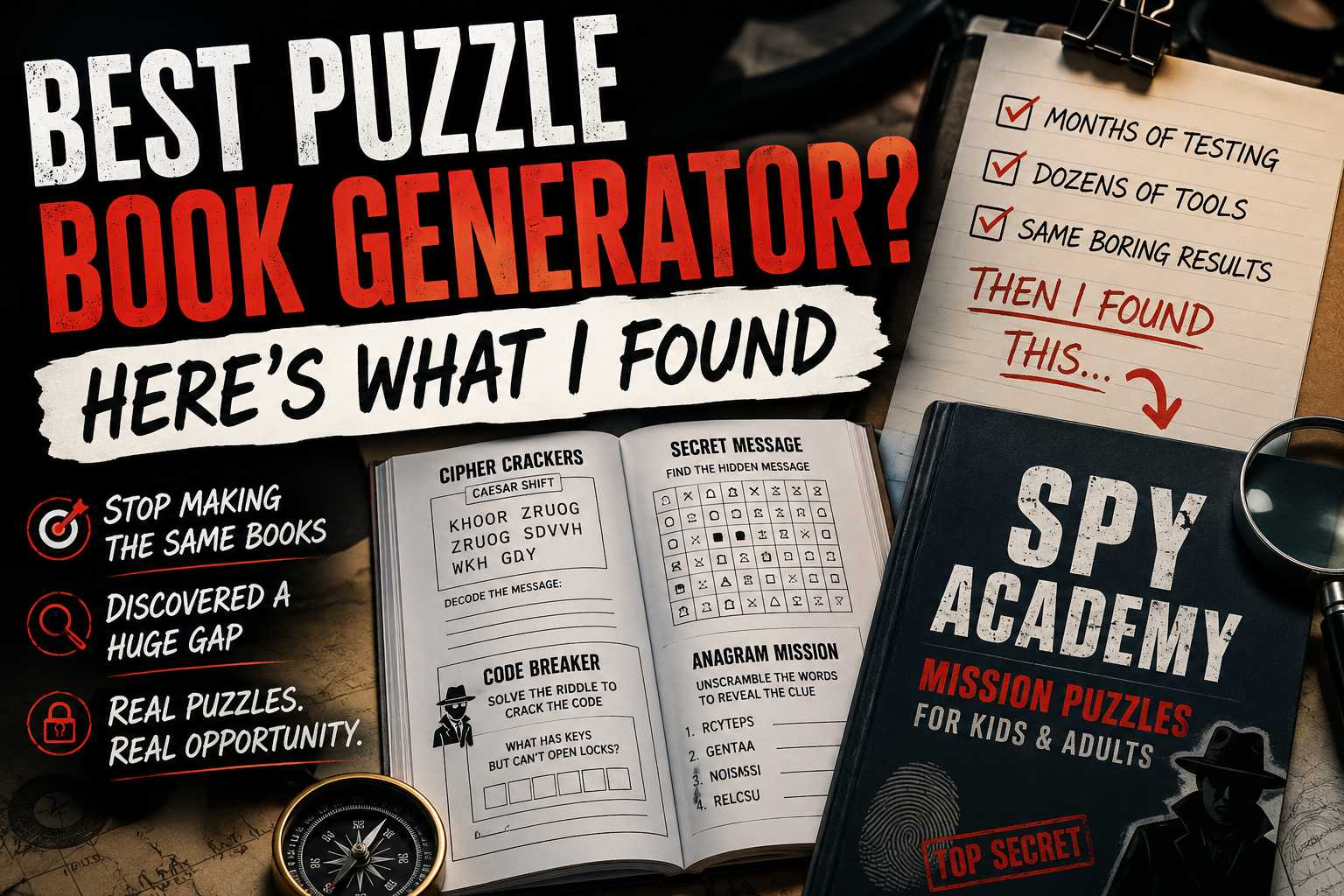
I started searching for puzzle books that had stories. Mystery books. Detective books. Spy-themed activity books. I found one where the puzzles were connected. You solved a cipher on page three to get a clue for page seven. You used the clue to eliminate suspects. The book had a beginning and an end. I read the reviews. Parents said their kids spent three hours on it. Adults said they bought it for themselves. That kind of engagement was missing from the grid-based books.
This got me thinking about whether any puzzle book generator software existed for this niche. I searched for code-breaking puzzle generators. I searched for mystery activity book software. I found almost nothing. The traditional tools did not build narratives. They built pages. One page did not know what the next page said. There was no architecture. Just inventory.
I kept digging. I found a forum post where a guy said he built his mystery books in Microsoft Word. He drew cipher wheels by hand. He wrote the connecting stories himself. He used no generator except for basic PDF export. That sounded honest. It also sounded slow. I was looking for a tool that could handle the complexity without me becoming a graphic designer.
Then one night I came across a page that was talking about spy-themed puzzle creation instead of the usual word-search formulas. One of the pages I spent time reading during that search was because it was one of the few discussions I found around spy-themed puzzle generation rather than traditional word-search software. I read through it. It was different from the other tools I had looked at. It was not just spitting out grids. It was building missions. Code-breaking pages. Fingerprint activities. Logic puzzles that connected to a story. I did not buy it. I did not even sign up. I just sat there realizing that someone had built software for the niche I had been trying to find.
But I still do not know if that makes it the best puzzle book generator. I have not tested the output enough. I have not compared the PDFs side by side with Amazon bestsellers. I do not know if the books it makes sell. I do not know if the niche is big enough. I do not know if three months from now the market gets flooded with spy-themed books that all look the same, just like the word search market. That is the thing about software. Once a tool exists, everyone can use it. And once everyone uses it, the advantage disappears.
What I do know is that after weeks of testing generators, I kept coming back to the same problem. The traditional puzzle book generator software is too good at making books that look like every other book. It is optimized for speed and volume. It is not optimized for making something a reader remembers. The activity book generator I want would need to make books that feel composed, not generated. Books with memory from page to page. Books where the puzzles serve a larger point. I have not found that yet. Not fully.
I still have those fourteen tabs open. I am still comparing outputs. I am still looking at Amazon previews and wondering who made them and how. My search for the best puzzle book generator has taught me more about the market than about the software. The market rewards sameness because sameness is cheap to produce. The software enables that. But the market also has corners where sameness has not arrived yet. Those corners are smaller. They are harder to reach. They require more work. For now, that is where my attention is.
I might be wrong about all of this. The spy niche could dry up. The mystery format could be too niche. The traditional grid books could keep selling forever because people like what they know. I am not a publisher. I am just someone who spent too many late nights looking at PDFs and Amazon listings. But if you are searching for the best puzzle book generator like I was, I would say this. Look at the output first. Do not look at the feature list. Look at whether the book the software makes is a book you would want to open. If the answer is no, then it does not matter how fast it generates.
That is where I am right now. Still watching. Still comparing. Still not sure.
About the Creator
Brooks Ghost Max
I'm just a running shoe geek with a serious addiction to foam. My current obsession? The Brooks Ghost Max. I spend my days analyzing stack heights and heel drops to help you decide if that $150 price tag is actually worth it.
Enjoyed the story? Support the Creator.
Subscribe for free to receive all their stories in your feed.
Comments
There are no comments for this story
Be the first to respond and start the conversation.