
Best KDP Puzzle Book Software? Most Publishers Are Solving the Wrong Problem
My search started with puzzle generators and ended somewhere I wasn't expecting.
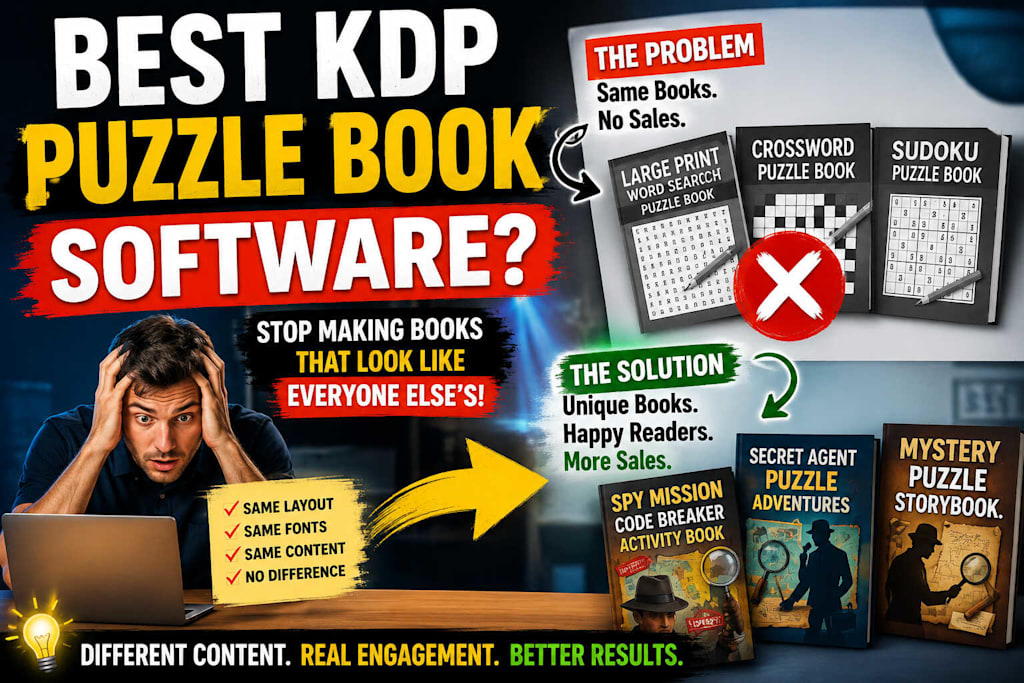
I was scrolling through puzzle book listings on Amazon, trying to understand why some categories feel impossible to break into. The covers were different bright colors, bold fonts, animals, flowers, geometric patterns but the interiors told a different story. Page after page, the same grid layouts. The same word search formats. The same sudoku templates. The same maze styles. It started to feel like the books were being assembled rather than created.
That observation sat with me for a while. I kept opening preview interiors from different publishers, and the repetition was striking. A word search book on gardening looked identical inside to a word search book on horror movies. A sudoku collection for seniors shared the same page structure as one marketed to commuters. The only thing that changed was the cover and the title. I began to wonder whether the saturation in these categories was a competition problem or a software problem. If everyone is using the same few tools, the output starts to look inevitable.
I decided to dig into what actually makes the best KDP puzzle book software, not by reading comparison charts, but by testing the tools myself and watching what they encouraged me to produce.
Part 1: The Assembly Line
I started where most publishers start: word search. The demand is obvious. The books sell. The interiors are simple. But after generating a few batches through different platforms, I noticed something about the experience. Most word search puzzle creator software operates on a similar principle. You input a word list, select a grid size, and the system arranges everything automatically. Within minutes, you have fifty puzzles. The file is clean. The margins are correct. It is technically ready for KDP.
But standing in the middle of all that output, I felt a strange hollowness. The puzzles worked. They were valid. Yet they had no relationship to each other. There was no escalation, no theme beyond the word list, no reason for a reader to finish one page and feel compelled to turn to the next. The software had solved the production problem completely and left the experience problem untouched.
Crossword publishing felt similar. The best puzzle book generators in this space can produce grids and clues with impressive speed, but the clues often read like database entries. You can adjust difficulty by changing word length, but the texture of the puzzle remains mechanical. I tried several activity book generators that promised crossword modules, and while the PDF exports were flawless, the creative control felt narrow. You could change the font, but you could not easily change the logic.
Sudoku was even more revealing. The software for puzzle books in this niche is remarkably efficient. A sudoku generator can produce thousands of unique grids ranked by difficulty. The math is sound. The formatting is automatic. But when I looked at the finished pages next to ten other sudoku books already on Amazon, I could not tell which was mine. The tool had erased the publisher. That is a strange feeling, to finish a book and feel anonymous.
Maze publishing offered slightly more visual variety. Some puzzle publishing software allows for custom path styles, branching complexity, and themed shapes. This was closer to what I was looking for. But even here, the maze books that seemed to perform well on Amazon were not just collections of random mazes. They had framing. They had progression. They had a sense that someone designed the journey, not just the walls.
I started to see the pattern. The KDP puzzle book software market is built around volume. Most tools are optimized for rapid generation, clean interiors, and bulk output. They solve the problem of making a book. They do not necessarily solve the problem of making a book someone remembers.
Part 2: The Research Deepens
I spent the next stretch of my research testing as many platforms as I could access. Some were browser-based. Some were downloadable programs. A few were Excel templates with macros. I was not looking for the fastest tool. I was looking for the one that made me think differently about what a puzzle book could be.
What I found was a spectrum. On one end, you have the pure generators. These are the best puzzle book generators for speed. You select a category, set your parameters, and receive a complete interior file. They are excellent for publishers who understand their market and need inventory. On the other end, you have design tools that happen to support puzzles. These offer total control but require you to build every page almost from scratch. They are not really KDP puzzle book software in the traditional sense. They are layout programs that tolerate grids.
In the middle, there are a few hybrid tools. These activity book generators try to combine templates with customization. You can sometimes add borders, adjust spacing, or insert instruction pages between puzzle types. This is where most publishers seem to operate. The software for puzzle books in this middle layer is competent. It produces professional files. But after using several of them, I noticed a shared limitation. They all assume the reader wants a collection. A bundle of discrete challenges. None of them assumed the reader wanted a narrative.
That assumption started to bother me. Not because narrative is inherently better, but because the Amazon marketplace I had been studying seemed to be drowning in collections. Every category I searched word search, crossword, sudoku, maze was filled with books that were essentially interchangeable. The covers fought for attention, but the interiors surrendered it immediately. If I was going to publish in this space, I did not want to add another interchangeable product. I wanted to understand what the tools were keeping me from seeing.
Part 3: A Different Shelf

My research took a turn when I started reading reviews. Not reviews of software, but reviews of puzzle books. I noticed that the books with the most enthusiastic, detailed feedback were rarely the pure grid books. They were mystery books. Detective books. Code-breaking books. Spy activity books. Readers wrote things like "my kid couldn't put it down" or "we solved it together over the weekend." The language was different. It was emotional. It was about experience, not completion.
I pulled some of these books up and looked at their interiors. They were messy in a way that the grid books were not. They had story fragments. They had puzzles that required context. A cipher only works if you care what it says. A hidden clue only matters if you are invested in finding it. These books were not just collections. They were environments.
I became curious about how these books were made. The traditional puzzle creator software I had been testing was not built for this. You cannot paste a narrative into a sudoku generator and expect it to respond. The activity book generators I had tried were flexible enough to combine puzzle types, but they treated each page as an isolated unit. They did not understand momentum.
So I started looking for tools that supported something closer to storytelling. This was harder to find. The search results for best KDP puzzle book software still pointed toward the usual suspects. But when I shifted my language and started searching for tools that supported ciphers, detective structures, or mission-style activities, I found a different corner of the market.
Part 4: An Interesting Example
One of the pages I came across during that research was because it focused on code-breaking and mystery-style puzzle creation rather than traditional grid-based formats.
I want to be careful here. I am not claiming this is the best tool, or the only tool, or the tool everyone should use. It was simply one of the more interesting examples I encountered during a period when I was specifically looking for software that treated puzzles as part of a larger structure rather than standalone pages.
What caught my attention was the approach to format. Instead of generating fifty identical puzzle types, the structure seemed built around progression. Ciphers that built on each other. Mission-style activities that required the reader to carry information forward. Detective formats where the solution to one page changed the context of the next. This was not just a puzzle publishing software in the conventional sense. It was closer to a book design philosophy that happened to include puzzles.
I spent some time examining how the narrative puzzle structures worked. The ciphers were not advanced cryptography. They were accessible codes designed to make a young reader feel like an operative. The mission-style activities used simple instructions but embedded them in a fictional context. The result was that the puzzle became a means rather than an end. The reader was not just filling a grid. They were advancing a story.
This felt fundamentally different from everything I had tested. The best puzzle book generators I had used earlier were optimized for efficiency. This approach seemed optimized for retention. It made me question whether the metric for good KDP puzzle book software should be puzzles per hour, or whether it should be something harder to measure, like whether the reader finishes the book and asks for another.
What I Learned
I entered this research thinking I would find a clear winner. A definitive answer to what makes the best KDP puzzle book software. I expected to compare features, output speed, and pricing, then emerge with a ranked list. That did not happen. Instead, I emerged with a question I could not fully answer: what is a puzzle book actually trying to do?
If the goal is to produce a clean, valid, marketable interior file, the existing software for puzzle books is already excellent. The puzzle creator software market has solved the technical problem completely. You can generate a professional book in an afternoon. The activity book generators are reliable. The puzzle publishing software is mature. There is no shortage of tools that will take you from idea to Amazon listing with minimal friction.
But if the goal is to produce something that feels distinct in a saturated category, the software question becomes more complicated. The tools that prioritize speed often standardize output. The tools that prioritize customization often sacrifice speed. And the tools that support narrative or thematic structures—like the code-breaking and mission formats I started exploring—occupy a much smaller, less visible corner of the market.
I am still uncertain about where I will land with my own publishing. I know that I do not want to add another identical interior to a category that already has thousands. I know that the books I found most interesting during this research were the ones that used puzzles as connective tissue rather than filler. And I know that the best puzzle book generator is probably not the one that makes the most puzzles, but the one that makes the right kind of puzzles for the specific book you are trying to build.
What I am continuing to watch is whether this middle space grows. The space between pure grid generation and full custom design. The space where KDP puzzle book software starts to account for story, progression, and reader memory. If more tools begin to support narrative puzzle structures—ciphers that compound, detective formats that branch, mission-style activities that reward attention—then the definition of what puzzle publishing software can do will expand.
For now, I am less interested in finding the single best tool than in understanding what the tools are quietly teaching us about the market. The repetition on Amazon is not an accident. It is the logical output of software that treats every page as independent. The books that stand out seem to come from publishers who either worked outside those tools entirely, or found ways to bend the tools toward something more continuous.
That is the thread I am following. Not the fastest export. Not the biggest template library. But the possibility of making a puzzle book that feels like it was written by someone who cared whether the reader turned the page.
About the Creator
Brooks Ghost Max
I'm just a running shoe geek with a serious addiction to foam. My current obsession? The Brooks Ghost Max. I spend my days analyzing stack heights and heel drops to help you decide if that $150 price tag is actually worth it.
Enjoyed the story? Support the Creator.
Subscribe for free to receive all their stories in your feed.
Comments
There are no comments for this story
Be the first to respond and start the conversation.