
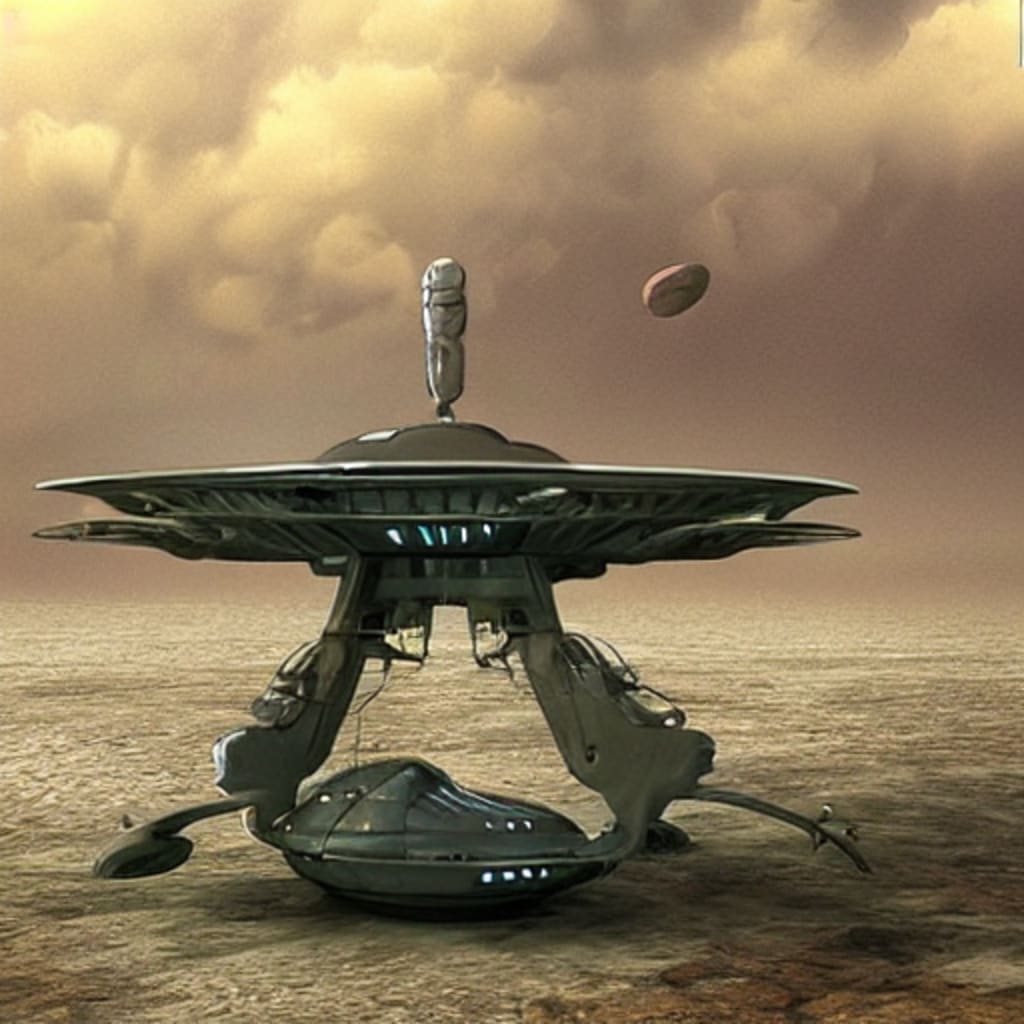
The universe is vast, with billions of galaxies, trillions of stars, and countless planets. If even a small fraction of them are habitable, life should be abundant. However, we see only emptiness. Where is everyone else? The answer may be that we are early, born before most other life. But this could soon change. Aliens could appear and compete with us for the universe. These ideas are based on limited data and extrapolation, so take them with caution. Ok! In order to comprehend the interstellar competition, we must consider three crucial issues: How quickly can bacteria construct spacecraft? Life as we know it must master a number of extremely difficult processes in order to become a starfaring civilization. The origin of life begins with dead matter transforming into its constituent parts. It must then group itself into independent cells. In order for those cells to create multicellular animals, they must learn how to cooperate. This continues until intelligent, complex animals learn how to employ tools and language. Cultures that value development and progress must be the foundation of civilization. They must then leave their home planet in order to do so. We are unsure of how difficult these steps are or how many are required. Life began to exist on Earth essentially as soon as the oceans began to emerge. The transition from single cells to multicellular organisms took place over a period of two billion years, and it took an additional two billion for us to emerge. However, the development of culture, civilization, and space travel was extremely rapid. Do things typically take so long, or was this a very quick process? Additionally, completing one step does not ensure success in the following one. For example, multicellularity has independently evolved on Earth over 25 times, but only one species is capable of creating spacecraft. We don't know how many steps life must take or how long they take in order to develop a modern society, but there are undoubtedly many. It's also conceivable that life has been difficult on billions of worlds for a very long time. We haven't discovered any other technological civilizations outside of Earth, so we could very well be the odd exception. We could be the Milky Way's first technological civilization, if not THE first. However, this is only one piece of the puzzle, and we might have just arrived at the ideal moment. Why are there human beings in the universe right now? Despite the fact that the universe is 13.8 billion years old, it is highly unlikely that many previous sophisticated civilizations had the opportunity to exist before us. Because of how terrible the environment was in the early Universe, life would have had a difficult time even surviving. Early galaxies collided with one another, supermassive black holes ejected enormous amounts of radiation, and stars were continually exploding. enough to repeatedly sterilize galaxies. Right at the conclusion of this cosmic death show, our Sun was born. Never before has the universe been more receptive to life. Thus, humanity has emerged at a very advantageous moment in time—possibly the earliest conceivable for life to flourish. The future, what about it? In our galaxy, the Sun shines brighter than 90% of the stars, and it will only increase brighter. It will eventually boil all of Earth's oceans in around a billion years, grow into a behemoth, and engulf the planet whole. In this sense, the sun is exceedingly transient in the galactic framework. Red dwarf stars, which can support habitable planets for tens of billions of years, make up the majority of stars. The time frame for life to emerge and progress through the difficult processes is extraordinarily long in these worlds. This makes the appearance of technological civilizations on one of those long-lived planets much more plausible in the future than it was in the past, even without knowing how frequent or uncommon life is. Because very few, if any, civilizations would exist before today if they appeared at random in the Milky Way during a time span of a trillion years. Before all star-faring civilizations that could possibly exist at once emerge, a few more arrive during this period of a billion years that we are in. The outcome of the hard steps model and another factor—a kind of deadline for every spacefaring civilization—is this peculiar tsunami-like distribution. All potential life must cram in before any civilization because it will be difficult for it to thrive after it. Because without humanity, we might have missed this deadline. This deadline is created by what or who? Why haven't aliens colonized Earth yet? Humans are inquisitive, eager to expand, and energetically ravenous. We have colonized the entire planet and made it our own. Over time, our technology has advanced gradually at first, then startlingly quickly. If nothing substantially changes and our descendants desire to succeed, they will spread out into space. We could build a dyson swarm for limitless energy and convert planets into brand-new dwellings. We could travel across the intergalactic void, which would enable us to search for planets orbiting far-off stars. We can develop into a cosmic society if we have the motivation. A civilization that engages in this type of behavior might be referred to as "loud" because of the "noise" that it produces. signs that are visible from a great distance. Imagine someone clearing land for roads, lighting fires, and chopping down trees in a forest. Their job becomes more obvious the harder it is to miss them. A growing technological civilization would likely be difficult to ignore. All of that energy would be captured by our telescopes, allowing us to easily spot artificial interference with stars and planets. This company's significant environmental disruption is another side effect. The fauna in a forest will perish if it is cleared. A squirrel civilization has little chance of emerging due to human activity. We simply never considered the possibility that they would want to do that in the future and needed wood, not because we detested squirrels. Similar to how they might have stopped us from existing if Loud civilizations had been roaming the galaxy in the past, terraforming planets or collecting star energy. We would never have evolved into humans if aliens had begun colonizing earth when we were still sludge in the oceans. This is how obnoxious aliens set a timetable for the emergence of new civilizations. There may be trillions of years for life to develop in the galaxy, but there may only be a small window for it to flourish. Any civilization on such a planet would never be able to expand, even if it respected worlds with naturally occurring life and expanded around them, as humans do with wildlife reserves. perpetually confined to a small island. But since we are here, it is unlikely that Loud aliens ever arrived. What about non-expanding aliens? They'd be 'Quiet' aliens. They presumably only exist in one star system and have little effect on the rest of the universe. Right now, humanity is like this. If we were on the other side of the Milky Way, we couldn't be seen. They won't truly be an issue for us if they remain silent forever—possibly due to their culture or aptitudes. Humanity is the only available sample, and we are currently moving toward being a loud species. Any other civilization with the drive and means to do so would eventually leave its home planet if we are not unique and succeed anyway. What are the effects of all these presumptions and concepts, then? Grave repercussions: Jump for the Stars If we are extremely early, other people will ultimately catch up with us. Over time, civilizations will develop everywhere. They will also observe that there are no traces of life in space, and they will draw the same conclusion: they exist because Loud civilizations have not yet engulfed the entire galaxy, but it only takes one Loud civilization to drive them out. Like us, they will have to make a crucial choice: do they expand to grab a portion of the galaxy before someone else shows up, or do they keep quiet, take it easy, and tend to their planet for as long as possible? Meeting new people need not result in strife or war. But it also means that new boundaries will form, possibly for all time. In the worst situation, a civilisation can be totally engulfed by the empires of others, destined to remain a cosmic outpost forever, powerless to change their destiny. Therefore, we had better get to work if we want a place at the galactic adults' table. If we are actually ahead of schedule, we have a fantastic opportunity. to sculpt thousands, perhaps even millions, of planets into the shape of our desires. And one day, when we meet new people, we can say hello and treat them equally. How great would that be?
About the Creator
Enjoyed the story? Support the Creator.
Subscribe for free to receive all their stories in your feed.
Comments
There are no comments for this story
Be the first to respond and start the conversation.