
An Overview of Supervised Learning in Machine Learning
Supervised Learning in Machine Learning

An Overview of Supervised Learning in Machine Learning
Machine learning is revolutionizing technology by enabling systems to learn from data and make intelligent decisions without explicit programming. Among various machine learning approaches, supervised learning in machine learning holds a prominent place due to its effectiveness in numerous practical applications.
What is Supervised Learning in Machine Learning?
Supervised learning in machine learning refers to training algorithms using labeled datasets. The labeled data includes input-output pairs where the outcome is already known. This method allows the algorithm to learn how to map inputs to outputs accurately, leading to effective predictions when new, unseen data is introduced.
Types of Supervised Learning in Machine Learning
Supervised learning in machine learning is broadly classified into two main categories:
1. Classification
Classification involves predicting categorical labels. For instance, determining if an email is "spam" or "not spam." Common algorithms used here include Logistic Regression, Support Vector Machines (SVM), and Decision Trees.
2. Regression
Regression is utilized for predicting continuous numerical outcomes. For example, predicting house prices based on features like location, size, and amenities. Linear Regression and Polynomial Regression are widely employed techniques within regression analysis.
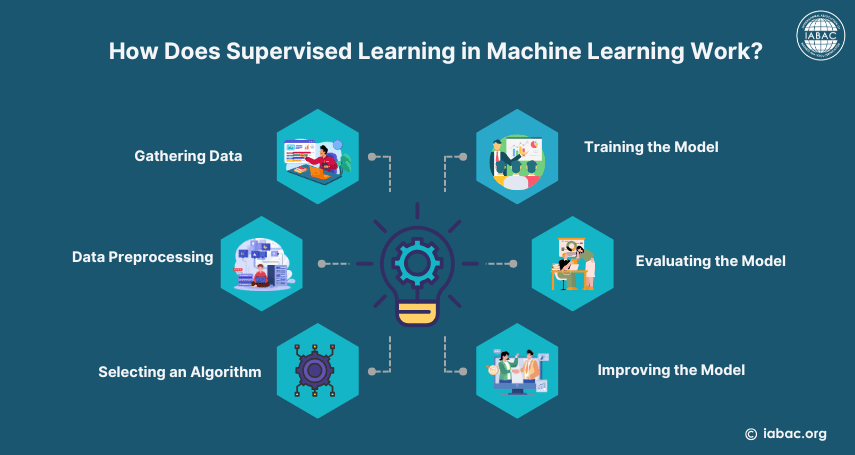
How Does Supervised Learning in Machine Learning Work?
The supervised learning process typically involves the following steps:
Gathering Data: Collecting a comprehensive and labeled dataset relevant to the task.
Data Preprocessing: Cleaning the dataset to remove inconsistencies, missing values, or irrelevant features.
Selecting an Algorithm: Choosing the right supervised learning algorithm based on the task at hand (classification or regression).
Training the Model: Using the labeled dataset to teach the algorithm how inputs map to outputs.
Evaluating the Model: Assessing the model's performance with metrics like accuracy for classification or mean squared error for regression.
Improving the Model: Fine-tuning model parameters to enhance performance.
Popular Algorithms in Supervised Learning in Machine Learning
Understanding specific algorithms used in supervised learning can help users make better choices for their applications:
Decision Trees: Simple to understand and interpret; decision trees classify instances by sorting them based on feature values.
Random Forest: An ensemble learning method that creates multiple decision trees and merges their results, typically improving accuracy and controlling overfitting.
K-Nearest Neighbors (KNN): Classifies or predicts new data points based on their similarity to the nearest neighbors within the training data.
Support Vector Machines (SVM): Find the optimal boundary between different categories to classify data points effectively.
Applications of Supervised Learning in Machine Learning
The practical implementations of supervised learning in machine learning are vast and varied, significantly influencing multiple industries:
Healthcare: Diagnosis of diseases, patient monitoring systems.
Finance: Predicting market trends, credit scoring, and fraud detection.
Retail: Customer purchase prediction, inventory management, personalized recommendations.
Marketing: Predicting customer behavior, enhancing targeted advertising.
Automotive: Autonomous vehicle navigation, driver-assistance technologies.
Speech Recognition: Converting spoken words into text accurately for voice-controlled systems.
Advantages of Supervised Learning in Machine Learning
Supervised learning comes with numerous advantages:
Accuracy: Generally provides high accuracy due to explicit labeling.
Clarity: Easy to interpret outcomes and understand model predictions.
Effectiveness: Proven effectiveness across numerous practical scenarios.
Predictive Power: Robust performance in predictive modeling, making it highly valuable in real-world scenarios.
Challenges Associated with Supervised Learning in Machine Learning
Despite its strengths, supervised learning faces several challenges:
Data Dependency: Requires large volumes of labeled data, which can be expensive or difficult to obtain.
Risk of Overfitting: Models may become too tailored to training data, limiting performance on new data.
Computational Complexity: Some supervised algorithms can be computationally intensive, especially with large datasets.
Bias and Variance Trade-off: Balancing bias and variance is challenging but essential for achieving optimal model performance.
Tips for Successful Implementation of Supervised Learning in Machine Learning
To maximize the effectiveness of supervised learning:
Quality Data: Invest effort in obtaining high-quality labeled data.
Feature Engineering: Carefully select and engineer features that significantly impact prediction accuracy.
Avoid Overfitting: Utilize regularization techniques and cross-validation methods to ensure model generalization.
Algorithm Selection: Test multiple algorithms to determine which best suits your data and objectives.
Continuous Learning: Regularly update and retrain your model as new data becomes available to maintain accuracy.
Future Trends in Supervised Learning in Machine Learning
Emerging trends suggest supervised learning will become more sophisticated, leveraging advanced technologies such as deep learning, automated machine learning (AutoML), and reinforcement-supervised hybrid models. These innovations will drive further enhancements in accuracy, scalability, and usability.
Supervised learning is a key part of machine learning, valued for being easy to understand, accurate, and useful in many areas. By knowing the steps, challenges, and best practices, businesses can make better use of data insights. Well-known methods, like regression and decision trees, are often used to create strong models. Getting certifications, such as the IABAC Machine Learning Expert Certification, can help improve skills and show expertise in this field.
About the Creator
Enjoyed the story? Support the Creator.
Subscribe for free to receive all their stories in your feed.
Comments
There are no comments for this story
Be the first to respond and start the conversation.