
An Interview with Anshul Rana: What AI Means for the Future of SEO
Insights on AI-driven SEO strategies, search evolution, content automation, and what businesses should expect from the future of search.

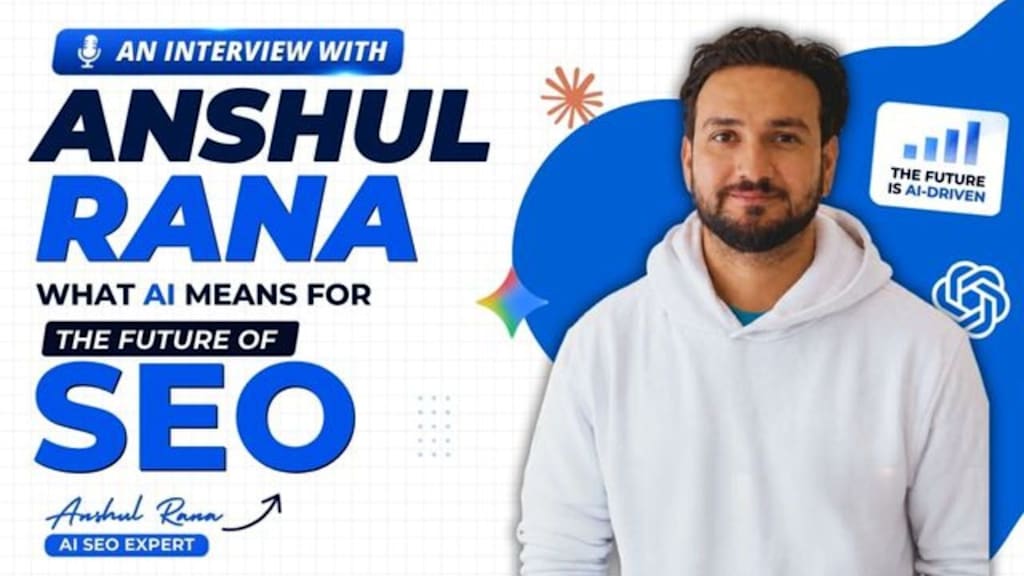
Anshul Rana has spent over eight years in SEO and the last three rebuilding his practice around AI search. He works with clients across India, Australia, the US, and the UK; holds Top Rated Plus on Upwork; and runs the blog at Anshul Rana. In, which he publishes regularly on answer engine optimization and generative engine optimization. We sat down to ask him what AI actually means for the future of SEO, not the slide-deck answer, but the practitioner's answer.
You have been doing SEO since well before AI search existed. What changed when LLMs entered the picture?
The first thing that changed was that I stopped trusting old rules. For a long time, the SEO playbook was stable enough that you could ship a checklist. Title tags, structured headings, internal linking, link earning, and content velocity. None of those became irrelevant. But they stopped being the whole picture.
By mid-2024, I was seeing real data on client accounts showing that pages without a top-10 Google ranking were generating leads. Where did those leads come from? People asking Claude or Chat GPT a question, getting cited, and clicking through. That changed how I thought.
So is SEO dead?
No. SEO is alive, just operating across more surfaces. The Google ten blue links is one surface. AI Overviews is another. Claude, ChatGPT, Perplexity, and Gemini each of those is a surface where buyers form opinions. The job is the same. Be the answer when someone is asking the question. The mechanics have widened.
You talk about AEO and GEO often. How do you define them in a sentence each?
AEO is about how an AI system can extract a clean, citable answer from your page. GEO is about whether the AI system trusts your brand enough to use the answer.
What is the most underestimated factor right now?
Third-party brand mentions. In 2026, brand mentions correlate roughly three times more strongly with AI citations than backlinks do. Most Indian SEO providers are still treating mentions as a soft PR outcome. They are not. They are a primary signal inside LLMs.
Where does someone start if they want to be cited by AI?
The order I recommend is this: clean the technical base, build entity clarity, restructure top content for direct answers, and then earn third-party mentions. People want to skip to the last step. That does not work because if your site is technically broken or your content is not answer-ready, mentions cannot do the heavy lifting.
I wrote a longer walkthrough of the audit version of this work that goes into the specifics of how to audit content for answer engine readiness. For anyone evaluating who to hire to do this seriously, the published list of Indian AI SEO experts for 2026 lays out the criteria worth using.
What do you tell clients who are worried about losing traffic to AI overviews?
The first thing is, yes, traffic is changing. Click-through rates drop by around 61% when AI overviews appear on a search result. That is not a number to dismiss. But the underlying intent has not vanished. People are still looking. They are looking inside AI answers now, and the brand that gets cited in the answer earns the next click.
So the strategy shifts. Instead of optimizing for ten blue link clicks, you optimize for being inside the answer. Same audience, different surface.
What is something most SEO providers in India still get wrong about AI search?
They treat AI SEO as a new service line on the same old execution. It is not. The execution has to change.
Example. Most blog content strategies in 2026 are still oriented around publishing twelve blogs a month, sixteen blogs a month. Claude cites utility content six to thirty times more than blog posts. A comparison page, a calculator, a pricing page, and a how-to with structured steps are cited. A 1500-word thought-leadership blog often does not. The ratio of utility to opinion in most Indian content programmes is upside down.
Is there a checklist version of the audit work for people who want to try this themselves?
Yes, I keep one on the site. The AEO audit checklist covers the essential pre-flight checks before any serious AI search programme: bot access, schema coverage, direct-answer structure, and entity signals. It is the same starting framework I run on new client accounts.
How do you stay current?
I read the bot documentation directly when it ships. I run controlled tests on my own and clients's sites. I publish what I find at anshulrana.in. Publishing is part of the discipline; if I cannot write the methodology clearly, I do not know it well enough.
Last question, what does the next twelve months look like for SEO?
More consolidation. The brands that already have authority will compound it inside AI answers. The brands that were getting by on shortcuts will lose visibility quietly, because LLMs are not going to send them a rank-drop notification.
The cost of doing nothing is going to be higher than the cost of acting. That is the part most decision-makers are still underestimating.
Frequently Asked Questions
Is SEO dead now that AI search is here?
No. SEO is alive but operating across more surfaces, Google's ten blue links, AI Overviews, Claude, ChatGPT, Perplexity, and Gemini. The goal remains the same: be the answer when someone asks the question. The mechanics have simply widened.
What is the difference between AEO and GEO?
AEO (Answer Engine Optimization) is about how an AI system can extract a clean, citable answer from your page. GEO (Generative Engine Optimization) is about whether the AI system trusts your brand enough to use that answer.
What is the most underestimated ranking factor for AI citations?
Third-party brand mentions. In 2026, brand mentions correlate roughly three times more strongly with AI citations than backlinks do, yet most providers still treat them as a soft PR outcome rather than a primary signal.
Where should I start if I want to be cited by AI?
Follow this order: clean the technical base, build entity clarity, restructure top content for direct answers, then earn third-party mentions. Skipping to mentions without the foundation in place does not work.
Should I be worried about losing traffic to AI overviews?
Traffic patterns are changing click-through rates drop by around 61% when AI Overviews appear. But the underlying intent hasn't vanished. The strategy shifts from optimising for blue-link clicks to being cited inside the AI answer itself.
What type of content gets cited most by AI?
Utility content comparison pages, calculators, pricing pages, and structured how-tos get cited six to thirty times more than standard blog posts. Most content programmes have the ratio of utility to opinion content the wrong way around.
What does the next twelve months look like for SEO?
More consolidation. Brands with established authority will compound it inside AI answers. Those relying on shortcuts will lose visibility quietly, without a rank-drop notification. The cost of doing nothing is higher than the cost of acting now.
About the Creator
Bradley Mitchell
I’m a passionate content writer who loves turning ideas into impactful stories. From blog posts to website copy, I create content that not only informs but also engages and inspires readers.
Enjoyed the story? Support the Creator.
Subscribe for free to receive all their stories in your feed.
Comments
There are no comments for this story
Be the first to respond and start the conversation.