

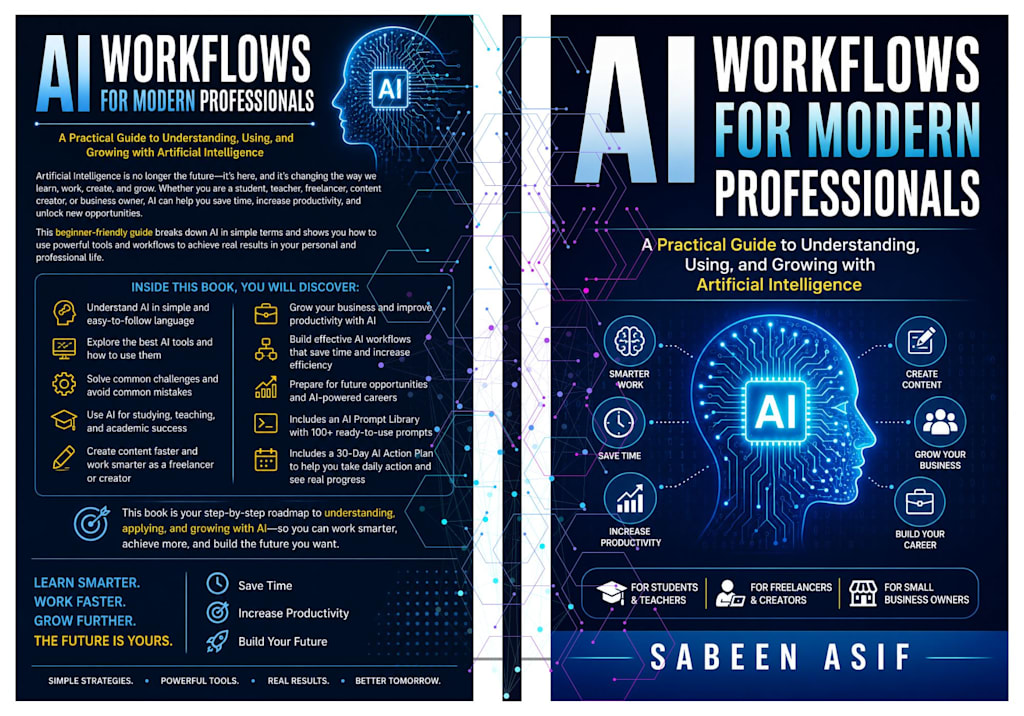
Why Learning to Work With AI May Be the Most Valuable Skill of the Decade
A few years ago, Artificial Intelligence felt like something out of a science fiction movie. Today, it is helping people write content, manage businesses, organize projects, create designs, conduct research, and solve problems faster than ever before.
Yet many professionals are still asking the same question:
How can AI actually help me in my daily work?
The answer lies in AI workflows.
AI is not just about using a chatbot or generating quick answers. The real power of Artificial Intelligence comes from building workflows that combine human creativity with AI efficiency. When used correctly, AI becomes more than a tool—it becomes a productivity partner.
An AI workflow is a step-by-step process that uses Artificial Intelligence to complete tasks more effectively.
Instead of spending hours researching, organizing information, writing drafts, or managing repetitive tasks, professionals can use AI to streamline these activities and focus on what matters most.
Think of AI as a highly capable assistant that works alongside you.
The goal is not to replace human skills. The goal is to enhance them.
The Productivity Challenge Facing Modern Professionals
Today's professionals face a common problem: there is simply too much to do.
Emails pile up. Projects become more complex. Content demands continue to grow. Information overload makes decision-making harder than ever.
Whether you are a student, teacher, freelancer, entrepreneur, or small business owner, time has become one of the most valuable resources. This is where AI workflows make a significant difference. By automating repetitive tasks and accelerating routine processes, AI helps people accomplish more in less time.
How AI Is Changing the Way We Work
Artificial Intelligence is already transforming workplaces around the world.
Writers use AI to generate outlines and brainstorm ideas.
Teachers use AI to create lesson plans and educational materials.
Freelancers use AI to draft proposals and communicate with clients.
Business owners use AI to improve marketing, customer service, and planning. Content creators use AI to develop content calendars, video scripts, and social media campaigns.
Across industries, the result is the same:
Greater efficiency and improved productivity.
The Before-and-After Effect of AI
Consider a typical content creator.
Before AI
Hours spent researching topics
Difficulty generating ideas
Slow content creation process
Manual editing and organization
Inconsistent publishing schedules
After AI
Faster research
Unlimited brainstorming support
Structured content workflows
Improved editing assistance
Consistent content production
The difference is not just speed. It is the ability to focus energy on creativity, strategy, and growth.
Why Some People Struggle With AI
Despite its benefits, many people feel overwhelmed when they first encounter AI.
Some worry that technology is becoming too complicated. Others fear that AI will replace jobs. Many simply do not know where to begin. These concerns are understandable.
However, most modern AI tools are designed for everyday users rather than technical experts.
The key is to start small. Choose one tool. Learn one workflow. Apply it consistently. Small improvements often create remarkable long-term results.
Human Skills Still Matter
One of the biggest misconceptions about Artificial Intelligence is that it can replace people.
In reality, AI performs best when combined with human strengths. AI can process information quickly. Humans provide creativity. AI can generate suggestions. Humans make decisions. AI can automate tasks.
Humans build relationships. The future is not about humans competing with machines. It is about humans and AI working together.
The Importance of Learning AI Today
Artificial Intelligence is no longer optional knowledge for professionals. It is becoming a competitive advantage. Those who understand how to use AI effectively will often complete tasks faster, solve problems more efficiently, and adapt more easily to changing workplace demands.
Learning AI does not require a technical background. It requires curiosity, practice, and a willingness to learn.
The sooner individuals begin exploring AI workflows, the sooner they can benefit from increased productivity and new opportunities.
Looking Ahead
The future of work is already being shaped by Artificial Intelligence. New tools will continue to emerge. Workflows will become smarter. Automation will become more accessible. But one thing will remain constant:
People who learn how to use AI effectively will be better prepared for the future than those who ignore it. Artificial Intelligence is not simply another technology trend. It is a powerful tool that is changing how we work, learn, create, and grow. And for modern professionals, mastering AI workflows may become one of the most valuable investments they ever make.
About the Creator
Noor
A quietly passionate enthusiast, subtly motivated by both truth and story, weaving narratives with a delicate touch. Always seeking the balance between reality and imagination, their words unfold with quiet purpose.
Enjoyed the story? Support the Creator.
Subscribe for free to receive all their stories in your feed.
Comments
There are no comments for this story
Be the first to respond and start the conversation.