
Agarose Gel Choice Changes What DNA Bands Can Show
Agarose Gel Choice Changes What DNA Bands Can Show

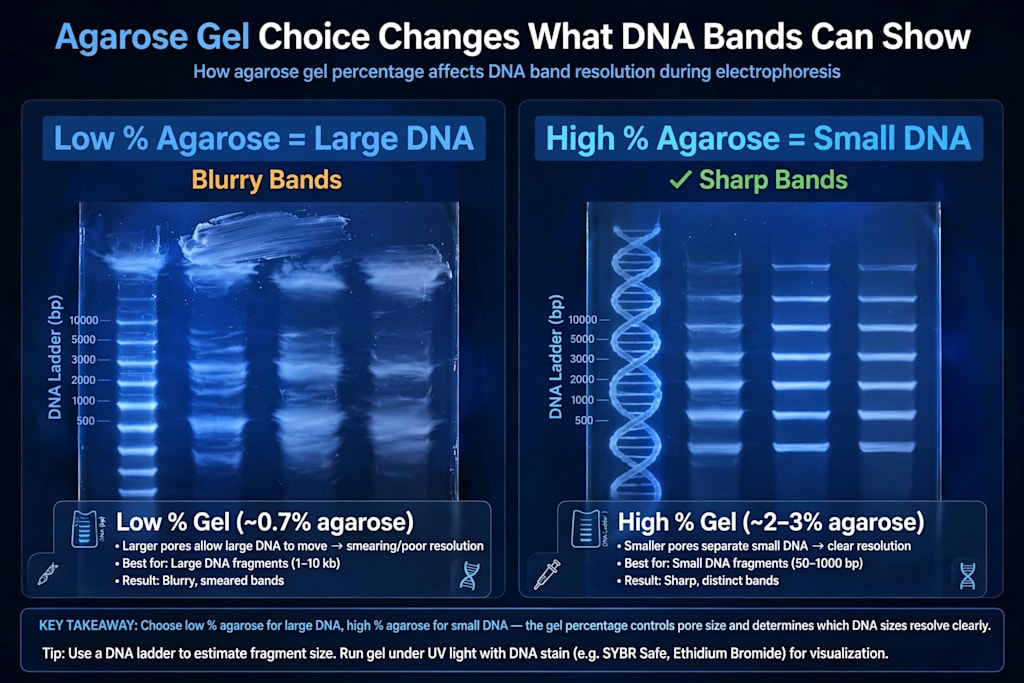
Agarose is often treated as a neutral gel powder, yet its grade and concentration directly affect how nucleic acids migrate, how sharply bands appear, and whether a gel can be handled without tearing. The polymer forms a three-dimensional network with pores that act as a molecular sieve. A low-percentage gel offers a more open path for large DNA fragments, while a higher-percentage gel restricts movement and can separate smaller fragments more effectively.
That relationship is only the beginning. Electroendosmosis, gel strength, melting behavior, impurities, buffer composition, voltage, DNA conformation, and staining conditions all influence the result. A laboratory that changes agarose grade without changing its validation record may be changing the separation method itself.
What Is Agarose?
Agarose is a purified polysaccharide obtained from agar, traditionally sourced from red seaweeds such as Gelidium and Gracilaria. Its repeating agarobiose units form helices and bundles when a hot aqueous solution cools. Those bundles join into a network that traps water and creates the pores through which charged molecules travel.
DNA and RNA carry a net negative charge under common electrophoresis conditions, so they migrate toward the positive electrode. Because nucleic acids have a broadly similar charge-to-mass ratio, the gel matrix contributes much of the size-dependent separation. Larger fragments experience more difficulty moving through the network. Their shape, the electric field, and the pore structure determine the final path.
The gel is therefore part of the analytical system. “Agarose” identifies the polymer family, but a product specification must define the grade and the properties relevant to the experiment.
Material Specifications and Gel Settings
Selection variable
What it changes
Why the laboratory should care
Gel concentration (method setting)
Effective pore size and migration range
Helps match the gel to the fragment sizes being compared
Electroendosmosis or EEO
Movement of buffer cations caused by charged groups
Excessive EEO can broaden bands and reduce resolution
Gel strength
Resistance to tearing and deformation
Controls whether a low-percentage or large gel can be handled safely
Gel point and melting point
Setting and remelting temperatures
Matters for casting, recovery, and in-gel reactions
Molecular biology suitability
Nuclease and enzyme-inhibitor control
Matters when DNA is recovered for downstream work
How Concentration Selects a Fragment Range
Agarose percentage is not a universal quality score. It is a separation variable. Lower percentages produce larger pores and are often selected for larger DNA fragments. Higher percentages create a tighter network and can improve the separation of smaller fragments, though the run may take longer and the bands can remain compressed if the concentration is too high.
The correct percentage depends on fragment size, DNA form, buffer, voltage, and the resolution needed. A routine PCR check may use a general-purpose agarose and a middle-range concentration to confirm that a product is present. If a band will be cut out for cloning, low-melting or DNA-recovery grade agarose may matter more than maximum resolution; check nuclease control and enzyme compatibility. A confirmation gel designed to separate two nearby fragments may need a different concentration and run condition. These examples are starting points, not universal percentage rules.
A useful development record includes the target fragment range, agarose mass, final buffer volume, concentration, casting thickness, well size, run voltage, run time, and ladder. Recording only “1% agarose” is not enough to reproduce the separation if the gel thickness or buffer system changes.
Why EEO Is More Than a Catalog Number
Electroendosmosis describes the movement of buffer cations caused by negatively charged groups associated with agarose. Those cations can move relative to the nucleic acids and disturb the local flow through the gel. Thermo Fisher describes EEO as an indicator of the amount of negatively charged groups in agarose and links higher negative charge with reduced separation efficiency and resolution.
Low-EEO agarose is therefore often preferred for routine nucleic acid work. The comparison still needs context. A low EEO value cannot rescue an unsuitable concentration, overloaded lane, degraded sample, or poor buffer. It is one material attribute within a method, not a substitute for method control.
When Does Gel Strength Matter?
Gel strength is expressed as the force needed to break a gel under a defined test. It generally rises with concentration, but the grade also matters. High-strength agarose can make low-percentage gels easier to lift from a tray and can support larger gels with less tearing. Low-melting agarose may be chosen when a DNA band will be excised and used in an enzymatic reaction, because the gel can be liquefied at a lower temperature.
The lowest melting point is not automatically the best option. A low-melting product can have different mechanical strength, setting behavior, and impurity specifications. If the gel will be used for DNA recovery, confirm nuclease control, enzyme compatibility, and recovery performance rather than selecting solely by the melting-point line.
How Purity Affects Molecular Biology Work
Routine visualization and downstream DNA recovery impose different quality requirements. A general-purpose agarose may be adequate for checking whether a PCR product is present. A preparative or cloning workflow may require low levels of DNase, RNase, sulfate, ash, and other contaminants that can affect enzymes or the recovered sample.
“Genetic quality” is a useful commercial term only when the supplier defines the tests and acceptance criteria behind it. Ask which nucleases were tested, which assay format was used, and whether the result applies to the stated grade. A clean-looking gel does not prove that a recovered DNA fragment will support ligation, digestion, amplification, or sequencing.
What Else Can Move a DNA Band?
Agarose grade is only one factor. DNA conformation changes mobility: a supercoiled plasmid, nicked circular plasmid, linear fragment, and single-stranded product of similar mass can migrate differently. Voltage affects heat generation and band distortion. Excess voltage can produce smiling bands or reduce resolution, especially in thick gels or poorly cooled tanks.
Buffer choice, ionic strength, gel temperature, sample salt, loading amount, staining chemistry, and run direction also matter. Ethidium bromide and other dyes can alter DNA conformation and migration. If a new agarose lot gives an unexpected band pattern, compare the full method rather than blaming the polymer immediately.
A Practical Lot Qualification Plan
For a new agarose grade, cast a small comparison set with the current reference grade. Use the same buffer, DNA ladder, sample mix, gel thickness, well geometry, voltage, run time, staining process, and imaging settings. Compare band position, width, intensity, background, gel handling, and DNA recovery where relevant.
The lot record should include gel strength or the supplier’s method, EEO, gel point, melting point, moisture, ash, and nuclease statements when the workflow requires them. The lab should also record whether the powder dissolves cleanly, whether the solution foams, and whether the gel sets uniformly. These observations often reveal a handling problem before a failed assay does.
When building an agarose supplier shortlist, teams can use PharmaSources to look for grades that match the workflow. Ask each supplier for EEO, gel strength at a stated concentration, gel point and melting point, and nuclease or enzyme-inhibitor data where DNA recovery is planned. A side-by-side gel remains the final check before changing a validated method.
Conclusion
Agarose is a separation medium with measurable chemistry and physical performance. Concentration sets the approximate pore range, EEO affects electroendosmosis, gel strength determines handling, and melting behavior influences recovery workflows. Once buffer, voltage, DNA conformation, staining, and impurities are added, the final band pattern becomes a property of the whole method. Selecting agarose by grade and intended use gives a laboratory a more reproducible result than selecting a powder by name alone.
FAQs
Q1. Does a higher agarose percentage always give better DNA resolution?
No. Higher concentration creates a tighter network that can help separate smaller fragments, but it can restrict larger fragments and increase run time. The percentage should match the fragment range and the required resolution.
Q2. What does low EEO agarose mean?
It means the agarose has relatively low electroendosmosis under the stated test conditions. Lower EEO can reduce cation movement and support sharper nucleic acid separation, but buffer, voltage, loading, and gel concentration still affect the result.
Q3. When should low-melting agarose be used?
It is useful when a DNA band will be recovered from the gel and exposed to a lower-temperature melting step, including some in-gel enzymatic workflows. Confirm mechanical strength, purity, and enzyme compatibility for the exact grade.
About the Creator
Gulshan
SEO Services, Guest Post & Content Writter.
Enjoyed the story? Support the Creator.
Subscribe for free to receive all their stories in your feed.
Comments
There are no comments for this story
Be the first to respond and start the conversation.