
adventhealth denials management automation case study
Transforming Revenue Cycles Through Intelligent Innovation
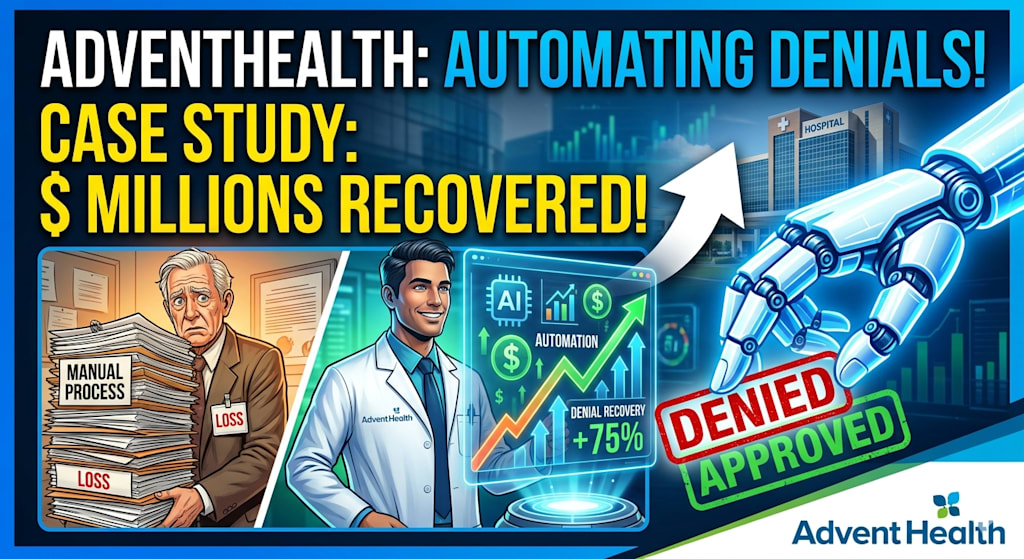
The journey toward efficient revenue cycle management is often hindered by the sheer volume of insurance denials that plague modern healthcare systems. For a massive organization like AdventHealth, the challenge of managing these denials manually was not only time-consuming but also prone to human error that cost millions in potential revenue. To combat this, they implemented a robust denials management automation strategy that has since become a benchmark for the industry. By leveraging artificial intelligence and robotic process automation, AdventHealth transformed its back-office operations from a reactive state to a proactive powerhouse of efficiency.
The Evolution of AdventHealth Denials Management Automation
The core of this transformation was the integration of intelligent workflows that could identify, categorize, and prioritize denials without requiring constant manual oversight. Before this shift, staff members had to manually sort through thousands of claim rejections, often missing the window for appeals or failing to identify root causes. Now, the adventhealth denials management automation case study highlights how the system automatically flags high-value claims that have the highest probability of being overturned. This ensures that the revenue cycle team focuses their energy where it matters most, significantly improving the net recovery rate.
- The automation platform uses machine learning to predict which claims are likely to be denied before they are even submitted, allowing for pre-emptive corrections.
- By automating the status checking of claims, the system reduces the "days in accounts receivable" (AR) by providing real-time updates from payer portals.
- AdventHealth saw a dramatic reduction in the manual labor required for repetitive tasks, such as data entry and basic appeal letter generation.
- The system categorizes denials into specific "buckets" like medical necessity, coding errors, or eligibility issues, which helps in identifying systemic problems with certain payers.
- Real-time dashboards allow leadership to see exactly where the bottlenecks are in the adventhealth denials management automation case study and adjust resources accordingly.
- Integration with the existing Electronic Health Record (EHR) system ensures that clinical documentation is pulled automatically to support appeals.
- The use of "bots" to handle low-complexity denials has freed up human experts to handle complex clinical appeals that require a more nuanced touch.
- Data analytics provided by the automation tool help in negotiating better contracts with payers by proving patterns of "wrongful" denials.
One of the most impressive aspects of the adventhealth denials management automation case study is the way it handles the logic of various insurance companies. Every payer has different rules, and keeping up with them manually is nearly impossible. The automation software stays updated with these rules in real-time. This means that if a payer changes a filing deadline or a specific requirement for an attachment, the system adjusts instantly. There is no more guessing work for the billing team. We see that the accuracy of the first-pass claim rate has improved because the system catches errors that a tired human eye might miss after eight hours of work.
Many people think that AI is going to replace workers, but in this case, it actually helped the staff feel less burnt out. Instead of doing the same boring tasks every day, they get to solve actual problems. The adventhealth denials management automation case study shows that when you take away the "grunt work," the quality of the work actually goes up. There was a time when denials were just written off as a cost of doing business, but that is no longer the case. Every dollar is tracked, and every denial is fought if it is valid. This level of precision is only possible because of the adventhealth denials management automation case study and the technology they chose to invest in.
Furthermore, the financial impact has been nothing short of extraordinary. When you look at the adventhealth denials management automation case study, the return on investment was realized much faster than anticipated. By reducing the number of "touches" required per claim, the cost to collect has dropped significantly. This allows the hospital system to reinvest those savings into patient care and newer medical technologies. It is a win-win situation for both the financial health of the organization and the patients who rely on their services. The adventhealth denials management automation case study proves that the future of healthcare administration lies in the seamless marriage of human expertise and digital precision.
In conclusion, the success found in the adventhealth denials management automation case study serves as a roadmap for other healthcare providers. It shows that while the initial transition to automation can be daunting, the long-term benefits are undeniable. By focusing on data-driven decision making and automating the mundane, AdventHealth has secured its financial future. They have turned a once-leaky revenue cycle into a streamlined, automated engine that supports their mission of whole-person care. The adventhealth denials management automation case study will likely be studied for years as a prime example of how to do digital transformation right in a complex environment.
About the Creator
Enjoyed the story? Support the Creator.
Subscribe for free to receive all their stories in your feed.
Comments
There are no comments for this story
Be the first to respond and start the conversation.