
A Working Writer’s Honest Take on Free AI Tools (After a Year of Using Them Daily)
The truth is that these programs are great at what I'm bad at,
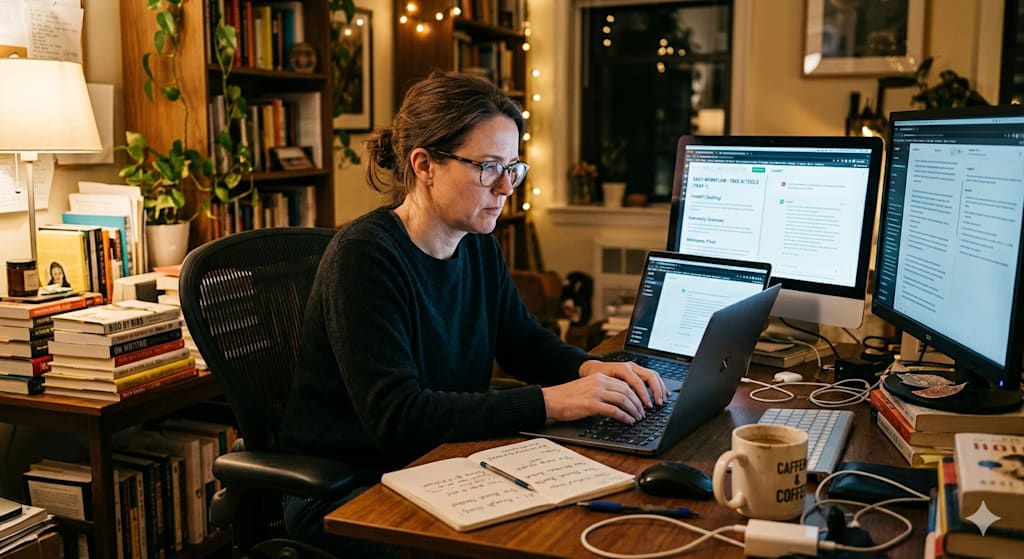
It has been almost twelve years since I earned my living through writing, and I held out against the temptation to embrace AI technology for longer than my contemporaries did. The reason for my hesitance was a fairly obvious one – I was afraid of having my unique style and expression stripped away from me and replaced by the bland soup of words that has taken over so much of the internet. However, after just one year of daily usage, my perspective has become rather nuanced – and even optimistic!
What they are genuinely good for
The truth is that these programs are great at what I'm bad at, and terrible at what I love about writing. They are great at helping me bust through a blockage, spit out a quick outline, come up with ten options for a headline, or churn out a first draft to provoke a reaction from me. What they are terrible at is nuance, specificity, and finding the right rhythm in a sentence to make someone feel something.
The surprising thing for me is that writing is mostly about overcoming your own inertia. It is easier for you psychologically to attack some draft rather than an empty screen, and this alone has led me to be much more productive without making any of my published writing worse. I keep a small set of online AI tools bookmarked for exactly this, used as a starting point I then rewrite, never as a finished draft.
The trap I watched other writers fall into
I know people who use the tools to write and do very little editing, and it shows. There becomes a sameness about their writing; a smoothness that lacks any sharpness at all. This may be hard for a reader to put a finger on, but they can sense it and they walk away. The danger lies in treating the output as an end in itself and not what it really is - a draft. As soon as you start relying on something other than yourself, you've outsourced what makes you special.
And that’s why my standard is inflexible. I allow the software to supply me with the raw material; however, each sentence that goes into print has to pass my editing. It has to be my writing in terms of how I hear it and what I think is real and true. Anything that I would be ashamed to sign goes out the door.
The bottom line for other writers
As a writer who is both inquisitive and cautious, I recommend using the following techniques to spice up the dull areas of writing, while protecting the interesting bits at all costs. They can be used to kick off any work, not to end it. There is no cost to experimenting, and a free option like this free AI tool is a low-stakes way to find out where it helps your particular process and where it does not.
As I mark my first year, I am not a doomsayer nor an evangelist. These are means to an end; effective at one task but completely incompetent at another, and only those who know which are which and have their hands on the wheel will emerge as masters of this game. The art did not become easy, but its practice became easy.
Protecting the parts that make you you
With one year of experience using these tools, the most valuable discipline that I have learned involves knowing exactly what parts of my writing should be safeguarded against whatever tool I use. It’s my unique voice, how I see things, how I say things. That is the very thing that makes people interested in reading me, instead of the hundred other authors who write about topics in the same way. The minute I allow some tool to strip me of my unique voice, I will have lost everything that makes me different.
It means that I never allow anything that is auto-generated to enter into those sections of my writing where the emotion is real or the insight is true. That very beginning that has to grab my reader’s attention, that very twist that has to surprise her – that is all mine to do in painstaking detail. The tool can be used to create a scaffold but not for the actual bearing sentences that make up the heart of my piece.
The writers who will fail are those who fail to draw the line, allowing themselves to be eroded paragraph by paragraph through a failure to resist convenience until they no longer have any unique qualities that make them stand out from other writers. The writers who will succeed are those who use technology ruthlessly when faced with drudgery but protect their meaning at all costs. This may be an uncomfortable process, and one which necessitates resistance to the temptation for the easier way out, but it is the only one that works.
Final thoughts on all of this, after a year of it. It’s the same error being made in each case by two different types of writers, one panicking about the use of these tools and the other succumbing to them, and it lies in confusing the role of the tool for its user with the role of the user himself. The tool does not exist as a savior or a danger but only as an amplifier, an amplifier of the judgments and tastes and energy you put into it. Put nothing into it, and you amplify your own laziness into mere drivel. But give it your full attention where it really counts, and it will amplify you by stripping away the distractions.
About the Creator
Enjoyed the story? Support the Creator.
Subscribe for free to receive all their stories in your feed.
Comments
There are no comments for this story
Be the first to respond and start the conversation.