
A Father’s Legacy, Divided: The Tale of Three Sons
When Pride Divides and Wisdom Unites
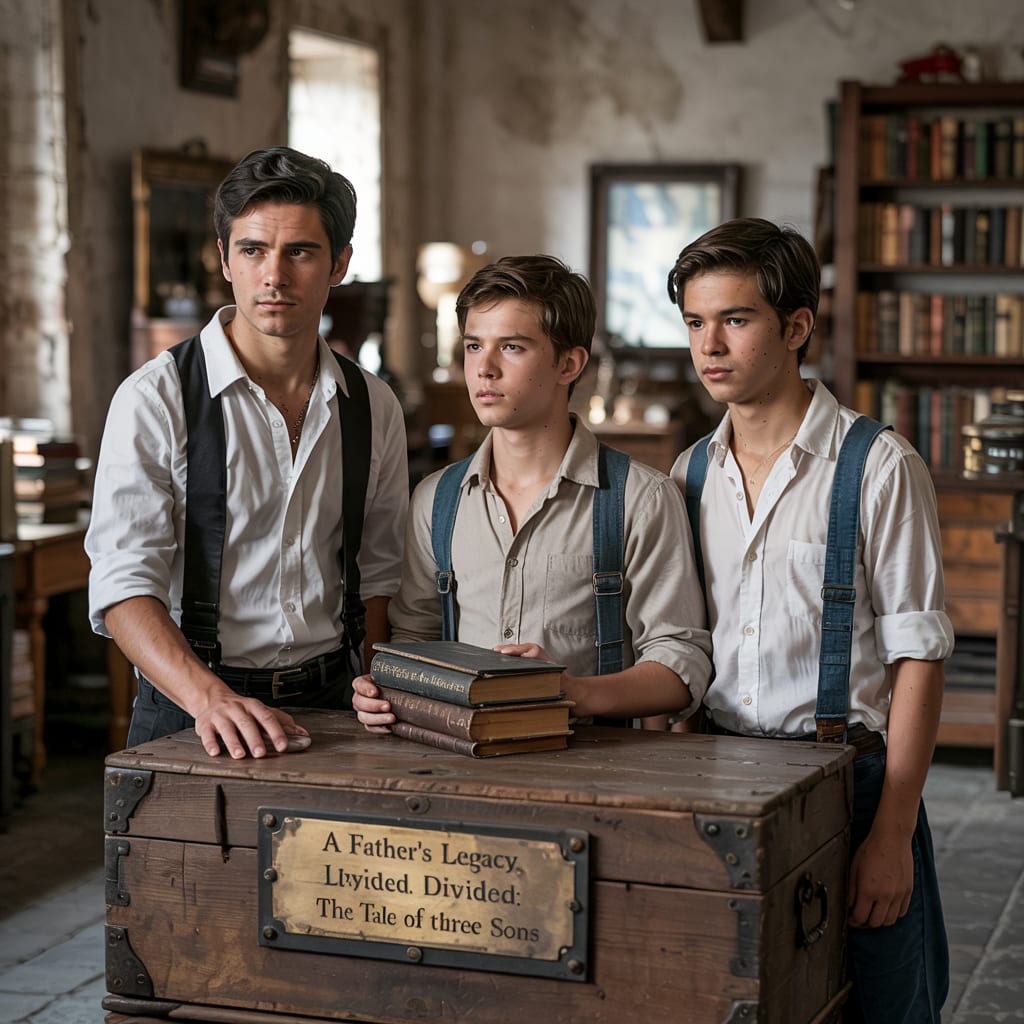
In a quiet village cradled by green hills and slow rivers, lived a man named Bhairav, known not for riches, but for wisdom. He was a hardworking farmer who had built his life from scratch—acres of fertile land, a fine house of stone, and healthy livestock. But what Bhairav prized more than all of this were his three sons: Ravi, Karan, and Mohan.
As boys, the three brothers were inseparable, but as they grew older, differences began to surface. Ravi, the eldest, was proud and domineering. He believed leadership came with birth order. Karan, the second, was sharp-tongued and opinionated. He constantly challenged Ravi’s authority. Mohan, the youngest, was quiet and often left out, but inside, he burned with a sense of injustice. He saw how his elder brothers dismissed him, how his voice was rarely heard.
Bhairav, aware of this widening gap, tried all he could to hold his sons together. He taught them through stories, shared meals, and his own example of humility. But nothing seemed to mend the cracks between them. The brothers often argued—about land boundaries, crop decisions, and responsibilities. Bhairav knew his time was drawing near, and with each passing day, his worry deepened.
One evening, as his health rapidly declined, he called his sons to his bedside. His breath was shallow, but his voice was steady.
“My sons,” he said, “I have little time left, and there is something you must understand. A family divided is a house made of sand. Everything I have built will crumble if you do not stand as one.”
He reached beside his bed and brought out a bundle of three sticks tied together with a rope. “Try to break this,” he said, handing it to Ravi.
Ravi pressed with all his strength, but the sticks would not break. Karan tried next, grunting with effort. Nothing. Then Mohan gave it a go, and still, the bundle remained intact.
Bhairav untied the rope and handed them each a single stick.
“Now, try again.”
This time, each of them broke their stick easily.
“You see?” Bhairav said weakly. “Together, you are unbreakable. Alone, you are fragile. Remember this.”
The next morning, Bhairav passed away, leaving behind his legacy—and his warning.
For a short while, the grief kept the brothers civil. But before long, old tensions resurfaced. When it came time to divide the property, the disagreements exploded.
“I’m the eldest,” Ravi declared. “Father would have wanted me to have the house and the largest share of land. I should oversee everything.”
Karan sneered. “Your pride speaks louder than sense. We divide everything equally, or I walk away with what’s mine.”
Mohan, simmering with frustration, said, “You two always talk over me, like I don’t exist. I’ve worked just as hard, but I’m always given the scraps.”
The discussions turned to arguments, the arguments to shouting. The village elders tried to mediate, but the brothers refused to listen. In the end, they split the property unevenly and bitterly: Ravi kept the ancestral home and the fertile central land. Karan claimed the eastern fields near the river. Mohan was left with the rocky, hilly stretch near the forest—land most believed was useless.
Time passed.
Ravi, with the best land and house, believed he would thrive. But without unity, there was no help, no joy, and no family to lean on. Workers came and went, but none stayed long, sensing the hostility in the household. Ravi grew lonely and irritable.
Karan was clever, and his riverside land looked promising. But he hadn’t accounted for the yearly floods. One monsoon, the river rose and washed away most of his crops. He blamed everyone but himself and grew more bitter with each passing season.
Mohan, despite being given the worst land, worked silently and diligently. With help from neighbors and advice from an old friend of Bhairav’s, he learned to grow hardy crops and even planted fruit trees that thrived in rocky soil. He married a kind-hearted woman from a nearby village, and together they built a simple life, filled with peace.
Years rolled on, and the brothers rarely spoke. The house that once held laughter and unity now stood quiet, its walls worn and its courtyard empty.
One day, during a local festival, Mohan sent handwritten invitations to Ravi and Karan. He invited them to his orchard for a small celebration and feast. Both brothers hesitated. Pride and resentment clouded their judgment. But something in the letter—the familiar handwriting, perhaps—stirred something deeper.
They arrived, reluctantly, and were surprised to see a thriving orchard where once there was only dry land. Children played, women laughed, and neighbors smiled.
Mohan welcomed them warmly, without a trace of anger.
That evening, under the shade of a mango tree, he served them food cooked by his wife. Silence sat heavy between them until Mohan spoke.
“Do you remember the bundle of sticks?” he asked quietly.
Ravi looked away, and Karan sighed.
“I remember,” Ravi said after a pause. “I thought it was just a story. A lesson meant for children.”
Mohan smiled faintly. “It was a lesson meant for all of us. We broke apart, and each of us struggled in our own way. I may have done well here, but I missed my brothers. And I know father would’ve wanted more than just land for us. He wanted unity.”
For a long moment, no one spoke. But something had shifted. That night, for the first time in years, the three brothers sat together like they used to—as a family.
In the months that followed, they began helping each other again. Ravi offered shelter and tools, Karan shared crop knowledge, and Mohan taught them the lessons he had learned about endurance and humility.
Though their father was gone, his legacy lived on—not just in the land, but in the reunion of his sons, once divided, now rediscovering the strength of unity.
About the Creator
Enjoyed the story? Support the Creator.
Subscribe for free to receive all their stories in your feed.
Comments
There are no comments for this story
Be the first to respond and start the conversation.