
A Beginner's Guide to Noorani Qaida - Where Every Quran Journey Starts
Everything you need to know before starting Arabic and Quran reading as a complete beginner

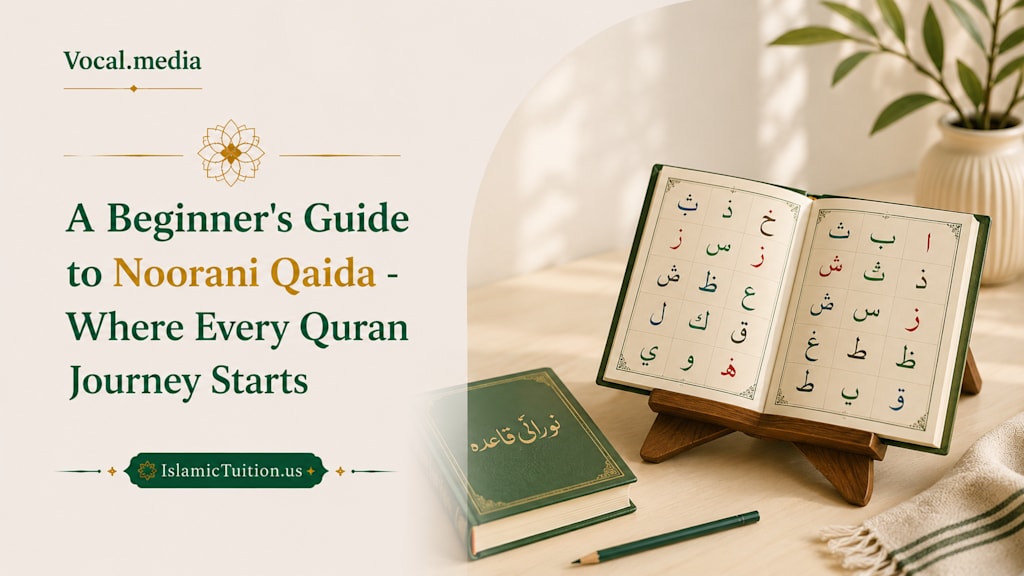
Learning to read the Quran is one of the most meaningful things a Muslim can do. But before that journey begins, there is a foundation that every fluent Quran reader built their ability on, whether they remember learning it or not. That foundation is called Noorani Qaida.
If you have ever tried to read Arabic without proper preparation and found it overwhelming, Qaida is the answer to why and the solution to what comes next.
What Is Noorani Qaida?
Noorani Qaida is a structured Arabic primer designed to take a complete beginner from knowing nothing about Arabic letters to reading connected Quranic text. It was developed specifically to make Arabic accessible to non-Arabic speakers and has been used for generations across Muslim communities worldwide.
The name comes from Noor, meaning light, and the approach reflects that meaning. Every lesson illuminates one more piece of the Arabic reading system until the full picture becomes clear.
What a Complete Qaida Course Covers
A well-structured Qaida course moves through a carefully sequenced set of lessons where each one builds directly on the previous:
First, the Arabic alphabet - all 28 letters with their correct pronunciation from the right articulation point. This stage cannot be rushed. Letters learned incorrectly here create problems that persist for years.
Then short vowels. Fatha produces an A sound, Kasra an I sound, Damma a U sound. These three marks transform a consonant into a readable syllable.
After that, long vowels - Alif, Waw, and Yaa in their Madd roles, each stretching the vowel sound for two counts.
Then Tanween, Sukoon, and Shaddah - the marks that indicate double vowels at the end of words, the absence of a vowel, and the doubling of a letter respectively. Understanding these marks is what separates basic letter recognition from actual reading ability.
Finally, letter joining - how Arabic letters connect to each other and change shape depending on their position in a word. This is the stage where reading Quranic text becomes possible rather than theoretical.
The English Sound-Based Approach
Traditional Qaida teaching uses Arabic naming conventions for each letter. For students whose first language is English, this creates an extra layer of unfamiliarity in the early weeks.
A significantly more effective approach for English speakers connects each Arabic letter to an English sound equivalent. Baa sounds like B. Alif sounds like A. When Baa combines with Alif, the student reads BA using a phonetic connection they already know. This approach reduces early frustration and accelerates the point at which reading feels natural rather than like decoding a foreign system entirely from scratch.
For Muslim families in the USA particularly, where children grow up speaking English as their primary or only language, this sound-based method produces noticeably faster early progress than traditional approaches designed for Urdu or Arabic speakers.
How Long Qaida Takes
Most students complete Noorani Qaida in 3 to 5 months with three classes per week and 15 to 20 minutes of daily home practice. Some students with prior exposure to Arabic letters complete it in two months. Others take six months if attendance is irregular.
The timeline matters far less than the quality of the foundation built. A student who completes Qaida properly in five months will move through Quran reading faster and more accurately than a student who rushed through in two months with gaps in their foundational understanding.
Why Skipping Qaida Is a Mistake
Many adults who want to start reading the Quran try to skip Qaida entirely and jump directly to Quranic text. The result is almost always the same - slow, broken reading with pronunciation errors that become increasingly difficult to correct the longer they are practiced.
The letters and rules learned in Qaida are not separate from the Quran. They are the exact building blocks every single word of the Quran is made from. Without them, Quranic text is a collection of unfamiliar shapes. With them, it becomes a readable system that unlocks 1,400 years of Islamic scholarship.
What Comes After Qaida
Once Qaida is complete, the natural next step is Quran recitation, reading the actual text of the Quran starting from Surah Al-Fatiha and progressing through the 30 Juzz systematically. For students who want to memorize the Quran, the next step is structured Hifz starting from Juzz Amma, the 30th part that contains the shorter Surahs most familiar from daily Salah.
The Qaida journey is short relative to everything that follows. But it determines the quality of everything that follows. A solid Qaida foundation makes the Quran readable, learnable, and beautiful. A weak one makes it a lifelong struggle.
About the Creator
Muhammad
Senior Educator & Operations Manager at Islamic Tuition | Dedicated to student success | Creating meaningful Islamic learning experiences, one student at a time
Enjoyed the story? Support the Creator.
Subscribe for free to receive all their stories in your feed.
Comments
There are no comments for this story
Be the first to respond and start the conversation.