
7 Year Old Doesn't Know the Alphabet? Here's What I Learned After Months of Worry
My son was already in school but still struggled with letters. I stopped guessing, researched different reading approaches, and finally understood what actually mattered.

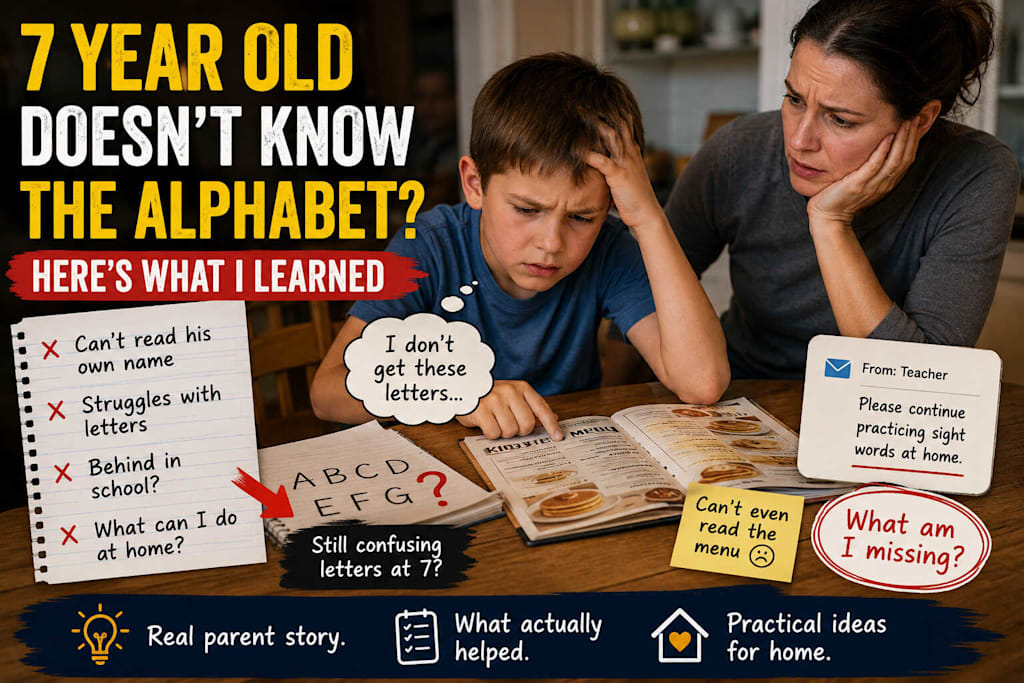
My son was seven and still couldn't read the menu at IHOP. Not the whole thing. Just his own name on the kids' menu. He'd stare at it, then look at me, then stare at it again. The waitress was waiting. He'd point at a picture of pancakes and say "that one." I didn't push it. I ordered for him. But on the drive home I kept thinking about it. Seven years old. Couldn't read his own name on a laminated menu.
That night his teacher sent an email. Nothing dramatic. Just a standard update. "Please continue practicing sight words at home." I read it three times. Sight words. We hadn't even gotten to sight words. We were still stuck on the alphabet. I had been telling myself he was a late bloomer. I had been telling myself boys develop slower. I had been telling myself a lot of things. That email made all of them sound like excuses.
I sat on the couch after he went to bed and I didn't google anything. I just sat there. I felt something I couldn't name. It wasn't panic. Panic I could handle. This was guilt. Heavy, stupid guilt. How did I not notice this was this bad? How did I let him get to second grade without knowing the alphabet? What kind of parent misses something that big?
The Night I Realized This Was More Than Homework
It wasn't one moment. It was a bunch of small ones that finally added up. The reading log that came home every week. He'd sit at the kitchen table and flip through a book without actually reading it. I'd sign the log anyway. I told myself he was "looking at the pictures" and that counted. It didn't count. I knew it didn't count. I signed it because I didn't want the teacher to think we weren't trying.
Then there was the night he brought home a spelling list. Ten words. Cat. Dog. Run. He couldn't spell any of them. Not because he didn't know how to spell. Because he couldn't tell you what letter made what sound. He'd look at "cat" and say "cuh... ahh... tuh" like he was guessing. He was guessing. He had no system. No phonics. No letter-sound connection. Just memorized shapes that looked familiar.
I asked him to write his name on a birthday card for his grandmother. He wrote the first letter. Then he stopped. He looked at me like he was waiting for me to tell him what came next. I spelled it out loud. He wrote each letter as I said it. When he finished, he didn't recognize what he'd written. He had copied sounds onto paper without understanding they were letters that made a word. That was the night I knew. This wasn't a phase. This was a real gap. And I had been walking around it for years.
Why I Stopped Comparing My Child To Everyone Else
The comparing started early. My friend's daughter was reading chapter books at six. She'd sit in the corner at parties with a Magic Tree House book and flip through pages like it was nothing. My son would be building Lego towers next to her. I'd watch them both and feel this tightness in my chest. I told myself they were just different kids with different strengths. But deep down I was measuring. Every time someone posted a video of their kid reading, I felt it. Every time a relative asked "so is he reading yet?" I felt it.
The worst part was he started comparing himself. He'd come home from school and say things like "I'm the worst reader in my class." Not crying. Just stating it. Like a fact. Like the sky is blue and I'm the worst reader. I used to argue with him. "No you're not, you're just learning at your own pace." He'd look at me like I was lying. Because I was lying. He knew where he stood. Kids always know.
I stopped comparing when I realized it was making both of us miserable. Not because I got enlightened. Because I got exhausted. I was tired of feeling bad every time another parent mentioned their kid's reading level. I was tired of watching my son shrink when he heard it too. So I made a rule. No more asking other parents about reading. No more checking where he ranked. No more "is your kid reading yet" conversations. I didn't tell anyone I was doing this. I just stopped.

The Mistakes I Didn't Notice I Was Making
The biggest mistake was assuming school would handle it. I thought that's what school was for. They teach reading. I send him there. He comes home knowing things. That is not how it works. Not for every kid. Some kids need more. Some kids need something different. School moves at a pace that works for most kids. My son was not most kids. And I spent two years waiting for the system to catch up to him instead of doing something myself.
I also made the mistake of helping too much. When he'd get stuck on a word, I'd jump in immediately. I'd finish the sentence for him. I'd tell him the word before he had a chance to struggle with it. I thought I was being supportive. I was actually teaching him that he didn't need to try. That someone would always bail him out. He started waiting for me to rescue him. Every time we sat down to read, he'd look at me after three seconds. Not because he was lazy. Because I had trained him to.
Another mistake: I kept buying him books that were too hard. I thought if I exposed him to harder material, he'd rise to it. That's not how struggling readers work. He'd open a book, see a wall of text, and shut down before he started. I was handing him mountain climbing gear when he couldn't walk up a hill. He needed simple. He needed repetitive. He needed to feel successful before he could feel challenged.
I also avoided the problem. I didn't want to admit how far behind he was. So I pretended it wasn't that bad. I'd tell myself "he knows most of the letters, he just mixes a few up." He didn't know most of the letters. He knew maybe half. And he mixed up b, d, p, and q so consistently that it wasn't mixing up. It was not knowing. I was softening reality because reality was hard to look at.
What Changed When We Focused On Confidence Instead Of Pressure
The first thing I did was stop making him read out loud to me. That sounds backwards. Every parenting article says read with your child. But reading with me had become a performance. He'd get anxious. He'd guess instead of sound things out. He'd watch my face for signs of disappointment. So I stopped. I read to him instead. Every night, I'd read books he loved. Comic books. Captain Underpants. Dog Man. Books with pictures and speech bubbles and not too many words on a page. He'd follow along with his finger. Sometimes he'd read a word before I got to it. Sometimes he wouldn't. Either way, there was no pressure.
I started putting labels on things around the house. Not fancy ones. Just index cards taped to the door, the window, the table, the couch. "Door." "Window." "Table." "Couch." I didn't quiz him on them. I just put them there. He'd walk by and sometimes read them. Sometimes he'd ignore them. After about two weeks, he pointed at the couch label and said "that says couch." I said "yeah." That was it. No celebration. No "good job." Just "yeah." I didn't want it to feel like a test he passed. I wanted it to feel like something he noticed.
We started playing board games that had words on them. Not educational games. Regular games. Monopoly Junior had words like "chance" and "go" and property names. He'd land on a space and I'd read it out loud. After a while, he'd start reading the ones he knew before I could. "Go to jail." "Free parking." He didn't know he was practicing reading. He thought he was playing a game. That was the point.
I also started letting him read menus. Real menus. Not kids' menus with pictures. The actual restaurant menu. He'd pick what he wanted and I'd help him sound out the words. "Hamburger." "Chicken." "Grilled cheese." It was slow. It was messy. The waitress would stand there longer than she wanted to. But he was reading real words in a real situation. That meant more than any worksheet.
We went to the library every Saturday. Not to check out educational books. To let him pick whatever he wanted. Comic books. Graphic novels. Books about Minecraft. Books with more pictures than words. The librarian knew us by name. She never judged his choices. She'd just hand him his stack and say "see you next week." That routine mattered. It made reading a place we went to, not a task we had to finish.
Why I Started Looking For A More Structured Plan
After a few months of this, something shifted. He was more willing to try. He wasn't running away from books anymore. But I also started hitting a wall. I didn't know what came next. I had been making it up as I went. Some days I felt like a genius. Other days I had no idea if I was helping or just keeping him busy. I needed a framework. Not because I wanted to stop being involved. Because I wanted to stop guessing.
I started looking into structured reading programs. Not because I thought a program would magically fix everything. Because I was tired of standing in front of my kid with no plan. I wanted someone to tell me what came first, what came second, what to do when he got stuck. I looked at a bunch of different options online. Some were too babyish. Some were too fast. Some assumed he already knew things he didn't know.
While comparing different reading programs, Reading Head Start was one of the structured options I spent time researching. I was looking for something that could give me a step-by-step path without turning me into a tutor. The program seemed to break phonics down into very small pieces. No expectation that a seven-year-old would sit still for an hour. No overwhelming worksheets. Just short sessions that built on each other.
I liked that it was visual and sound-based. My son learned better when he could hear the letter sound and see something move than when he stared at a static symbol on paper. The program seemed to get that. It didn't look like a textbook. It looked like something built for a kid who was already frustrated with traditional methods.
But I had reservations. Any program that costs money makes me pause. There are so many free resources out there. Worksheets. YouTube videos. Library books. I wondered if paying for something was necessary or if I just hadn't been patient enough with the free stuff. I also knew that no program works if the parent turns it into another source of pressure. I was still learning how to help without hovering. How to guide without pushing.
I spent some time reading through this breakdown of how Reading Head Start approaches early reading skills It explained the phonics sequence in a way that felt less like a sales pitch and more like an actual guide. I also looked at this year's honest parent feedback on the program which mentioned both what worked and what didn't. I always trust that more than reviews that all sound identical.
I didn't sign up immediately. I bookmarked it. I came back to it. I thought about whether my son was ready for something structured or if we needed more time with the casual approach first. I still haven't decided for sure. But having a real option on the table felt better than continuing to wing it.
Comparing Different Reading Approaches
I tried enough different things to know that not every approach fits every kid. Some children sit still and love tracing. Mine doesn't. Some kids learn from apps with cartoons. Mine watched the cartoons and ignored the letters. Some parents have the patience to create elaborate alphabet games every day. I don't. I have a job and two kids and a house that never stays clean.
What I learned is that the best reading help for kids is the kind that happens without them knowing it's happening. If you have to bribe your kid to do it, it's not working. If you have to threaten them, it's definitely not working. Reading should be part of the world they live in, not a subject they study.
Structured programs can help. They can give parents a roadmap when they feel lost. But they only work if the parent doesn't turn them into another form of pressure. A reading program for kids should feel like support, not a replacement for paying attention to your own kid. No program knows your child better than you do. But some programs can tell you what to teach next when you honestly don't know.
I also realized that alphabet recognition at seven is different from alphabet recognition at four. At four, you're planting seeds. At seven, you're filling a gap. The child knows they're behind. They feel it every day at school. Early reading difficulties at this age carry a weight that younger kids don't feel. The frustration is deeper. The shame is real. You have to be more careful. More patient. More aware that every failed attempt chips away at something that matters more than letters.
Final Thoughts
My son is not reading chapter books. He is not flying through worksheets. He still mixes up b and d. He still hesitates when he sees a word he hasn't looked at in a while. But he can recognize most of the alphabet now. He can identify numbers one through ten without panic. He doesn't run out of the room when I pull out a book. That doesn't sound like much. It is everything.
If you are in the middle of this right now, I want to tell you something directly. Your seven-year-old not knowing the alphabet does not mean you failed. It does not mean they failed. It does not mean they will never read, never catch up, never be okay. It means they are on a different timeline. And timelines at seven years old are not destiny.
Some kids sprint out of the gate and then stall in third grade. Some kids can't read a word at seven and then something clicks at eight and they never look back. The early numbers don't predict the later story. What predicts the later story is whether your kid still believes they can learn. Whether they still feel safe trying. Whether they know that not knowing something today doesn't mean they won't know it tomorrow.
Protecting their confidence matters more than pushing their progress. Every time my kid felt stupid because he couldn't name a letter, we lost more than we gained. Learning happens in a brain that feels safe, not in a brain that feels judged. If your kid is avoiding books, avoiding homework, avoiding anything that smells like reading, that is data. That is their body telling you the current approach isn't working. Not that they aren't capable. That the approach is wrong.
The mistakes that make learning harder are usually the ones that look like good parenting. Pushing through tears because "we have to get this done." Buying harder books because "he needs to be challenged." Correcting every mistake because "how will he learn if I don't tell him?" I did all of that. It came from love. It landed like pressure. The real work is backing off enough that they can step forward on their own.
School has expectations. The other kids might be further ahead on paper. But your kid is not a paper. They are a whole person figuring something out in their own way, on their own schedule. The best thing you can do is walk beside them without dragging them.
They will get there. Not on your timeline. On theirs. And when it clicks, and it will click, you will look back at this worried version of yourself and wish you could have told them to relax a little sooner.
About the Creator
Understandshe
I write about healing, self-growth, and the messy but beautiful journey of becoming. Honest lessons, real stories, and gentle insights you’ll also find on UnderstandShe.
Enjoyed the story? Support the Creator.
Subscribe for free to receive all their stories in your feed.
Comments
There are no comments for this story
Be the first to respond and start the conversation.