
17 DIY Code Breaker Puzzle Book Ideas Beyond Word Searches and Sudoku
Creative cipher, detective, and secret-message concepts for publishers looking for something different.
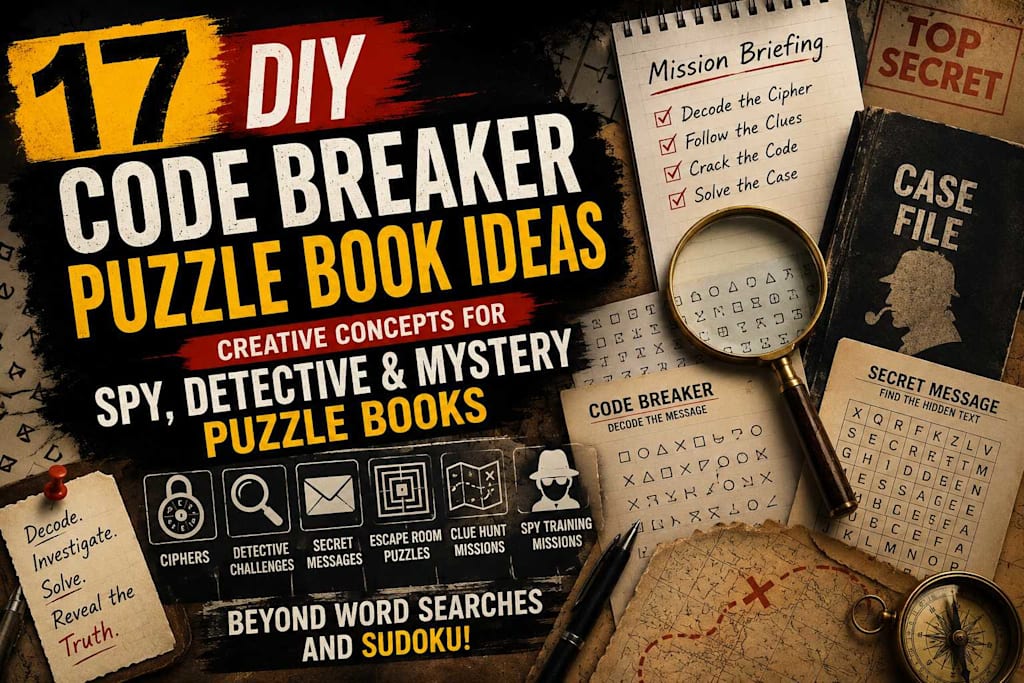
The puzzle book market has long been dominated by a familiar set of formats. Word searches, Sudoku, crosswords, fill-in puzzles, I Spy books, and maze books line bookstore shelves and fill Amazon search results. These categories remain popular because they are proven, reliable, and readers know exactly what to expect.
But that consistency makes them extraordinarily crowded. A new Sudoku book competes against thousands of established titles with hundreds of reviews. A word search collection enters a space where dozens of new editions appear every week. Standing out has become remarkably difficult.
This saturation has pushed creative publishers to look elsewhere. Readers still want puzzles — demand for brain-challenging content has not diminished. What has changed is the appetite for novelty. Puzzle enthusiasts seek fresh experiences that surprise them and offer something beyond the familiar grid.
Code breaker and mystery-themed puzzle books represent one of the most promising alternatives. These formats combine logical reasoning with narrative immersion, giving readers purpose and discovery that traditional formats rarely achieve. For creators seeking practical code breaker puzzle ideas and cipher puzzle ideas, the concepts below offer concrete starting points.
Code Breaker Puzzle Book Ideas
The foundation of this category is the cipher itself. A code breaker puzzle book built around cryptographic challenges gives readers the satisfaction of cracking real secrets. The most effective approach uses progression readers start with simple substitution ciphers and gradually advance to complex systems.
A well-designed book might begin with Caesar shifts, move into atbash ciphers, then introduce keyword ciphers, polybius squares, and Vigenère methods. Each chapter reveals a piece of a larger hidden message, so completing the book means uncovering a final secret. The puzzles are not isolated challenges but steps in a larger journey.
Cipher Puzzle Book Ideas
Beyond basic code breaking, cipher books can explore the history of secret communication. One compelling concept organizes puzzles around historical cipher systems. Readers solve simplified Enigma machine rotor mechanics adapted for paper and pencil. They decode Bacon's cipher, which hides information within text using two different typefaces. They unravel messages written in the language of flowers, where each bloom represents a letter.
Another approach is the dual-cipher book, where every puzzle must be solved twice first to decode the message, then to discover that the decoded message itself contains a second hidden cipher. This layered approach creates depth without requiring advanced mathematics.
Detective Challenge Ideas
Detective challenge books place the reader as investigator. Rather than simply decoding messages, readers analyze evidence, spot inconsistencies in witness statements, compare fingerprints, examine photographs for clues, and piece together timelines. One effective format is the case file book, where each chapter presents a complete investigation folder.
Readers might begin with a crime scene photograph showing subtle details. They read witness statements containing contradictions only visible to careful readers. A timeline puzzle requires placing events in correct order. A cipher at the end reveals the suspect's confession. Each case functions as a self-contained story, while recurring characters create continuity. This structure works particularly well for detective activity book ideas aimed at readers who want narrative immersion alongside logical challenges.
Secret Message Puzzle Ideas
Secret message puzzles work for younger audiences but can engage adults with clever design. One concept is the multi-channel message book, where the complete story only emerges when readers decode communications across multiple formats. A symbol string on one page, musical notation cipher on another, and map coordinates on a third might all point to the same hidden location.
Another approach uses interactive page elements red filter cards that reveal hidden layers, heat-concept demonstrations through puzzle logic, or puzzles requiring readers to combine information spread across non-consecutive pages. Books built around these concepts reward thoroughness and create genuine discovery.
Escape Room Puzzle Ideas
Escape room books translate the physical experience into a portable format. The best versions create pressure through narrative framing rather than actual time limits. One effective structure is the countdown book, where each chapter represents a room and readers must solve all puzzles before advancing.
These books thrive on environmental storytelling. A puzzle might require decoding a message on the back of a painting, then using that code to unlock a combination found in a desk drawer, then using those contents to solve a final door puzzle. Successful escape room books make readers feel like they are physically manipulating objects even though everything exists on paper.
Clue Hunt Puzzle Ideas
Clue hunt books create narrative treasure maps where each solved puzzle leads to the next. Unlike traditional puzzle books, clue hunts vary puzzle types dramatically since each challenge serves the hunt rather than standing alone.
One engaging format is the city-wide hunt book, where each puzzle reveals a location within a real or fictional city. At each location, readers find clues embedded in architectural details, historical facts, or local legends. These can be adapted to real cities as walking tours or set in fictional locations where creators have complete control.
Spy Training Mission Ideas
Spy training books frame puzzles as skills a recruit must master before field missions. This structure naturally creates difficulty progression while maintaining narrative coherence. Early chapters focus on observation spot-the-difference puzzles mimicking surveillance training, memory challenges simulating briefing preparation, language puzzles practicing code-switching.
Later chapters introduce complex tradecraft. Dead drop puzzles require identifying hidden messages in public spaces. Surveillance detection routes challenge readers to determine if they are being followed through logical deduction. Each completed training module unlocks a mission combining all previously learned skills.
Double Agent Puzzle Concepts
Double agent books introduce uncertainty readers are never sure which information to trust. One puzzle's solution might deliberately mislead, with the correction only becoming apparent chapters later. Characters who help early on might be revealed as antagonists, making their earlier assistance suspect.
This format works well with unreliable narrator mechanics. A journal written by a double agent contains puzzles where solutions reveal two different messages depending on which cipher key the reader uses one provided by the narrator, another hidden in the book's design. Readers must determine which version represents truth.
Missing Artifact Investigations
Missing artifact books combine code breaking with historical research. Readers investigate stolen treasures Crown Jewels of a minor kingdom, a missing page from a medieval manuscript, a disappeared artifact from museum storage. Each chapter presents historical documents, letters with gaps to fill, maps with coordinates to decode, and suspect interviews to analyze.
These books succeed when historical details feel authentic. Creators can draw on actual unsolved mysteries, adapting real documents into puzzle formats. Educational value emerges naturally as readers absorb genuine historical knowledge while pursuing the fictional case.
Cold Case Puzzle Books
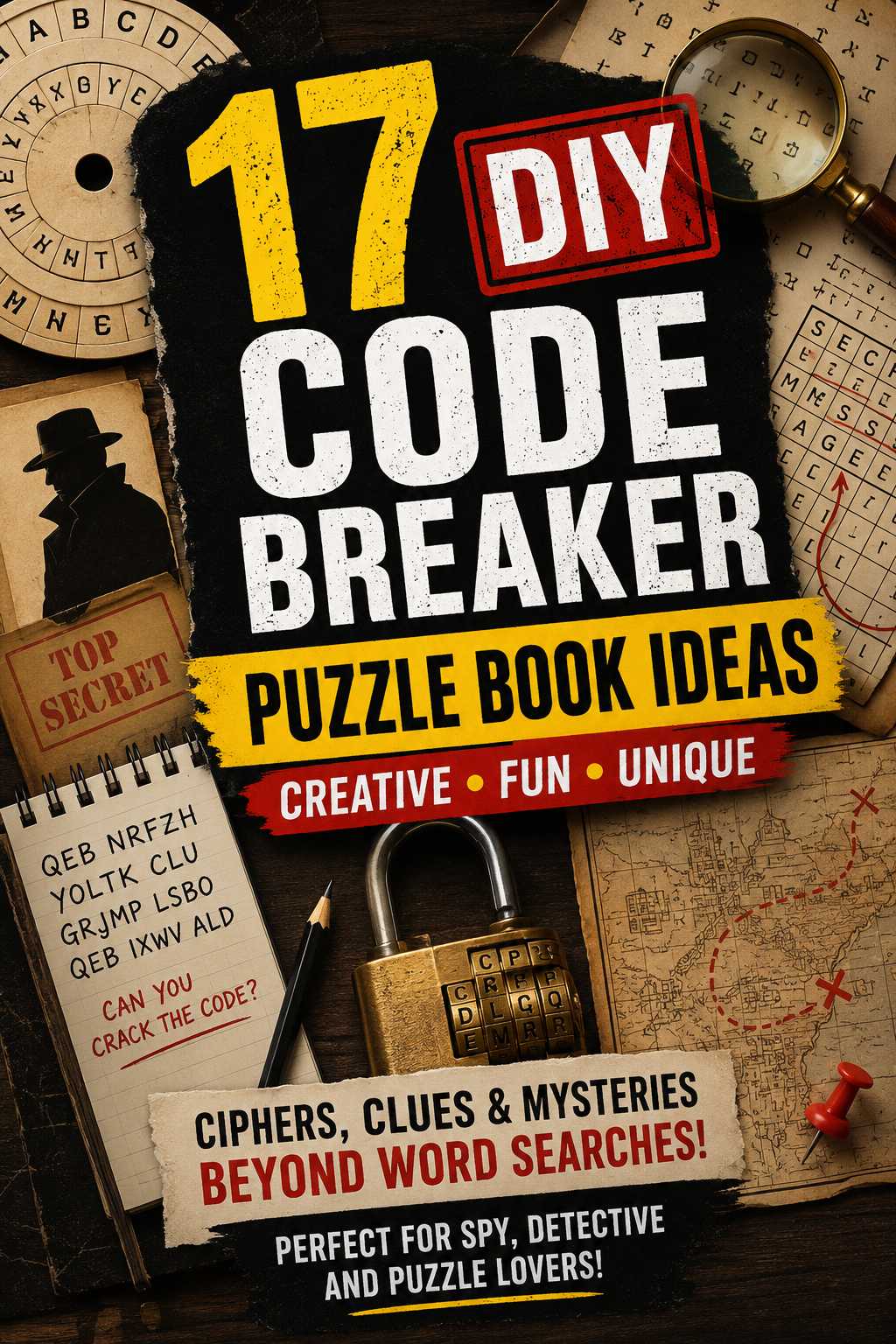
Cold case books reimagine unsolved investigations as interactive experiences. Readers receive complete case files evidence reports, photographs, findings translated into puzzle formats, and witness statements with redacted sections that must be decoded. The narrative explains that modern technology enables new analysis, and readers apply these tools to old evidence.
Fingerprint analysis might reveal a name, leading to a background check containing coded information, which reveals a hidden evidence location. Each layer peels back another piece of a decades-old mystery. This format excels at multi-layered puzzles that reward sustained attention.
Treasure Hunt Puzzle Missions
Treasure hunt books emphasize long-form narrative and substantial rewards. They often span multiple volumes, with each book containing pieces of a larger puzzle only solvable when the series is complete. Individual puzzles must satisfy on their own while contributing to something bigger.
One proven approach is the family legacy treasure hunt, where readers follow ancestors through historical periods with era-appropriate puzzles. A pirate ancestor uses nautical ciphers. A Victorian ancestor uses society ciphers and etiquette-based logic. A wartime ancestor uses military encryption. Treasures found in each era combine to reveal a final family secret.
Secret Society Puzzle Challenges
Secret society books immerse readers in organizations with their own histories, rituals, and coded communications. The book itself might be presented as a recovered document watermarked pages, marginalia with hidden messages, symbols recurring throughout requiring interpretation.
Readers progress through society ranks by solving increasingly complex initiation puzzles. Early puzzles demonstrate worthiness through logic and pattern recognition. Advanced puzzles test commitment through multi-step challenges requiring readers to return to earlier chapters with new understanding.
Historical Cipher Adventures
Historical cipher adventures transport readers to moments when cryptography changed history. A book set during the American Revolution might feature actual ciphers used by the Culper Spy Ring. A World War II setting could guide readers through techniques developed at Bletchley Park.
These books work best when historical accuracy serves the puzzle experience. Real cipher methods provide authentic starting points, with adaptations that simplify complex mechanical processes into paper-friendly formats without losing historical immersion.
Museum Heist Puzzle Books
Museum heist books reverse the typical format readers plan a heist rather than solve one. Puzzles focus on security analysis, timing calculations, guard route optimization, and alarm system decoding. The narrative creates moral framing by establishing that the target was originally stolen, or by placing readers in competition with villainous thieves.
These books excel at spatial reasoning. Floor plans with sight lines require identifying blind spots. Security camera timing puzzles require calculating optimal movement windows. Display case puzzles translate weight sensors and pressure plates into logical challenges.
International Spy Missions
International spy mission books create globe-trotting narratives where each location introduces culturally distinctive puzzle styles. A chapter in Japan might feature haiku-structure puzzles. A chapter in Egypt requires hieroglyphic decoding combined with architectural measurements. A chapter in Brazil incorporates musical rhythm patterns into cipher keys.
This format introduces variety while maintaining narrative coherence. Cultural elements must be handled respectfully drawing on genuine traditions rather than stereotypes. These books offer educational value alongside entertainment, making them excellent candidates for crossover appeal in both spy puzzle book ideas and mystery puzzle book ideas categories.
Undercover Detective Missions
Undercover mission books place readers in deep cover where maintaining their false identity is itself a puzzle. Readers must remember cover story details, identify when characters test their credibility, and solve puzzles without breaking character. A medical cover requires anatomical puzzles. An academic cover uses research-based challenges.
The identity maintenance mechanic creates natural replay value — readers who forget early details may find later puzzles impossible without careful review. This encourages thorough reading and creates engagement that extends beyond simple puzzle completion.
Stolen Painting Investigations
Stolen painting books focus on the art world, combining visual puzzles with code breaking. Readers analyze paintings for hidden messages steganography puzzles encoding secrets in brushstroke patterns, forgery detection requiring comparison of genuine and fake works.
The art itself becomes part of the puzzle, making these suited to formats that reproduce images well. The intersection of visual art and cryptography creates a distinctive experience unlike any traditional puzzle category.
Missing Person Mystery Challenges
Missing person books create personal narratives where puzzles feel like genuine investigative work. Readers reconstruct disappearances by analyzing last communications, decoding journals, mapping digital footprints, and tracking movements through timeline reconstruction.
These books succeed when they create emotional investment in finding the missing person. Each solution brings readers closer to a human resolution rather than just unlocking the next chapter. The final reveal must feel earned through cumulative investigative work.
The Challenge of Creating These Books
Developing these concepts presents challenges beyond formatting traditional puzzles. Cipher creation requires understanding enough cryptography to design puzzles solvable without being trivial. The margin between satisfying challenge and frustrating obstruction is narrow.
Clue chain construction demands meticulous planning every puzzle in a connected sequence must lead naturally to the next. A single weak link breaks the entire chain. Story continuity adds complexity, as puzzles must serve narrative and narrative must justify puzzle existence.
Difficulty balancing presents the greatest challenge. A cipher that entertains an experienced solver may defeat a beginner. Creating adaptive hint systems within print requires innovative design thinking.
For creators drawn to these formats, starting with simpler ciphers and shorter narrative arcs allows skill development before attempting complex concepts. Many successful creators began with single-concept books and expanded as they learned.
While researching ways to create code-breaking and mystery-style puzzle books, one resource I came across was because it focused specifically on spy missions, ciphers, and detective-style puzzle creation.
The puzzle book market rewards novelty, but novelty alone is not enough. Successful code breaker and mystery puzzle books must deliver puzzles that challenge, narratives that engage, and solutions that satisfy. The ideas above offer starting points, but execution determines success.
Independent publishers should consider which concepts align with their strengths. A creator with historical knowledge might excel at cold case or missing artifact investigations. Someone with visual design skills might thrive with stolen painting or museum heist formats. The intersection of skills and ambition produces the most distinctive work.
The traditional puzzle categories will continue serving their audiences well. But for creators seeking to stand apart, code breaker and mystery puzzle books offer remarkable creative freedom in an underexplored space.
About the Creator
Brooks Ghost Max
I'm just a running shoe geek with a serious addiction to foam. My current obsession? The Brooks Ghost Max. I spend my days analyzing stack heights and heel drops to help you decide if that $150 price tag is actually worth it.
Enjoyed the story? Support the Creator.
Subscribe for free to receive all their stories in your feed.
Comments
There are no comments for this story
Be the first to respond and start the conversation.