
Your Brain Doesn’t Sleep So You Can Dream. It Sleeps So You Don’t Fall Apart.
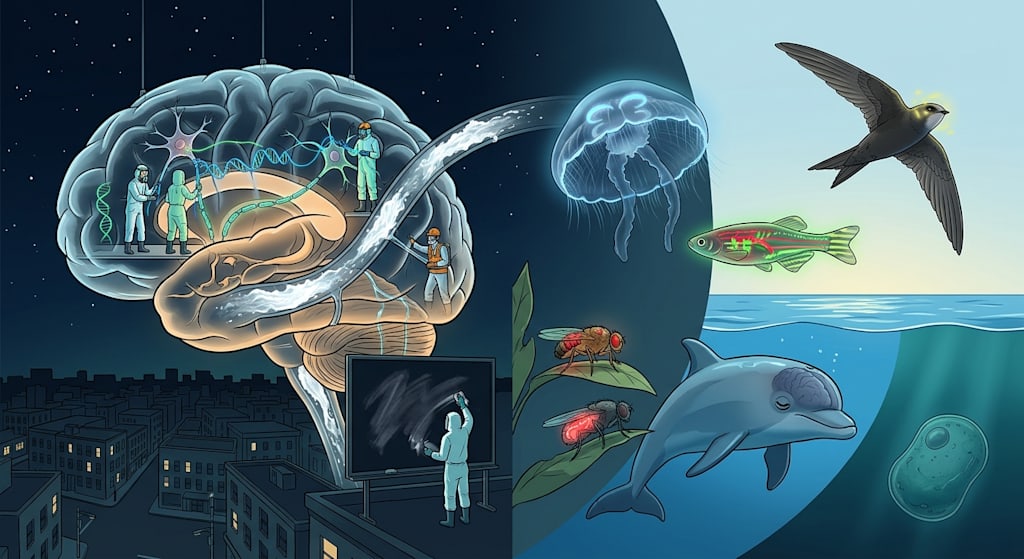
Jellyfish, zebrafish, fruit flies, and dolphins all point to one strange rule: waking is the risky part.
1. A flaw that looks like an evolutionary mistake
If an engineer designed a wild animal, he probably would not add a feature that makes it lose consciousness for hours every day. Eyes closed. No real-time response. No hunting, courting, or fleeing. To a predator, that animal has washed itself and climbed onto the plate. Sleep researcher Allan Rechtschaffen put it bluntly: if sleep does not provide some irreplaceable vital function, it is the biggest mistake evolution ever made.
The line stings because it names a real problem. Sleep costs too much. Yet hundreds of millions of years later, from jellyfish, hydra, zebrafish, and fruit flies to dolphins, elephants, and humans, no species with complex behavior has shed the flaw. Natural selection did not delete it. It kept it as one of life’s most stubborn protocols.
We used to think sleep was a luxury for animals with big brains. Humans consolidate memories, dream, and let neurons rest. Science has taken that anthropocentric picture apart. Sleep is not an accessory of the clever brain. It is older than the centralized nervous system and more basic than dreaming.
2. Even jellyfish without a decent brain sleep
In 2017, Caltech researchers studied moon jellyfish. The animal drifts in water without a centralized nervous system. Its body is a loose nerve net. High-definition cameras recorded them for thousands of hours. Late at night, the bell’s pulsing rate fell from about sixty times a minute in daytime to about thirty-nine. When researchers squirted water beneath a jellyfish with a pipette, a daytime animal pulsed away at once. A nighttime animal wobbled for several seconds before reacting.
The deprivation test mattered more. A device removed the partition under the jellyfish every so often, letting it drop and disturbing it all night. The next day the animals were wilted. Their pulsing rate dropped, and they napped during daylight. In 2020, Kyushu University ran a similar test on hydra. Hydra are more primitive, with very few neurons. Under specific biochemical stimulation, they still showed regular sleep-like states.
One scientific caution belongs here. For jellyfish and hydra, researchers use the term sleep-like state. Activity drops. Response thresholds rise. Stronger stimuli can wake the animal. Deprivation produces rebound. This is not human eyes-closed dreaming. It does show that sleep may predate the centralized brain.
Sleep was not invented after brains became sophisticated. It was written into the factory settings when the first primitive neurons appeared.
3. Waking is slow poisoning
What does sleep repair?
One core answer sits in microscopic DNA damage. In 2019, Lior Appelbaum’s team at Bar-Ilan University published a zebrafish study. Zebrafish are almost transparent. After live fluorescent staining, chromosomes inside individual living neurons are easy to see. While a zebrafish is awake and sensing the world, neurons fire hard. Mitochondria inside them act like small furnaces and release reactive oxygen species that damage fragile DNA double strands. While the animal is awake, chromosomes barely move. Repair enzymes are stuck outside.
Think of a busy bridge. When traffic is heavy, you cannot close a lane to repair cracks in the piers. A neuron’s first job while awake is to process signals and maintain membrane potential. Repair has to wait. Once the zebrafish sleeps, chromosome movement inside nerve cells rises sharply. Chromosomes that looked lifeless begin to churn and unfold like noodles in boiling water. PARP1 repair enzymes can then wedge into DNA double-strand breaks and stitch up the day’s damage.
When researchers used drugs to block this nighttime chromosome movement, DNA damage piled up. Within days, nerve cells began to trigger mass suicide. Waking is a slow poisoning process. Every waking second pushes neurons toward breakdown. Sleep pulls the main breaker so the repair crew gets a few hours.
This is only single-cell patching. The neural circuit scale is more complex.
4. The brain wipes the blackboard late at night
Giulio Tononi and Chiara Cirelli at the University of Wisconsin-Madison proposed the synaptic homeostasis hypothesis. Many popular articles say sleep consolidates memory. It prints the day’s knowledge into the brain. Tononi’s view is colder. That is not quite what happens.
Every experience while awake, meeting a person, smelling a flower, solving a problem, changes synapses. Connections between neurons become thicker and stronger. Neurobiologists call this long-term potentiation. It is the physical basis of learning. The problem is scale. The brain spends the day wrestling with every image, sound, and smell. Billions of synapses get stronger and thicker. Limited skull space and glucose supply approach a red line.
The human brain is about two percent of body weight and uses about twenty percent of the body’s energy. If hundreds of billions of synapses only grow, the brain would overexcite, short-circuit, and run out of energy within a week. Signal-to-noise ratio would also collapse. If every connection is strong, you cannot tell important signals from noise.
Sleep steps in. During deep slow-wave sleep, the brain releases specific neuromodulators. Synapses undergo broad pruning. Overall strength drops by about twenty percent. Weak, unimportant connections, like small ads on a roadside pole, fall to zero. Important connections that were repeatedly used during the day are also weakened. Their relative advantage survives.
Sleep does not build towers in the brain. It wipes the blackboard you scribbled on all day. It leaves a few chalk marks pressed deepest into the surface. Without that wipe, tomorrow has no space to write.
5. The brain opens the sluice at midnight
The physical cleanup is stranger.
In 2013, Maiken Nedergaard’s team at the University of Rochester published a widely cited study in Science. They described the brain’s glymphatic system. Anatomy had a century-old puzzle. The body has lymphatic networks that carry immune cells and flush metabolic waste. The delicate, metabolically hungry brain had no traditional lymphatic vessels. Where do neuronal metabolic toxins go?
Nedergaard used two-photon microscopy to image live mice through thinned skulls. The brain has no lymphatic vessels, but it has precise perivascular channels. Glial cells normally cling to blood vessels. The spaces are so narrow that water molecules struggle to pass. When the mouse enters slow-wave sleep, molecular switches close. Astrocytes shrink like squeezed sponges. Interstitial spaces between brain cells expand by about sixty percent. Cerebrospinal fluid, driven by aquaporins in glial cells, rushes along perivascular spaces into the enlarged gaps. It sweeps away amyloid protein and metabolic waste built up during the day and pushes them into the venous system.
Think of a mall at noon. The cleaning crew cannot drag a hose through the crowd. At midnight the mall empties, the gates open, and a fire hydrant blasts the floor. Beta-amyloid and Tau proteins linked to Alzheimer’s disease are cleared more than twice as fast during sleep as during waking.
Why can’t this flush run during the day? Large-scale cerebrospinal fluid flow would disrupt the fragile ion gradients around neurons. If sodium and potassium concentrations go wrong, neurons cannot fire basic action potentials. Running the cleaning system at full power during the day would cause severe seizures or fainting. Biochemistry forces organisms to separate the systems. Either stay awake and process signals, or shut down and flush the waste.
6. Sleep deprivation may rot the gut first
Many people still think this is all about the brain. Isn’t sleep just service for a picky head?
Science has challenged that view. In 2020, the Vaccaro team at Harvard Medical School published an experiment in Cell. They used transgenic fruit flies for long total sleep deprivation. They wanted to see which organ starts killing the animal first. Everyone bet on brain neurons. The slices showed something else. After several days without sleep, brain cell morphology was basically intact. The gut tissue was a mess.
After a few days of sleep deprivation, reactive oxygen species in the fly gut rose to extreme levels. Intestinal epithelial cells suffered massive irreversible oxidative damage. The gut mucosal barrier broke apart. Bacteria and toxins entered the hemolymph. The flies died of systemic sepsis. Then came the reversal. The Harvard researchers fed the sleep-deprived flies high doses of oral antioxidants, or activated antioxidant enzyme genes in gut cells. Once intestinal reactive oxygen species were cleared, the flies lived. They had been sleepless for days, yet their lifespan matched the normal-sleep control group.
This experiment challenged the century-old dogma that sleep is a brain patent. It does not mean sleep is only for the gut. It shows that sleep deprivation can kill through intestinal oxidative stress before the brain collapses. The deepest source of sleep need may not be in the head at all. It may sit in ancient metabolic and redox balance. As long as mitochondria make energy, they make reactive oxygen species. Under long high-load operation, tissues throughout the body get scorched by their own exhaust. Sleep is a full-body redox reset.
7. Dolphins and swifts cannot delete sleep. They break it apart.
Many tough organisms have tried to fight sleep. Their compromises show how immovable it is.
Bottlenose dolphins and sperm whales face survival pressure far worse than land animals. They must surface to breathe. Sharks and orcas are everywhere. Full shutdown sleep means drowning or being eaten. Minimal evolutionary logic says a dolphin should delete the sleep gene and become a perpetual motion machine. Nature cannot do it. The dolphin’s solution is unihemispheric slow-wave sleep. The left hemisphere sleeps for two hours while the right stays awake, controls swimming, and keeps one eye on the surface and predators. Two hours later they swap. The right hemisphere sleeps while the left stands watch.
South American fur seals sleep on land like dogs, belly up, both hemispheres asleep. The moment they enter the cold Atlantic, they switch to the dolphin pattern of alternating single-hemisphere sleep. Swifts are more extreme. Outside the breeding season they can fly for ten months without landing. The Swiss Ornithological Institute fitted swifts with micro-sensors. When gliding on rising air at high altitude, their brains enter micro-sleep lasting only seconds. Sometimes only one hemisphere naps.
Nature forced dolphins into alternating shutdown. It forced swifts into seconds-long naps during ten months of nonstop migration. It still could not pry this life-threatening flaw out of the gene pool. Sleep can be modular, localized, and fragmented. It is very hard to delete wholesale.
8. Evolution is balancing costs, not chasing a flawless design
“Sleep is the biggest mistake of evolution” has punch. It is not a conclusion.
Natural selection does not chase flawlessness. It balances net fitness. Sleep is expensive, but waking benefits must be built on repair. Sleep is not a single gene switch that can be deleted. It is a system state tightly tied to cellular homeostasis, synaptic plasticity, immunity, and metabolism. Deleting it often means pleiotropic collapse, not more time. Dolphins and swifts show that evolution has tried. It can only split sleep, chop it up, and rotate it. It cannot throw it away.
A more defensible statement is this. Sleep-like homeostatic maintenance is an ancient cellular program. Waking is a high-damage, high-plasticity state layered on top for real-time modeling of the world. The same regulatory system switches between two necessary modes. Neither mode is simply default or exile.
9. A philosophical reversal: sleep is ancient, waking is the adventure
Some neurobiologists are re-examining the primordial state of life. We treat waking as life’s default color. We treat sleep as a concession after waking gets tired. The timeline may be reversed. Sleep may be the older steady state. Waking may be the dangerous, costly adventure.
In the ancient oceans where life began, primitive single cells and brainless multicellular organisms stayed quietly in the water. They repaired proteins, copied genetic material, and maintained osmotic balance across membranes. This was pure repair and homeostatic maintenance. It was the prototype of sleep. Later, competition for scarce nutrients forced some cells to evolve light-sensitive receptors, beating cilia, and axons for rapid electrical signaling. To grab food, they had to leave the safe steady state and expose themselves to ultraviolet light, oxygen radicals, and predators. This high-cost, high-damage hunting state became waking.
This is still a hypothesis and a metaphor, not a fully proven timeline. It corrects one arrogance. Sleep is not the failure of waking. Waking is not the defection of sleep. They are two protocols life must switch between, repair and adventure.
10. Tonight, close your eyes
Back to the first question. Why did animals evolve sleep?
The question may have started from a human bias. Life did not evolve sleep. Life evolved waking. Sleep-like homeostatic maintenance is the older, more fundamental cellular program. Waking is the high-damage, high-plasticity state layered on top for real-time modeling of the world. Every day we wake and trade damage for plasticity, risk for exploration, and energy for learning. Every day we sleep and settle the bill.
Tonight you turn off the light. Your fingers touch the pillow. You pull the blanket up. The brain does not shut down. It still fires in rhythms. It replays the day’s paths. It pushes cerebrospinal fluid through intercellular spaces and washes away amyloid protein. You retreat from the field-operation state that requires real-time modeling. You return to an older, quieter steady state. When the alarm rings tomorrow, you will reassemble yourself and go out to set the world on fire.
About the Creator
Jin
Writer of reamstories
https://reamstories.com/jin
Enjoyed the story? Support the Creator.
Subscribe for free to receive all their stories in your feed. You could also become a paid subscriber, letting them know you appreciate their work.
Comments
There are no comments for this story
Be the first to respond and start the conversation.