
Why Humans Wear Clothes When Every Other Animal Goes Naked
Polar bears can’t knit. Humans can. That one trick turned us into a global species.
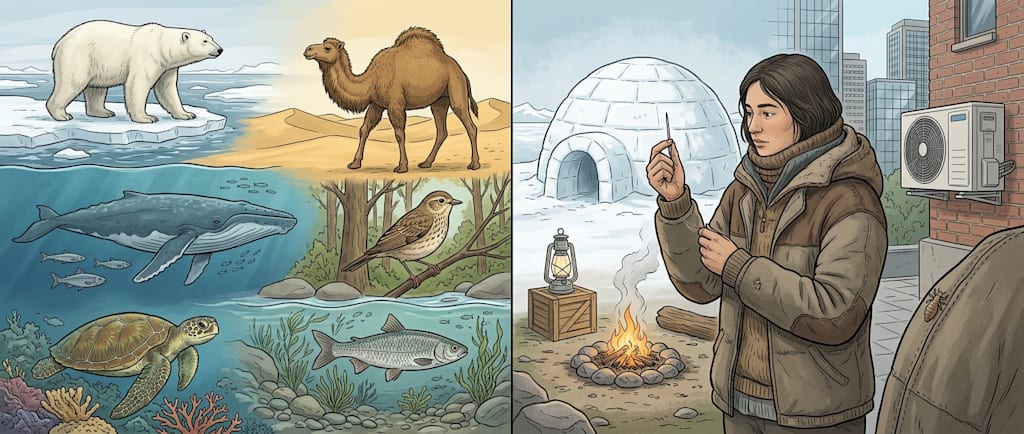
Shave a polar bear and put it in the Arctic. It will die.
Put a human in the Arctic with a down jacket, a snow house, fire, and an oil lamp. They can live.
Polar bears cannot knit sweaters. Humans can.
Animals do not wear clothes, yet they live in grasslands, forests, and oceans. Humans wear clothes. The difference is not weakness.
Look at animals first. They are not naked. They wear their coverings on their bodies. Polar bears have thick fur and fat. Camels have long hair. Whales have blubber. Birds have feathers. Fish have scales. Turtles have shells. These coverings provide warmth, sun protection, waterproofing, and protection from cuts. But they are fixed. When it is cold, animals cannot add more. When it is hot, they cannot take it off. A polar bear lives well in the Arctic. Moved to the tropics, it dies. A camel lives well in the desert. Put it in a rainforest, it gets sick. Their bodies write environmental adaptation into genes. Genes change slowly, over tens of thousands of years.
Humans took another path. We hold our clothes in our hands. Cold: down jacket. Hot: short sleeves. Rain: waterproof. Snow: snow boots. Clothes are adjustable. Animals rely on thick fur for warmth. Humans rely on making clothes for warmth. Animals rely on genes to adapt. Humans rely on technology. Clothes are only the first step. After that come fire, houses, heating, and air conditioning.
Humans lost most of their body hair. Hair is useful, so the change needs explanation. There is no single answer. One explanation is heat dissipation. In 2004, Nature published a paper on the evolution of human endurance running. Humans are not fast, but we have great endurance. When tracking prey over long distances, the body constantly produces heat. The faster you dissipate heat, the less likely you overheat. Humans have many sweat glands, little body hair, exposed skin, and fast sweat evaporation. Long legs, an arch and Achilles tendon that act like springs, gluteal muscles that stabilize the trunk, and a slender, narrow body. Together, these structures suit sustained activity in hot environments. Less hair means worse insulation, but stronger heat dissipation.
Another explanation is parasites. Body hair is habitat for lice and ticks. Less body hair means less space for parasites and less disease pressure. Sexual selection may also have played a role. Less body hair may have been seen in some groups as healthier or younger. These factors may have worked together. The result: humans became animals that are very good at sweating but not very good at staying warm. Clothes filled the insulation gap.
Scientists know when humans began wearing clothes by looking at lice. Humans carry Pediculus humanus. Head lice live in hair. Body lice live in clothes. Body lice eggs stick to clothing fibers. If humans had not worn clothes for a long time, there would be no clothing niche, and body lice would not appear. Molecular clocks estimate that body lice split from head lice about 100,000 years ago. That time roughly corresponds to when humans began wearing clothes more regularly. Lice cannot speak, but their genes left a timestamp.
Clothes solve more than cold. Ultraviolet radiation is strong at the equator, so desert peoples wear long robes. The robe is not for heat; it is for shade, wind protection, and reducing water loss. Loose clothing forms an air layer between the body and the outside, insulating and ventilating. In forests, clothes protect against mosquitoes, thorns, and scrapes from rocks. Later, clothes also became markers of identity, etiquette, profession, and religion. At first, they were most likely survival tools.
Naked survival is possible in a narrow range of environments. In the tropics, where it is warm year-round, resources are abundant, and insects are few, it can work. Some tropical peoples historically wore very little. But with no covering at all, they still face harsh sun, insects, thorns, rain, and nighttime cooling. In temperate zones, winter kills. In polar zones, without clothes and fire, death is almost certain. In deserts, without cover, dehydration and sunburn can be fatal. At high altitudes, ultraviolet radiation, low temperatures, and strong winds are equally dangerous.
The Inuit live in extreme cold. They wear multiple layers of animal skin: an inner layer for warmth, an outer layer against wind, snow boots, snow houses, and oil lamps. They are not physically stronger than polar bears. They pushed technology to its limit. Without clothes, fire, and snow houses, they would not last long in that environment. Clothes allowed humans to expand their habitable zone to almost the entire planet.
Animals adapt to the environment through their bodies. Humans adapt through technology. Genetic evolution is slow. Cultural evolution is fast. One person invents sewing, and others learn it. Fire spreads the same way. We make clothes instead of waiting for thick fur. We cook instead of waiting for stronger stomachs. When darkness comes, we make lamps. Cooked food made teeth smaller and intestines shorter. Houses let humans settle in cold regions. Air conditioning lets humans work in hot cities. These are all the same path.
Humans wear clothes not simply because we cannot live without them. Without clothes, humans could only stay in a narrow range of environments. With clothes, humans walked into ice fields, high mountains, deserts, and forests. Clothes are the human second skin. They can be taken off and swapped out. They beat fur on flexibility and cost. Animals wait for natural selection to change their outfit. Humans change outfits through culture.
Today, before you go out, you check the weather, choose a coat, and pull up the zipper. Body lice still live in the seams. They adapted to this add-on earlier than we did.
About the Creator
Jin
Writer of reamstories
https://reamstories.com/jin
Enjoyed the story? Support the Creator.
Subscribe for free to receive all their stories in your feed. You could also become a paid subscriber, letting them know you appreciate their work.
Comments
There are no comments for this story
Be the first to respond and start the conversation.