
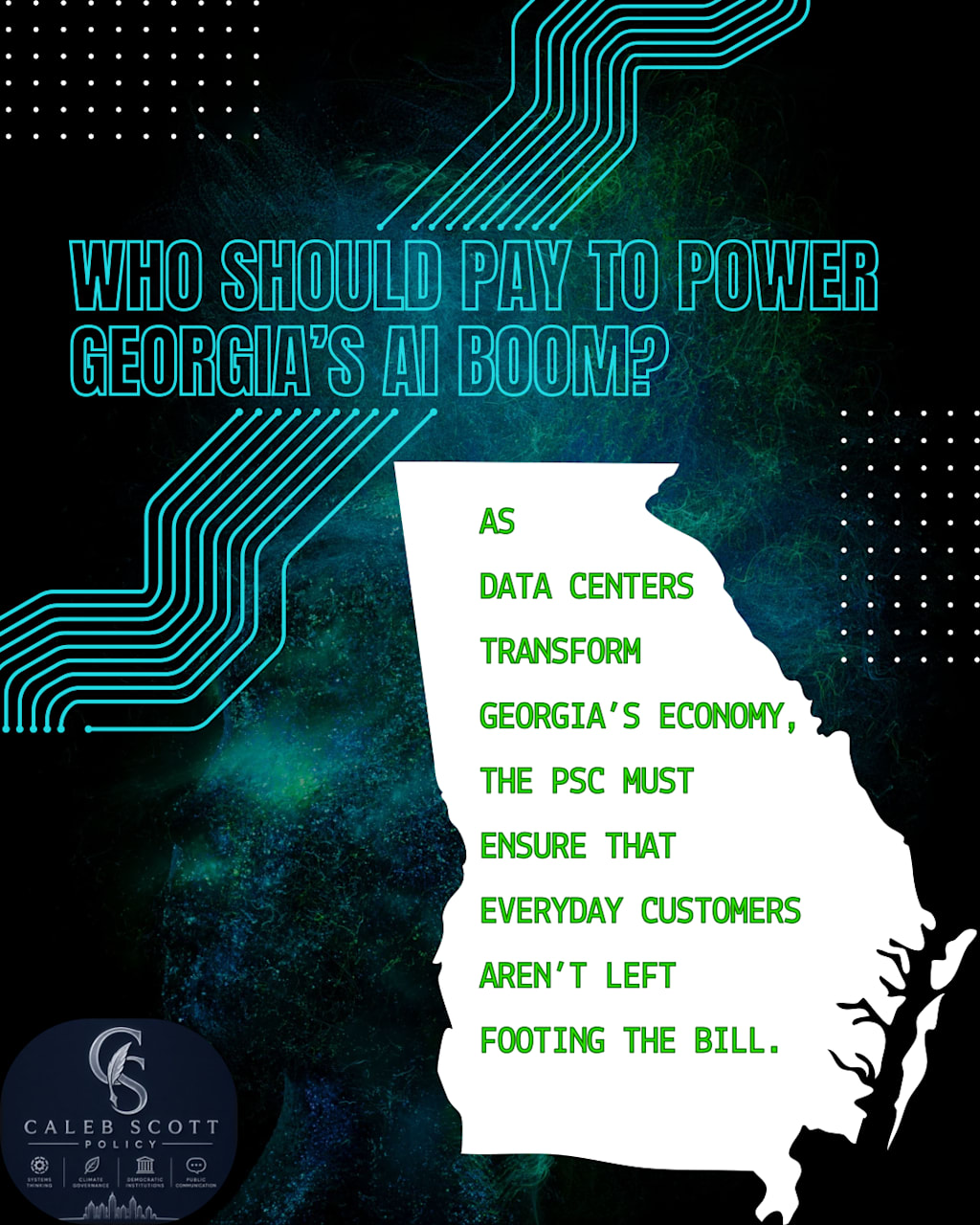
Who Should Pay to Power Georgia's AI Boom?
As data centers transform Georgia's economy, the Public Service Commission must ensure that everyday customers aren't left footing the bill.

Thesis
Georgia should welcome innovation—including AI and data centers—but the costs of powering that growth should be allocated fairly. The PSC's job is not to stop economic development; it's to ensure that growth strengthens the grid without shifting unnecessary costs and risks onto families and small businesses.
I. Opening: The Hidden Question
Artificial intelligence is transforming nearly every sector of our economy—from healthcare to education to manufacturing. But before AI can reshape our future, it must first plug into the electric grid.
The question isn't whether Georgia should embrace AI. The question is who pays for the infrastructure required to power it.
II. Why the PSC Matters
Many Georgians barely know the PSC exists. They simply know their bills are too high and Georgia Power sends the bill. But it is more nuanced than that. Every time the PSC approves new power plants, transmission investments, or other major Georgia Power expenditures, it is also deciding how much of those costs customers may ultimately pay. Those decisions shape household budgets across the state.
The PSC also reviews major infrastructure investments made by Georgia Power. One of the most visible examples was Plant Vogtle. The project ultimately cost far more than originally projected, prompting years of debate over how much of those costs should be recovered from customers. Decisions like these illustrate why the commission’s work matters to households across Georgia.
The commission also shapes how high or low electricity rates are set. This is the most vivid part of what the PSC does that ratepayers can see because it ultimately is reflected in their bills. That is why the people serving on the commission play such an important role in how rates are calculated, and what types of energy are approved in the Georgia Power long-term plans.
The PSC's authority may not extend to every electric provider in Georgia, but its decisions affecting Georgia Power influence millions of customers and shape the state's broader energy future.
That is why citizens can play a huge role in how the commission makes decisions for Georgia Power through voting, and public comment. Decisions made in PSC hearings today could affect electric bills for years.
III. Georgia's Opportunity
Georgia has long attracted investment because of its business climate, transportation network, skilled workforce, and growing technology sector. Those strengths have helped make the state a destination for companies looking to expand. Georgia has earned the title The #1 State to Do Business for years on end for good reason. Georgia’s growth has been driven by a business climate that pairs economic development with long-term investment in infrastructure and opportunity.
This is shown most vividly in one of Georgia’s prominent emerging industries, artificial intelligence. The growth of cloud computing and artificial intelligence has increased demand for high-capacity digital infrastructure, contributing to the expansion of data centers across Georgia.
The growth of cloud computing, artificial intelligence, and advanced manufacturing has also expanded demand for skilled workers across Georgia. Universities, technical colleges, and private employers are investing in the workforce needed to support these industries. This has created an explosion in economic development that has added to the Georgia economy with a slew of new jobs.
Growth isn’t the problem. The challenge is ensuring that the costs of growth are allocated fairly. Companies building new data centers should bear the costs associated with the infrastructure they require—not everyday consumers already facing rising expenses.
IV. The Risk
Data centers require enormous amounts of electricity so meeting that demand may require additional power generation, transmission upgrades, and long-term infrastructure investments. The key policy question is how those costs are allocated.
That debate is no longer hypothetical. The proposed OpenAI data center project in Effingham County shows why Public Service Commission oversight matters right now. OpenAI says the project would require 3.2 gigawatts of power from Georgia Power, delivered in phases over the coming years. Georgia Power has said the agreement includes demand response commitments during periods of high demand. Those details matter, but they don’t remove the need for public scrutiny. The PSC must ensure that large load contracts are transparent, enforceable, and structured so the companies creating the demand pay for the infrastructure they require, not families, seniors, renters, or small businesses already carrying higher costs.
That raises a fundamental question: If these investments primarily serve large commercial users, should residential customers be forced to bear those costs?
V. Fairness
Families are already struggling with higher utility bills. Rising housing costs, groceries, insurance, transportation, and healthcare have stretched household budgets across Georgia. Higher electricity costs add to those pressures. The affordability crisis continues to affect families through rising food, housing, car loan, credit card, student loan, and power costs.
These rising costs hit especially hard for seniors on fixed incomes, renters already spending a large share of their income on housing, and small businesses operating on tight margins.
Economic development succeeds when its benefits and costs are shared fairly. That balance is exactly what the Public Service Commission is meant to protect.
VI. Planning for the Future
Achieving that balance requires thoughtful planning. Georgia should continue welcoming investment while ensuring infrastructure costs are transparent, responsibly financed, and designed to protect both grid reliability and affordability. Good infrastructure policy isn’t anti-growth—it plans for growth before it arrives.
VII. Conclusion
Georgia has an opportunity to lead the nation in artificial intelligence, advanced computing, and the infrastructure that supports them. But leadership is measured by more than the number of companies we attract. It is measured by whether economic growth strengthens the systems every Georgian depends on.
The question before the Public Service Commission is not whether Georgia should embrace innovation. It should.
The question is whether Georgia can embrace that future while ensuring that the costs are shared fairly, the electric grid remains reliable, and everyday customers are not left carrying burdens that belong elsewhere.
That is what good governance looks like.
About the Creator
Caleb Scott
Policy writer and digital strategist writing about power before it calcifies, institutions before they fail, and the choices that decide whether democracy delivers. Climate, GA politics, legitimacy, and the gap between promise and capacity.
Enjoyed the story? Support the Creator.
Subscribe for free to receive all their stories in your feed.
Comments
There are no comments for this story
Be the first to respond and start the conversation.