
Whispers of the Wildflower Valley
Where every leaf tells a secret and rivers remember the sky

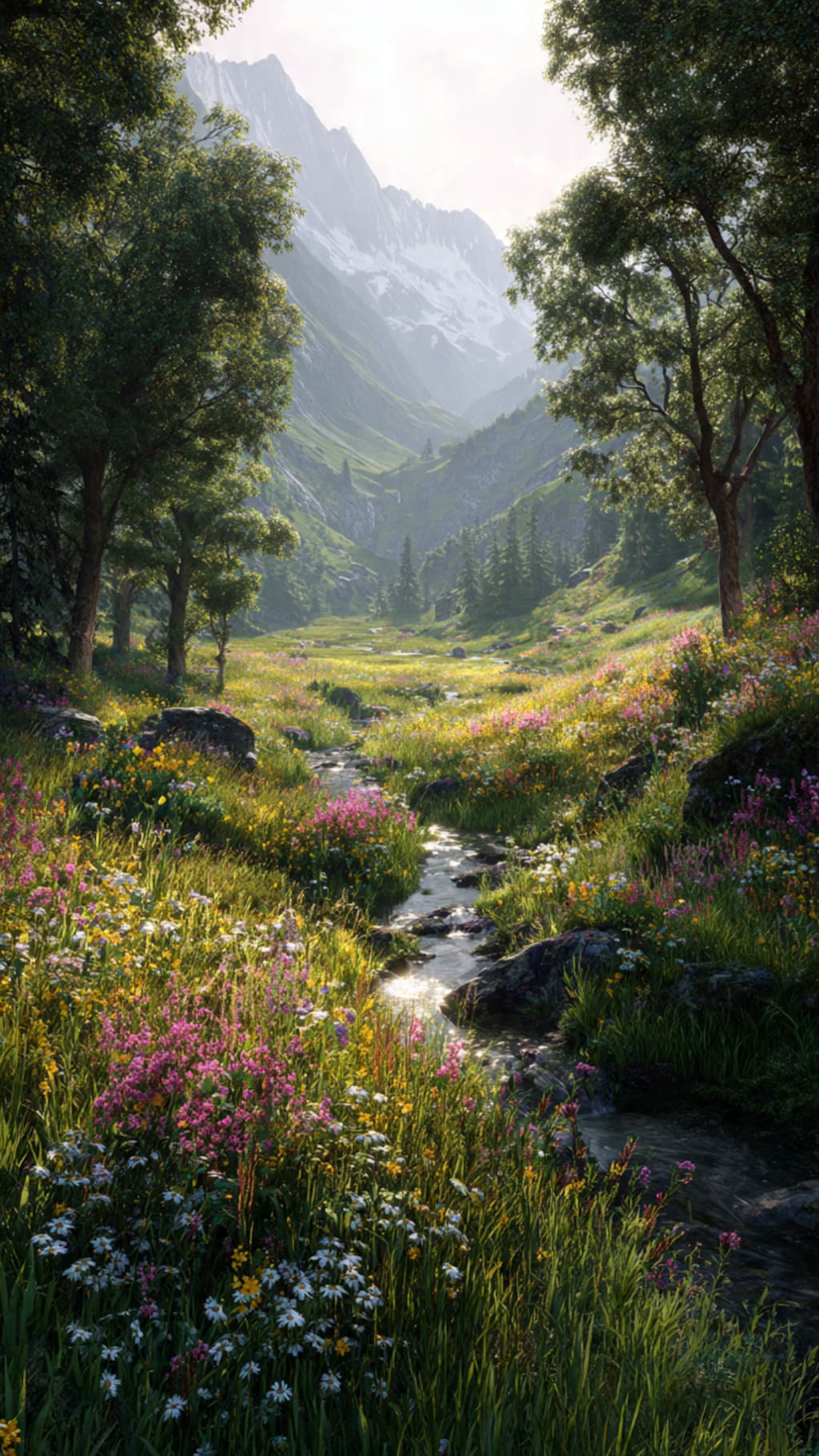
Mira had walked past the old stone bridge every summer of her childhood, but she never crossed it. The villagers called the meadow on the other side “the Wildflower Valley,” and they said it only showed itself to those who were listening. She was fifteen when she finally stopped being afraid of listening. The bridge was made of river stones worn smooth by time and water. Below it, the river didn’t rush. It moved like it was thinking. Mira crouched and pressed her palm to the surface. The water was colder than she expected, and for a second she thought she heard her own name in the current. Not spoken. Remembered. She crossed. The valley opened like a held breath. Wildflowers stretched to the horizon in every color she didn’t have names for. There were blues that belonged to deep water, yellows that held sunlight, and purples so quiet they felt like dusk. Bees moved lazily between them, drunk on pollen. The air smelled like honey and rain that hadn’t fallen yet. An old woman sat on a fallen log near a circle of white stones. Her hair was the color of river mist and she was weaving something from grass and thread-thin twine. She didn’t look up when Mira approached. “You heard it, then,” the woman said. “Heard what?” Mira asked. “The valley.” The woman lifted her weaving. It was a map, but not of roads. It was made of leaves stitched together, each vein dark and deliberate. “Every leaf tells a secret. You just have to be quiet enough to let it.” Mira sat on the grass. The silence here was different. In town, silence was empty. Here, it was full. She could hear the roots drinking, the flowers turning toward the light, the river speaking to the stones. The woman handed her a maple leaf. It was red at the edges and gold at the center, though it was only June. “This one remembers a winter that lasted too long. The tree that grew it thought the sun had forgotten it. But the river kept whispering that spring would come. Rivers remember the sky even when the ground can’t.” Mira turned the leaf over. She didn’t know how, but she could feel it: the slow ache of waiting, the patience of branches, the relief when green finally returned. It wasn’t magic. It was attention. The valley had been paying attention for a thousand years, and now it was letting her listen too. Days passed without Mira noticing. She learned to read the leaves. The narrow ones told stories of wind. The broad ones remembered shade and the children who hid under them. The fern fronds carried the memory of rain, drop by drop. At night she slept by the river and dreamed in colors that didn’t exist in town. The river hummed against the stones, and she understood it was humming the sky back to itself, note by note. On the seventh day, the woman gave Mira a choice. “You can stay. Learn all the secrets. Become part of the listening. Or you can take one leaf back with you. Just one. It will remind your town what it’s like to be remembered.” Mira thought of her grandmother’s garden behind their small house, where the soil was tired and the flowers bloomed small. She thought of how quickly people walked past the river without touching it. She picked a leaf from a wild rose. It was small, with five points, and along one edge a caterpillar had taken a bite that made it look like a crescent moon. “I’ll go back,” she said. “But I’ll come back to listen.” The woman smiled. “That’s the only way it works. The valley doesn’t belong to anyone. It belongs to the remembering.” Mira crossed the stone bridge again. The town looked the same, but she didn’t. She planted the rose leaf at the edge of her grandmother’s garden and watered it every evening. It never grew into a tree. That wasn’t the point. On windy days it would tremble, and if you were quiet, you could hear it whisper. Not words. A feeling. Of patience. Of water moving over stone. Of a sky that the river had memorized and was still trying to teach the earth. Years later, when Mira was the one with mist-colored hair, children would come to her garden. They’d press their ears to the soil and ask what the leaf was saying. She’d tell them the truth: that nature doesn’t shout. It waits. That beauty isn’t just what you see, but what you’re willing to hear. That every leaf, every river, every blade of grass is keeping a story, and the world gets kinder when someone stops to listen. And on summer evenings, when the light turned gold and the air smelled like rain that hadn’t fallen yet, Mira would walk back to the old stone bridge. She’d crouch, press her palm to the water, and let the river remind her of the sky. Then she’d cross over, because the Wildflower Valley was always there for those who remembered how to listen. The seasons turned. Drought came once and the river shrank to a thread, but it never forgot the sky. Mira taught the children to cup their hands in the shallow water and feel the memory of rain. When frost came early, she showed them how the bare branches still held the shape of leaves, like a promise. One spring, a boy who never spoke brought her a stone from the riverbed. It was smooth and gray, with a white vein running through it like lightning. He placed it in her palm and looked at her, waiting. Mira closed her eyes. The stone remembered pressure, centuries of it, the weight of mountains becoming sand. It remembered being held by water. It remembered being found. She tied the stone to a string and gave it back to him. He wore it every day after that. He started speaking again, but only in whispers, as if he’d learned that quiet things carry farther. The Wildflower Valley never changed, and yet it was always new. Each time Mira crossed the bridge, the flowers had rearranged themselves. New secrets in old leaves. New light on old water. The valley asked nothing of her except attention, and gave her everything in return: the understanding that beauty is not a thing you take, but a conversation you join. On her last evening, Mira sat on the fallen log where the old woman had once woven leaves. The woman was gone now, but the weaving remained, tucked under a stone. Mira added one more leaf to it: a thin, silver birch leaf that had floated down that morning. It told the secret of letting go. She pressed her palm to the river one last time. The water was cold, and it remembered her name. It remembered all the names of everyone who had ever listened. Then she stood, and walked home through the meadow, the wildflowers brushing her knees, the sky reflected in every petal, every drop, every quiet, listening heart.
About the Creator
Enjoyed the story? Support the Creator.
Subscribe for free to receive all their stories in your feed.
Comments
There are no comments for this story
Be the first to respond and start the conversation.