
While some parts of Earth are becoming darker at night, the planet is becoming brighter overall.
The lights at night are constantly changing.

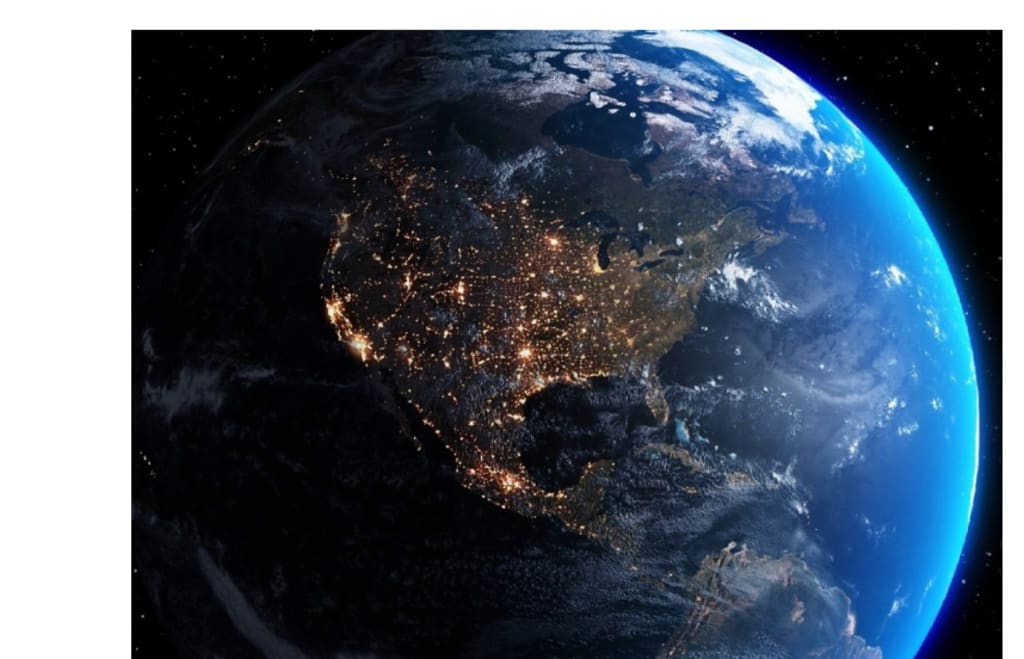
Have you ever observed how a city appears to be breathing at night? Imagine that vista from space now. The Earth doesn't just glow silently; it pulses, flickers, and changes to show how people live, construct, suffer, and develop.
The lights at night are constantly changing.
Researchers looking at NASA and NOAA satellite photos made an unexpected discovery. Yes, the amount of nighttime light on Earth is growing, but not steadily or smoothly. The world doesn't only get brighter every year. Rather, light appears, vanishes, spreads, and fades simultaneously.
Every year, certain locations become brighter, while others go dimmer. In actuality, places that underwent transformation did not remain steady. Numerous sites changed repeatedly, almost like an unsettling beat. This exposes a startling reality: the Earth's nightside is never peaceful but rather restless.
Growing cities and bright lights
The shift is noticeable in areas where cities are growing quickly. As new buildings are constructed, roads expand, and more people have access to power, nations like China and India become increasingly illuminated every year.
In this way, light turns into a signal. It displays places where people congregate, where economies flourish, and where life is hectic. Development is frequently taking place in a brilliant area.
Sometimes the transformation occurs abruptly, as a new business, a highway, or even a small community receiving electricity can swiftly transform gloom into brightness. A location that seems dark at one point could suddenly gleam brightly from space.
Darkness for various causes
While some fading areas undoubtedly do, not all of them do. Cities in several regions of Europe, particularly France, decide to turn out the lights after midnight. This lessens light pollution and conserves energy.
However, darkness comes for more difficult causes in other areas. Lights may dim due to financial difficulties, power outages, or malfunctioning systems. One such instance is Venezuela, where deteriorating infrastructure decreased nighttime brightness.
Therefore, darkness might have two very distinct meanings. It may demonstrate meticulous planning or highlight more serious issues. Certain changes are abrupt and dramatic; for example, storms can leave cities black overnight and conflicts can darken entire regions, producing distinct signals that satellites pick up right away.
Following the Russian invasion, Ukraine's light levels drastically decreased. There was a noticeable difference. Nighttime data is powerful since it can see change very instantaneously. It transforms light into proof of actual occurrences.
Real changes are revealed by daily data
Long time periods were examined in earlier research, which obscured numerous minute features. Scientists now use satellite photos on a daily basis. According to Christopher Kyba, a co-author from Ruhr University Bochum, "no global analysis had been conducted using the full resolution nighttime data until now."
Even brief incidents can be seen with daily data. Cities all over the world dimmed as activity paused during COVID-19 lockdowns. The streets emptied, factories stopped, and the silence was mirrored in the night.
The rhythm has a heartbeat-like quality. Brightness increases, decreases, and then increases once more. In real time, the world reacts to human activity.
A world of mobility rather than stability
The most important finding of this study is straightforward but surprising. The light at night is unstable. It is always changing, sometimes gradually and other times abruptly. There are many locations that don't have a single direction. Growth and decline coexist. Disruption meets progress.
The Earth's night map comes to life as a result. It responds, adjusts, and evolves with each significant choice and occurrence.
Why this is more important than it appears
At night, light is more than just visibility. It has an impact on the environment, energy use, and even ecosystem health. "Light pollution damages ecosystems, and artificial light consumes a significant amount of electricity at night," Kyba stated.
Leaders and scientists can make better decisions by being aware of these trends. It protects natural systems, enhances energy planning, and directs policy. A planned mission by the European Space Agency is one of the new initiatives aimed at further examining these changes. One thing becomes evident as this inquiry proceeds. At night, the Earth is a dynamic, ever-changing record of human activity.
About the Creator
Enjoyed the story? Support the Creator.
Subscribe for free to receive all their stories in your feed.
Comments
There are no comments for this story
Be the first to respond and start the conversation.