
When Competitors Join Forces: The Real Fight to Save Social Startups
How Eight Impact-First Investors Chose Collaboration Over Competition to Solve the “Valley of Death”

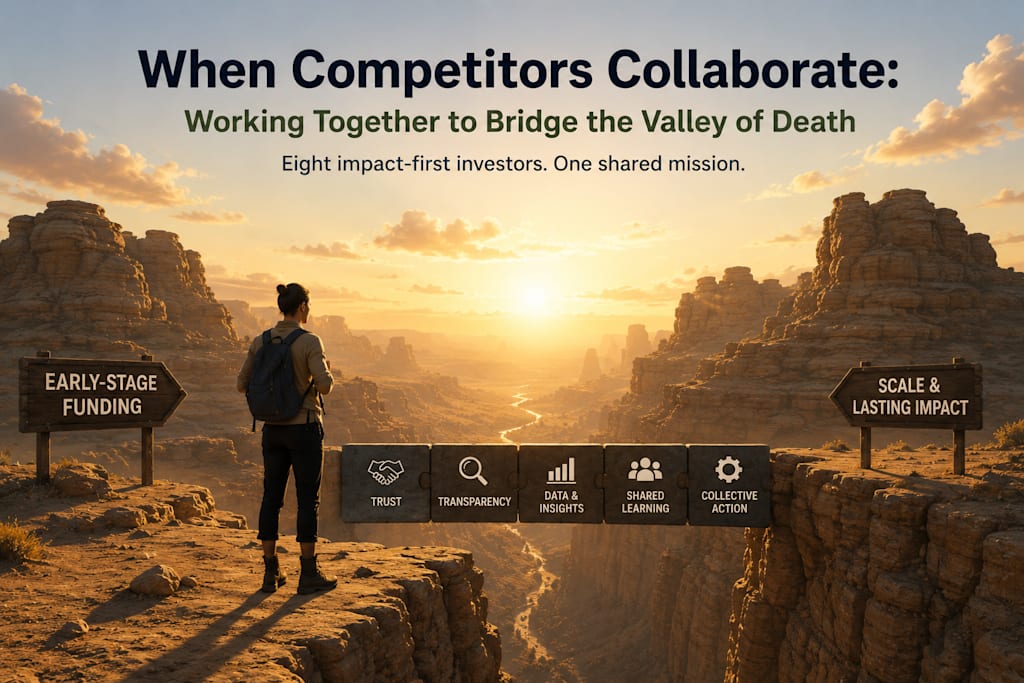
In the world of social entrepreneurship, great ideas are everywhere. Passionate founders are building solutions for poverty, education, healthcare, climate change, and financial inclusion. Yet many of these promising ventures never reach their full potential.
Not because the ideas are weak.
Not because the founders lack commitment.
But because the funding system often fails them at the exact moment they need support the most.
This difficult stage is widely known as the “Valley of Death.”
It refers to the dangerous gap between early startup funding and the larger-scale investment needed for growth. Many social enterprises survive their first few years, prove their impact, and even build strong communities around their work only to hit a wall when trying to expand.
Traditional investors usually want faster profits and lower risks. Social enterprises, however, often require patience, flexibility, and hands-on support. As a result, countless impactful ventures remain trapped between potential and scale.
For years, experts in development finance have discussed this problem. But talking about it and truly understanding it are two different things.
That is why something unusual happened recently.
Eight organizations Acumen, Global Partnerships, Halcyon, Kiva, MCE Social Capital, Miller Center for Global Impact, Open Road Impact, and Village Capital decided to work together on a collaborative study to better understand why the Valley of Death continues to exist.
What made this remarkable was the fact that these organizations are not simply colleagues.
In many ways, they are competitors.
They often compete for donor funding. Sometimes they support similar entrepreneurs. Each organization operates under pressure to show measurable results, financial discipline, and impact efficiency.
Yet instead of protecting their own systems and data, they chose transparency.
And that decision may become one of the most important lessons in the future of impact investing.
Choosing the Difficult Path
Collaboration sounds inspiring in theory, but in practice it can be uncomfortable.
Sharing operational strategies, financial structures, and internal costs with peer organizations requires trust especially when everyone is working in a competitive environment.
Still, the participating groups believed the challenge was bigger than any single institution.
They realized that if social enterprises were struggling to survive, then perhaps the organizations trying to support them were facing structural problems too.
Rather than working in isolation, the group agreed to openly examine the economics behind impact-first investing.
Their goal was simple:
Understand the true cost of helping social enterprises grow.
To make this possible, the organizations shared internal fund data under strict agreements. Information would remain anonymous, and no single organization would be publicly ranked or compared.
This created a safe environment where honest conversations could happen.
And those conversations led to powerful discoveries.
What the Research Revealed
The study was eventually titled “The True Cost of Impact-First Investing.”
The name reflected a growing realization that the financial systems designed for mainstream investing do not always fit the realities of social impact work.
One of the biggest myths the study challenged was the idea that impact-first investors are somehow less disciplined or less efficient than commercial investors.
The data told a different story.
When measured by the cost per investment, impact-first funds performed just as efficiently and sometimes even better than mainstream commercial funds.
That finding surprised many people in the industry.
It proved that impact-driven organizations can operate with serious financial rigor while still prioritizing social outcomes.
However, another metric revealed a major difference.
The cost per dollar deployed by impact-first funds was significantly higher often two to three times more than traditional commercial funds.
At first glance, critics might see that as inefficiency.
But the reality is more complex.
Impact-first investors usually make smaller investments and spend far more time supporting entrepreneurs directly. They provide mentorship, strategic guidance, relationship-building, and long-term partnership.
Commercial investors often deploy larger amounts of money into fewer deals, allowing them to spread operational costs more easily.
In contrast, impact-first investing is deeply hands-on.
That additional cost is not waste.
It is the actual price of helping vulnerable but promising businesses survive the Valley of Death.
Why Philanthropic Support Matters
One of the most important conclusions from the study is that philanthropic capital plays a critical role in strengthening impact-first investing.
When donors support these funds, they are not simply financing one organization.
They are helping entire ecosystems grow.
A single well-supported impact fund can guide dozens of social enterprises toward long-term sustainability. Those enterprises can then create jobs, improve communities, and solve problems at scale.
In many ways, supporting impact-first investors becomes a multiplier effect.
Instead of offering one-time aid, it helps build lasting economic resilience.
This shift in thinking could reshape how philanthropy works in the future.
Rather than focusing only on direct charitable giving, funders may increasingly recognize the value of supporting the infrastructure behind social innovation.
A New Era of Collaboration
Perhaps the most inspiring outcome of this initiative is not the data itself, but the spirit behind it.
Eight organizations with decades of combined experience chose cooperation over competition.
They demonstrated that meaningful change often begins when institutions stop guarding information and start building trust.
The collaboration also showed that transparency does not weaken organizations.
It strengthens them.
By learning together, these groups gained a clearer understanding of the challenges they all face — and discovered opportunities to improve the system collectively.
Now, the coalition is expanding.
More partners and funds are joining the effort, with hopes of creating a long-term, practitioner-led research network focused on improving impact investing worldwide.
The movement is still growing, but its message is already clear:
No single organization can solve the Valley of Death alone.
But together, they might finally build a bridge across it.
About the Creator
Farooq Hashmi
Thanks For Reading! Subscribe To My Newsletters.
Storyteller, Love/Romance, Dark, Surrealism, Psychological, Nature, Mythical, Whimsical
Love You All❤️❤️❤️
Enjoyed the story? Support the Creator.
Subscribe for free to receive all their stories in your feed.
Comments
There are no comments for this story
Be the first to respond and start the conversation.