
What Would Happen to You Inside the Black Hole
Black Hole
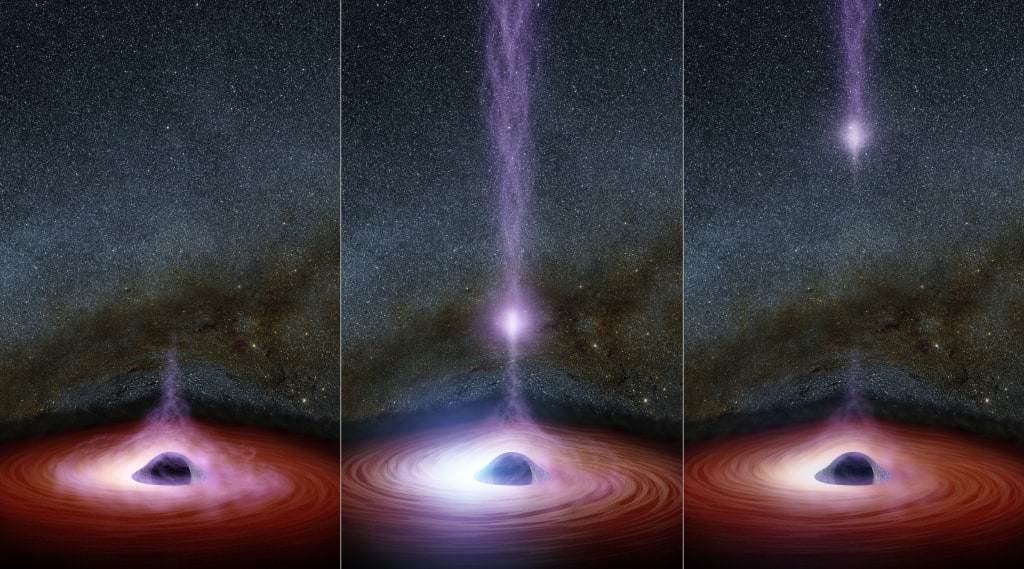
Embarking on a journey to a black hole requires extensive provisions, given the immense distances involved. The nearest black hole in the HR 6819 solar system is approximately 10^11 (100 billion) light years away. This black hole is part of a system of two other stars that can be observed with the naked eye. Scientists have studied this system since the 1980s, but recent revelations have shed new light on its secrets. Despite being considered relatively small, this black hole's mass is four times greater than our Sun's, and it is 2,500 light years closer to Earth than the next nearest black hole.
However, traveling a distance of 10^11 light years is currently beyond humanity's reach. To put this into perspective, if we were to create a model where the distance from Earth to the Sun is only 0.05 inches, you would need to travel approximately four miles to reach this black hole. While our Milky Way galaxy spans around 100,000 light years in diameter, the distance of 10^11 light years may not seem as vast.
Before embarking on such an extraordinary journey, it's essential to understand the nature of black holes. Black holes represent regions in spacetime where nothing can escape their gravitational pull, not even particles, electromagnetic radiation, or photons of light. Traveling to a black hole is a one-way ticket, as nothing can exit its orbit.
The birth of a black hole is a remarkable process. When a massive star exhausts its nuclear fuel, it undergoes gravitational collapse, resulting in a concentration of mass compressed into a tiny volume—a black hole. This transformation can be observed in supermassive black holes like the one in the Messier 87 Galaxy, which has a mass seven billion times greater than our Sun. This supermassive black hole was famously captured in an image by The Event Horizon Telescope in April 2019.
Assuming you have acquired a faster-than-light spaceship ticket, there is no possibility of refunds, and the journey is imminent. As you leave Earth's orbit and bid farewell to the Moon, it's worth acknowledging Pluto, which is significant enough to be considered a planet by some. You proceed through the dark expanse of space until you reach your destination—the black hole.
As you approach the black hole, you encounter the Event Horizon—the point of no return. The black hole's gravitational field is so intense that it bends light around its edges, creating an optical illusion resembling a croissant for the observer. Beyond the Event Horizon, escape is impossible, and you may notice peculiar movements and lights due to the mirror effect caused by the warped spacetime.
Inside the black hole's vicinity, you decide to send in a drone as a scout. The drone quickly succumbs to the black hole's gravitational forces. As it enters the Event Horizon, its shape distorts, resembling a strand of spaghetti, and its movement appears to slow. This time dilation effect results from the black hole's immense gravitational field, which curves space and time.
Simultaneously, the drone's motion is mirrored, appearing to approach the black hole's center more slowly. This phenomenon illustrates the profound gravitational time dilation within the black hole's vicinity. While these events transpire in milliseconds, they unfold slower due to the time-warping effects.
The drone's flashlight emits a red glow due to gravitational redshift, another consequence of the black hole's gravitational field. As it approaches the black hole's center, the redshift intensifies. The closer you observe the drone's journey, the redder it appears.
Upon reaching the center of the black hole, the drone's mission is complete, and it transmits its final data before being lost to the singularity. At this point, you witness the extreme darkness of the black hole's interior—a place where the laws of physics as we know them cease to apply. Time appears to move agonizingly slowly, and the absence of light is pervasive.
In this enigmatic realm, the concept of time itself becomes distorted. While you may perceive mere seconds passing, time outside the black hole progresses vastly. Your stay within the black hole is determined solely by the duration of your oxygen supply, and you become an unwitting witness to the cosmos's gradual transformation.
As you contemplate the mysteries of the black hole, you entertain the possibility that it might be a wormhole, a hypothetical passage connecting distant regions of the universe. However, the existence of such wormholes remains unconfirmed and speculative. They remain the stuff of science fiction, awaiting scientific verification.
Moreover, white holes, theoretical counterparts to black holes, remain speculative. While black holes are renowned for their gravitational capture of matter and light, white spots are hypothesized to expel matter and energy reversely. These hypothetical entities remain unobserved and are the subject of ongoing scientific investigation.
Black holes are among the most intriguing and enigmatic phenomena in the vast cosmic tapestry. These celestial objects are formed from the remnants of massive stars that have exhausted their nuclear fuel and undergone gravitational collapse. The outcome is a concentration of mass compressed into a minimal volume, resulting in a gravitational field so intense that nothing, not even light itself, can escape its grasp.
One of the most remarkable aspects of black holes is their ability to merge. This event, known as a black hole merger, is a profoundly energetic and powerful occurrence in the cosmos. When two black holes approach one another, their intense gravitational attraction causes them to enter a spiral orbit. As they draw closer, they emit gravitational waves—ripples in spacetime—providing valuable insights into their behavior.
Ultimately, these two black holes either merge into a single, more massive black hole or, in the case of a particularly enormous collision, give rise to a black hole with a significantly increased mass. These mergers release an astonishing amount of energy, often in the form of gravitational waves, which can be detected and studied by scientists.
Black hole mergers represent some of the most energetic events in the universe, and their study offers a unique window into the nature of gravity and spacetime itself. These cosmic phenomena continue to captivate astronomers and astrophysicists, shedding light on the enigmatic properties of black holes and the dynamic nature of our cosmos.
The universe is a vast and intricate expanse, teeming with many celestial phenomena and objects. Among these, neutron stars are particularly fascinating. Neutron stars are incredibly dense, with a mass similar to our Sun but compressed into a space 12 miles in diameter.
When two neutron stars approach one another in space, they initiate a captivating cosmic dance. Their orbits gradually spiral closer together as they draw nearer due to their gravitational attraction. Depending on their combined mass, one of two outcomes may occur. If the total group remains below a critical threshold, the two neutron stars may merge to form a single, more massive neutron star. However, if their combined mass surpasses this crucial point, an awe-inspiring event unfolds.
In the latter scenario, the two neutron stars collide, creating one of the universe's most mysterious and energetic phenomena—a short gamma-ray burst. These bursts are among the brightest and most powerful electromagnetic events known to science, emitting intense flares of high-energy gamma-ray radiation in milliseconds.
This spectacular display of energy results from the extreme compression and heating of matter as the two neutron stars merge. While the exact outcome can vary, it may lead to the formation of a black hole, an entity characterized by an incomprehensibly gravitational solid pull that engulfs everything in its vicinity, even light itself.
These neutron star mergers and their subsequent transformations into black holes offer a tantalizing glimpse into the dynamic and evolving nature of the universe. They represent some of the most energetic and enigmatic events in the cosmos, challenging our understanding of the fundamental forces that govern the cosmos.
While black holes are typically associated with devouring nearby objects, a fascinating theory suggests they could serve as portals or wormholes to other regions of the universe. This theory posits that black holes may not merely consume matter and energy but could offer a passage to distant cosmic destinations.
However, it's important to note that this theory remains speculative and unverified. While the mathematical equations governing black holes allow for the possibility of wormholes, there is currently no empirical evidence to support their existence. Wormholes are a popular concept in science fiction, often portrayed as shortcuts through spacetime, enabling rapid travel between distant regions of the universe.
In this theoretical scenario, entering a black hole might lead to an extraordinary journey through a tunnel-like structure that connects two separate points in space and time. According to some interpretations, the destination on the other side of the wormhole could be another location within our universe or even an entirely different universe.
However, the notion of traversable wormholes, allowing matter and information to pass through them safely, remains a topic of intense scientific investigation and debate. Theoretical challenges, such as the stability and existence of stable wormholes, continue to puzzle physicists and cosmologists.
Another intriguing theory related to black holes suggests that they may serve as gateways to parallel universes or alternate dimensions. This idea posits that black holes are cosmic vacuum cleaners and portals to realms beyond our comprehension.
According to this theory, each black hole may connect to a different universe, potentially populated by alternate versions of ourselves and the entire cosmos. In this speculative scenario, the choices we make in our galaxy might lead to alternate outcomes in other parallel universes.
However, it's essential to emphasize that these concepts remain firmly within theoretical physics and cosmology. While they inspire the imagination and captivate the human spirit, the existence and nature of wormholes and parallel universes remain subjects of ongoing scientific exploration and investigation.
As we unravel the mysteries of the universe, humanity's understanding of black holes and their potential roles as gateways to other realms may evolve. The cosmos is a vast and enigmatic frontier, offering endless opportunities for discovery and exploration in theoretical physics and our collective imagination.
Collisions in the cosmos are rare and extraordinary events, occurring approximately once every ten thousand years. These cosmic spectacles are captivating and awe-inspiring, but their beauty is best appreciated from a safe distance, as they can have profound and far-reaching consequences.
If a star were to collide with our Sun, it would unleash a cataclysmic event of global proportions, leaving no chance for the survival of any life forms. While the odds of such an event are exceedingly remote, the consequences would be catastrophic. Such a collision would likely involve a rogue star—one not gravitationally bound to any galaxy—and would have devastating consequences for our solar system.
One such example of a wandering star is Scholz's star, a binary system consisting of a red dwarf and a brown dwarf. Approximately 70,000 years ago, Scholz's star passed through the outskirts of our solar system, specifically the Oort Cloud—a protective shield of comets and cosmic bodies surrounding our solar system. Early humans may have witnessed the faint glow of Scholz's star in the night sky during its passage.
While Scholz's star remained at a distance of about 0.8 light-years during its flyby, its gravitational influence significantly impacted the motion of various cosmic bodies within our solar system. This close encounter likely increased the incoming meteorites and comets rate, which could have affected Earth's environment.
However, the most significant celestial collision that looms in our future is the eventual merger of our Milky Way galaxy with the Andromeda galaxy. Despite Andromeda's current distance of 2.5 million light-years from Earth, it is on a collision course with our universe. Over approximately 3 billion years, Andromeda will approach our Milky Way, and the two galaxies will engage in a complex dance.
As they draw near, the galaxies will interact gravitationally, circling around each other in a cosmic tango. This dance will lead to multiple close encounters, with the galaxies passing by one another at close range before eventually merging into a single, colossal universe. This eventual merger has been dubbed "Milkomeda" or "Milkdromeda."
The consequences of this galactic collision are of great interest to astronomers and astrophysicists. There are several potential scenarios for what might happen to our solar system during this event. In one possibility, our solar system could remain relatively undisturbed, with the stars continuing their orbits as the galaxies merge.
However, there is also the possibility that our solar system might be ejected from the merged galaxy or find itself in a more chaotic environment due to interactions with other stars and celestial objects. The fate of our planet and its inhabitants would depend on the specifics of these interactions.
Regardless of the outcome, the collision of the Milky Way and Andromeda galaxies reminds us of the dynamic and ever-changing nature of the cosmos. It is a testament to the vast scales of time and space that govern the evolution of galaxies, and it offers a glimpse into the future of our galactic neighborhood billions of years from now.
In summary, cosmic collisions are extraordinary events that occur infrequently but can have profound consequences. While we are unlikely to witness such events directly, their study provides valuable insights into the dynamics of our universe and the forces that shape its evolution. As we explore the cosmos, we gain a deeper understanding of the vast and interconnected nature, from the smallest particles to the most giant galaxies.
About the Creator
Enjoyed the story? Support the Creator.
Subscribe for free to receive all their stories in your feed.
Comments
There are no comments for this story
Be the first to respond and start the conversation.