
what might be the cause of climate change
scientists believe that a blackhole might be the cause of climate change
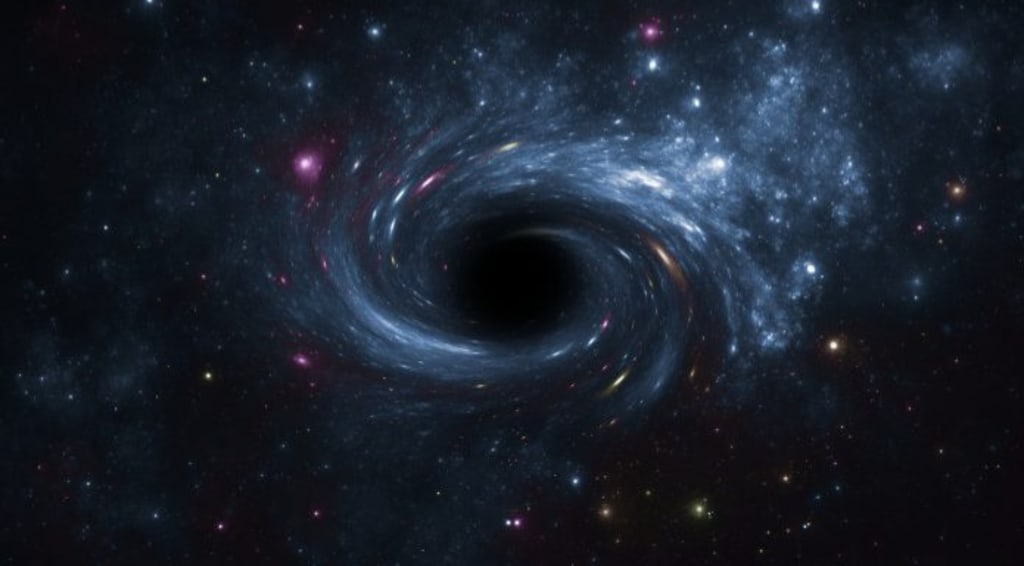
NASA scientists discovered a big, unknown object beyond our solar system in May 2016. The thing is practically imperceptible because it is so dark. There is a hidden star killer out there in space. Under the radar. And this planet Destroyer could be on its way to us. However, the readings that have been returned point to one scary conclusion. It's a black hole, but it's unlike any other we've seen.
Super strong and terrifying. Black holes are massive, dense masses of matter that cause spacetime to bend. They are usually more easily detected. Gravity is extremely strong, so strong that not even light can escape. Whatever goes into this thing is gone for good. When other objects come close to black holes, they are broken apart and form a disk around the black hole called an accretion disk, which allows us to view them. And this produces a strong x-ray signature, which usually indicates the presence of a blackhole. Black holes are far more powerful than anything mankind can comprehend. Worryingly, this one, barely visible, is sitting in our own galaxy, steadily devouring the nearby solar system. Finding this black hole that's so stealthy was kind of a fluke.
Worryingly, many more undiscovered black holes may be closer to Earth than previously imagined. Worse, black holes can move at incredible speeds, ripping through space at a mind-boggling 5 million miles per hour. It's likely that a black hole is approaching us in space right now. And you won't notice it until it begins to effect you gravitationally. There will be minimal warning if and when we are attacked by a black hole. Astronomers estimate that we will not detect its presence beyond our solar system until it is only 800 days away.
Our first warning could arrive in the Oort Cloud. The Oort Cloud is a region of space on the periphery of our solar system. It's like a galactic minefield full of frozen comets, several of which are massive enough to kill a planet. Any bodies in the Oort cloud that were not directly consumed by the black hole would be thrown in various directions, some of them possibly towards the inner solar system and Earth herself. If the black hole continues in this direction for another two terrible years, Earth and its nearby planets will be assaulted with massive comets. Consider the possibility of a comet shower in the inner solar system. Colliding with Earth and causing massive destruction. Indeed, mass extinctions can occur For that reason.
After passing through the comet fields of the Oort Cloud and Kuiper Belt, the black hole will arrive at the gas giants of the outer solar system. It will feast on Jupiter in just three days and unleash a new terror on humanity. However, it came very close to colliding with Jupiter. It can begin to drag stuff away, emitting hard x rays, hard gamma rays, and other forms of radiation. And that will be re-emitted in jets, sometimes highly intense and collimated jets. It appears to be a Star Wars lightsaber erupting from the black hole. These enormous lightsaber blasts or accretion jets will shoot out from the black hole millions of miles through space. If it slices past us, we'll get incinerated. Even if we avoid the accretion jet three days after the black hole devours Jupiter, it could reach Earth. If it came close to Earth, it might be a terrible disaster. At first, we will feel the effects of the black hole's gravitational pull, similar to how the moon affects us, but far more powerful. We might see massive tides, tidal surges, and tsunamis, practically washing over the continents. As the black hole approaches, its gravitational attraction increases, distorting the planet and forcing its crust to stretch and tear.
There would be earthquakes and volcanoes on a scale never seen before. It will get close enough to our planet to eat it. Eventually, the atmosphere is ripped away completely, and the world is simply dragged apart. It has the potential to consume the entire globe. Just swallow it up and there will be no sign of earth. Any beings who escape this disaster will be sucked into the blackhole at breakneck speed. If you come too close to a black hole, or one gets too close to you, two things can happen, and neither is good. It may either rend you apart or it could suck you in. As you approach the black hole, its gravitational pull will intensify massively , but also extremely locally, causing your head to accelerate towards the hole. Quicker than your feet. You'll get stretched like spaghetti As you're falling in Any human who miraculously survives will find themselves in the weirdest place in the universe beyond anything we are capable of imagining. Mathematicians call it a singularity, where all logic as we know it ceases to exist, where existence itself is redefined.
One of the reasons I think black holes are unusual is that they have this thing called an event horizon, and if you cross it, you're out of luck. You'll never make it out. Then you'll encounter a singularity in the heart of this black hole. And some of us believe that the physical laws themselves have broken down. The roles of space and time are reversed. When you reach the event horizon, what you call time becomes space, and then space becomes time. You would be immortal. Immortal, but confined in another world. Even if a black hole enters our solar system, there is still hope for the planet and civilization. In a battle between the sun and the blackhole there can only be one possible outcome. Eventually the black hole will win and will devour the sun. But in the havoc caused by the destruction of the sun, the earth could escape its gravitational moorings and be flung from the solar system to begin a lonely journey through the galaxy.
Nasa scientists are hoping the newly discovered black hole will pass our solar system, leaving it unscathed. If not our only possible future is living deep underground as our world hurtles through the infinite darkness of space. Perhaps one day to enter another solar system, go into its orbit and become the planet of an alien star.
About the Creator
Enjoyed the story? Support the Creator.
Subscribe for free to receive all their stories in your feed.
Comments
There are no comments for this story
Be the first to respond and start the conversation.