
What if Uranus collided with Earth?
If Uranus suddenly veered towards Earth at 1,000 kilometers per second, we'd only have 30 days to react. Its gravitational pull would cause massive volcanic eruptions and earthquakes. The asteroid belt's disruption would send asteroids crashing into Earth, while Uranus's hydrogen sulfide atmosphere would create a noxious stench. The impact of Uranus and its 27 moons would annihilate Earth, turning it into one of Uranus's moons and potentially altering Uranus's unique axial tilt. This scenario underscores the fragile balance of our solar system.
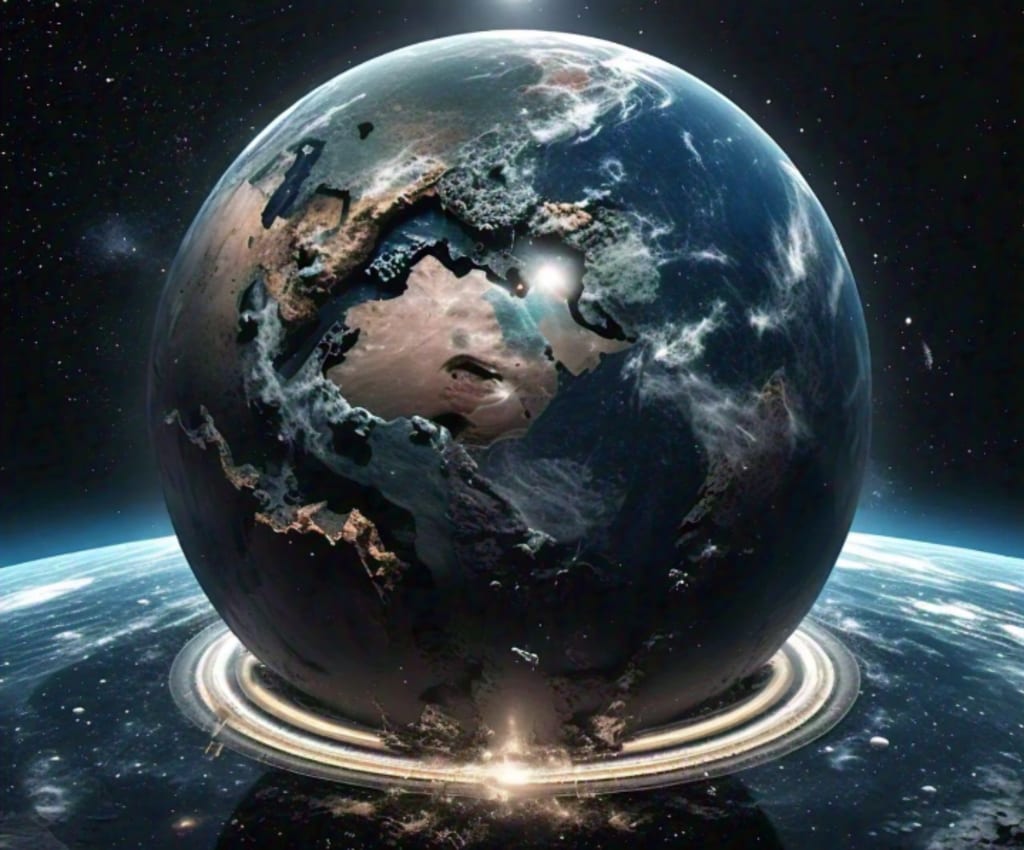
Imagine waking up to a bright new celestial object in the sky. At first, it might appear as though our moon has found itself a stellar partner. But as days pass, the object grows larger and brighter, revealing itself as something much more ominous: Uranus, one of the outer planets of our solar system, is on a collision course with Earth. This scenario might sound like science fiction, but let’s explore what could happen if Uranus, the ice giant, were to collide with our home planet
The sudden Movement of Uranus
Under normal circumstances, Uranus resides peacefully on the outskirts of our solar system, approximately 3 billion kilometers away from Earth. However, in this hypothetical scenario, Uranus inexplicably begins to move closer. Normally, planetary bodies do not suddenly change their orbits without a significant external force. Here, we assume that some cosmic event has dislodged Uranus from its orbit, causing it to hurtle towards Earth at an unimaginable speed of around 1,000 kilometers per second. This unexpected acceleration reduces our time to respond from 13 years to a mere 30 days.
### Astronomers Sound the Alarm
The first to notice Uranus’s erratic movement would be astronomers. Using advanced telescopes and observational technology, they would detect the ice giant’s approach and quickly calculate the dire implications. Panic would ensue as the scientific community realizes the gravity of the situation. Normally, humanity would have a decade or more to devise a plan, but in this scenario, we only have a month. Evacuation efforts would be frenzied, but with such a short timeframe, the chances of a successful global evacuation are slim.
### Disruption of the Asteroid Belt
As Uranus makes its way towards Earth, it must pass through the asteroid belt situated between Mars and Jupiter. This passage would cause significant disruptions in the belt’s stability. Uranus’s immense gravitational field would disturb the orbits of countless asteroids, sending many of them hurtling towards Earth. These asteroids, some as large as 240 kilometers in diameter, could cause catastrophic impacts even before the main collision. Such impacts would dwarf the asteroid that led to the extinction of the dinosaurs 65 million years ago.
### Gravitational Chaos
As the massive ice giant approaches, its gravitational pull would start to wreak havoc on Earth. The gravitational forces exerted by Uranus, which is about 15 times more massive than Earth, would cause unprecedented geological and atmospheric disturbances. Volcanic activity would increase dramatically, with volcanoes erupting uncontrollably across the globe. Simultaneously, tremendous earthquakes would rock the planet, devastating infrastructure and causing widespread destruction. The Earth would begin to tear itself apart even before the actual collision with Uranus.
### A Stench from the Heavens
Adding to the apocalyptic scenario, Uranus’s atmosphere would bring with it a horrific stench. The upper atmosphere of Uranus is rich in hydrogen sulfide, a gas that smells like rotten eggs or farts. As Uranus draws closer, this gas would begin to mix with Earth’s atmosphere, creating an unbearable and noxious odor. The stench would be so potent that even a single whiff could cause people to drop unconscious. The thought of an entire planet engulfed in this foul odor is nauseating.
### The Arrival of Uranus’s Moons
Uranus does not travel alone; it is accompanied by its 27 moons. These moons, ranging in size, would bombard Earth, causing additional destruction from all sides. The impacts from these moons would add to the already catastrophic scenario, leaving little hope for survival.
### The Cataclysmic Collision
Finally, the moment of impact arrives. The collision between Uranus and Earth would be cataclysmic, destroying the Earth’s surface and potentially igniting the atmosphere due to the rapid compression and rising temperatures. The once beautiful blue planet would be shattered, and what remained would likely fall into orbit around Uranus, becoming one of its many moons.
### Uranus’s Tilt
Interestingly, Uranus is known for its unique axial tilt, spinning on its side compared to the other planets in our solar system. This unusual tilt is believed to be the result of a massive collision with another celestial body in the distant past. The impact with Earth could potentially alter Uranus’s tilt once again, perhaps even correcting it to a more typical planetary orientation. However, for Earth, this impact would mean total annihilation.
### A Grim Future
If, by some unexplained mystery, life were to emerge again from the remnants of Earth, the survivors would see Uranus dominating the horizon, a constant reminder of the cataclysmic event. The Earth, now a moon of Uranus, would be a drastically different place, marked by the blue hue of the ice giant in the sky.
This “what if” scenario serves as a dramatic reminder of the fragile balance within our solar system. While such an event is highly improbable, it underscores the potential for catastrophic change and the importance of understanding and monitoring our cosmic neighborhood.
About the Creator
Enjoyed the story? Support the Creator.
Subscribe for free to receive all their stories in your feed.
Comments
There are no comments for this story
Be the first to respond and start the conversation.