
What If Planets Were Cubes or Triangles?
Planet Shapes
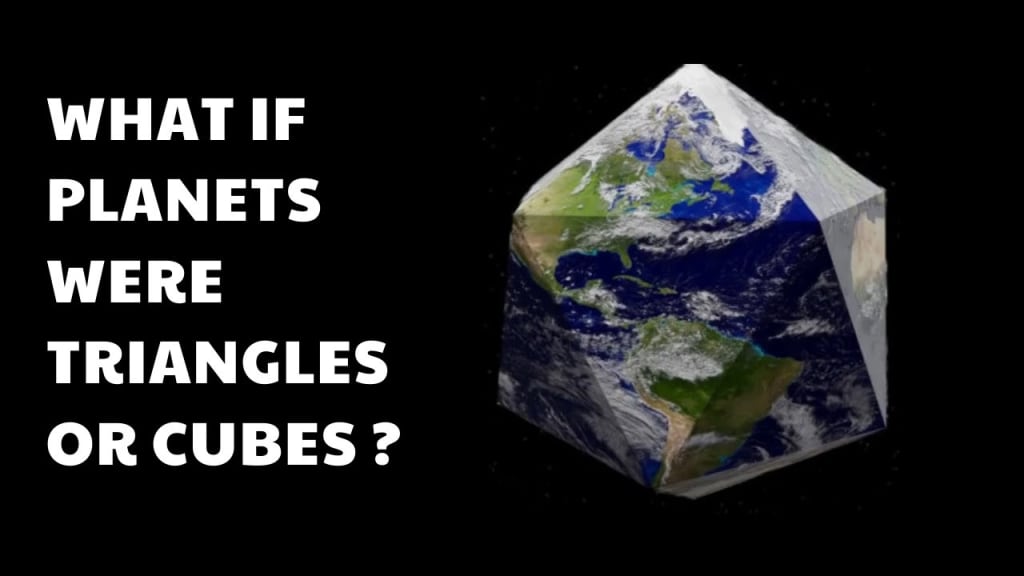
Have you ever questioned why all planets are round and what would happen if these heavenly bodies decided to defy the rules and adopt a different shape? Would we eventually have square planets, triangle moons, or perhaps even unimaginable intergalactic shapes? Let's find out, then.
So, how do planets initially come into being? The molecular clouds, which are swirling clouds of gas and dust that include a variety of atoms and compounds like carbon, oxygen, hydrogen, and other elements, are like a cosmic kitchen that contains everything needed to create new planets. The accretion theory is the initial phase in the process of forming planets.
Let's imagine that a nearby supernova or some other event results in gravitational instability. Due to gravity, this causes the gas and particles in the cloud to press together and form a cloud. As they move closer to the center, the particles start to cluster closer together, much like when you squeeze a ball in your palm. And soon they squeeze so hard that the cloud begins to flatten into a disc form, resembling the process of making pizza dough by combining flour and water. This disc is known as a protoplanetary disk, and it is spinning as a result of the initial rotation of the cloud's particles.
Imagine the gas molecules and microscopic dust particles now dancing inside the disk. They occasionally collide, and when they do, they adhere to one another like Velcro. Planetesimals are these microscopic balls of gas and dust that serve as the foundation for planets. The planetesimals also became bigger and bigger as they kept slamming into one other and merging, eventually producing protoplanets.
The protoplanets were taking their size seriously, and their gravity was intensifying. Some of them grew to such size that they overcame their localities in space to become the planets that we are familiar with today. Every planet had its own distinct composition of gases, rocks, and occasionally even water.
However, why do the planets appear to be spheres? Well, gravity is to blame for everything. Returning to our protoplanets now. Imagine using your hands to squeeze a balloon. Pressure is created by the air inside the balloon pushing against itself. Planets experience a similar phenomenon; its mass is drawn toward the core by gravity as it is compressed inward. Gravity pulls matter from all sides of the center of mass in the same direction, giving the object a sphere-like form. And that substance pushes back under pressure, defying gravity. They eventually reach a sweet spot where they can balance one another out; this is known as hydrostatic equilibrium, a fancy term for when everything inside a planet is in equilibrium.
That's not all, though. The rotation of the planets is another factor in sphericity. Imagine a Play-Doh ball or something like. Imagine spinning it quickly; as the substance begins to push outward, the Play-Doh bulges at the equator and flattens at the poles. Planets experience the same thing when they rotate on their axes. The planets bulge near the equator as a result of the material being pushed outward by gravity and spin; they secretly wish to return to being discs. However, gravity keeps pressing on the material in an effort to make everything as compact as possible since it doesn't want any lumpy planets; it wants them to be beautiful and round. In the end, gravity triumphs, and the planet assumes a spherical shape.
Take a look at some of the songs on our planet playlist. The giant of the solar system, Jupiter, enjoys flaunting its oblateness. It rotates so quickly that it obviously gets fat in the middle and compressed at the poles. It has a lovely belly and spins like a toy. The ringed wonder Saturn also joins the oblate gathering. It revolves with its lovely rings and has an even more prominent oblateness than Jupiter. The planets in these instances change from being completely round to having a nice bulge around the middle, demonstrating how rotation can give planets a distinctive shape. Similar to cosmic pottery, a distinct and fun shape is produced by the spinning process.
You now know why the planets are spherical. But what if they weren't, which is more intriguing? What if they had a cubical or even triangular shape, for example? Let's see, then.
The mass of a cube- or triangle-shaped planet would be distributed very differently from a sphere. Do you understand what that implies? Even gravity would be shaken.
Because the mass is uniformly distributed around the planet's center, gravity pulls everything there towards it. But things start to get interesting when we include a cube- or triangle-shaped planet. You would experience the strongest pull of gravity if you were standing in the middle of one of those faces. The faces are closest to the center of gravity, which explains why. And when you go away from the middle and move in the direction of the edges, gravity begins to mislead you. You would experience resistance from the sharply inclined gravity. Due of gravity's desire to keep you in the exact middle of the face and nowhere else, walking along those edges would feel very similar to climbing a mountain or moving along a very steep slope.
Imagine the terrain at the corners and edges now. The surroundings are desolate, rocky, and arid. Why? The edges would remain dry because all the water would collect in the center of each face. The air quality, too? Either it doesn't exist or it is too thin to support life. Undoubtedly not the most comfortable location for a camp. Additionally, don't forget to pack a lunch, thick clothing, and hiking boots because the unpredictable weather calls for them.
Your experience on our cube- or triangle-shaped Earth will depend on how it spins. It would have a moderate, temperate environment on each side if it rotated at its corners. However, things get intense if it rotates on an axis through two of its faces.
Imagine our existing environment as a rollercoaster. The top and bottom faces of the cube and the bottom face of the triangle would both be polar wonderlands, cold and frosty. The opposing sides would be wholly distinct in the meantime. They would be extremely hot within a cube, with an equatorial climate that would cause you to perspire. Sunlight would beam directly onto these faces rather than slowly curling down the surface. Discuss experiencing the heat. Additionally, on a planet with three sides, the sun would shine at an angle on the faces. The intriguing temperature fluctuations around the earth would result from this angled sunlight. Imagine if the temperatures would progressively drop as you moved from the triangle's base to its tip. The warmest area would be at the base, where the sunshine falls most directly, precisely like the equatorial temperature we are accustomed to on our spherical Earth. However, the angle of the sun would be less direct as you moved closer to the point, resulting in colder temperatures. However, because sunlight cannot directly penetrate the base, it is still extremely cold and gloomy. Therefore, in terms of temperature changes and climate zones, the triangle would be completely absurd.
You know that warm layer of air we refer to as the atmosphere, right? On our angular Earth, though, things would start to turn upside down. The outcome would be that gravity would be pulling away more strongly from each face's center. The environment would undergo some bizarre modifications. Imagine the atmosphere gathering and thickening at the center of each face, where gravity is highest. It would resemble a hive of air molecules rather than a city. However, as you moved closer to the outskirts, things started to get sparser and the air became quite thin. Therefore, it would be difficult to breathe at the margins, and life would struggle to survive there. Additionally, a thinner atmosphere offers less shielding from solar winds and radiation from the sun. Therefore, corners and edges provide a serious risk to people.
Of course, all of this is just an imaginative exploration of possibilities. The fact that our planet enjoys its spherical shape is a wonderful thing. However, there is no harm in thinking fantastical scenarios. Therefore, continue to let your imagination fly and to be in awe of the wonders of our wonderful world, no matter how it may be shaped.
About the Creator
Enjoyed the story? Support the Creator.
Subscribe for free to receive all their stories in your feed.
Comments
There are no comments for this story
Be the first to respond and start the conversation.