
What if Earth suddenly stoped spinning?
The Day the World Stood Still: A Hypothetical Catastrophe of Supersonic Winds, Mega-Waves, and Eternal Sunlight
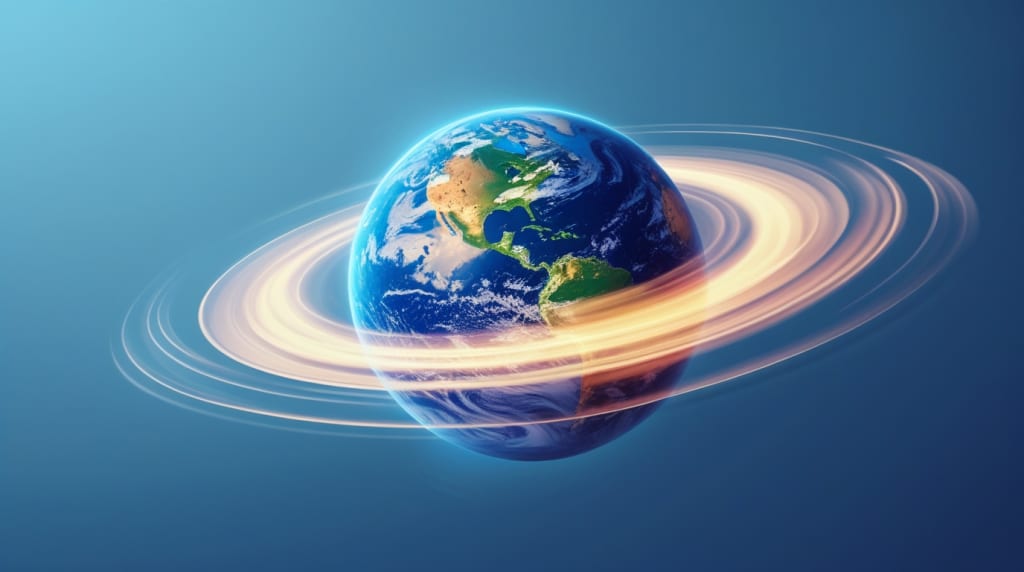
If the Earth and all terrestrial objects suddenly stopped spinning while the atmosphere retained its velocity, the initial consequence would be catastrophic winds. At the equator, where the surface is moving at roughly 470 meters per second (over 1,000 mph), the air would continue at that speed. Since supersonic speed is 343 m/s, most of the world would experience winds exceeding that threshold. People living between 42° North and 42° South—about 85% of the global population—would face these devastating conditions. The winds would last for only a few minutes before friction slowed them down, but that would be long enough to demolish nearly all human structures. Even those in sturdy bunkers wouldn't be safe, as airborne debris would strike with immense force. The destruction would be unprecedented, reducing cities to rubble in moments.
Boston, being farther north, would not experience supersonic winds, but the destruction would still be immense. The force of the winds would surpass the strongest tornadoes ever recorded. Skyscrapers, homes, and infrastructure would be torn apart, lifted from their foundations, and hurled across the landscape. Even the most remote human cities, such as those in northern Norway, would still endure hurricane-force winds. No place would be entirely safe from destruction. However, not all human life would be wiped out. Some underground shelters, caves, or deep bunkers would provide protection. The South Pole would be the safest inhabited location. Because it sits on the Earth's axis, its surface does not move relative to rotation, meaning people there would experience no sudden winds. However, they would soon notice something was wrong when the Sun stopped moving across the sky, leading to a slow and eerie realization that something catastrophic had occurred.
Meanwhile, the oceans would be thrown into chaos. The powerful winds would churn the water, vaporizing the surface and mixing it with the air. The boundary between sea and sky would vanish in a storm of mist, creating a surreal and violent environment. The energy of the winds would dissipate as heat, warming the mist and causing massive thunderstorms. Additionally, the oceans' momentum would generate gigantic waves, which would crash into the coasts with unparalleled force. West-facing shorelines would face the worst storm surges in recorded history, as walls of water would push miles inland. Once the winds settled, thick blankets of fog would develop over the oceans. This cooling effect would normally lower global temperatures, but due to another major consequence of the Earth stopping—permanent daylight on one side of the planet—temperature shifts would become extreme.
If the Earth ceased rotating entirely, the normal cycles of day and night would disappear. The Sun would no longer rise and set daily but instead move across the sky once per year. Each half of the planet would experience six months of unbroken daylight followed by six months of darkness. This would result in unbearable heat on the sunlit side and extreme cold on the dark side, rendering much of the surface uninhabitable. However, the atmosphere's momentum would gradually transfer back to the Earth, causing it to spin again very slowly. Without external interference, a single rotation would take approximately 3,000 years. This means that for practical purposes, Earth would settle into a year-long day-night cycle, drastically altering climate, ecosystems, and survival conditions for any remaining life on the planet.
The Moon, however, would continue its orbit around the Earth, playing a crucial role in slowly restoring rotation. Before the event, the Moon’s gravity caused tidal bulges that gradually slowed the Earth's spin while pushing the Moon into a higher orbit. With the Earth’s rotation halted, the Moon’s gravitational pull would create forces that would very slowly restart the spin. Over a long period, this effect would become noticeable. At the same time, the Moon itself would decelerate slightly. Given enough time—perhaps thousands or even millions of years—Earth’s normal rotation could partially return. But until then, the planet would remain in a drastically altered state, struggling with new weather patterns, harsh environmental extremes, and the long-term consequences of Andrew’s hypothetical catastrophe.
About the Creator
Enjoyed the story? Support the Creator.
Subscribe for free to receive all their stories in your feed.
Comments
There are no comments for this story
Be the first to respond and start the conversation.