
WHAT IF An Asteroid COLLIDED With Earth
What would actually happen if an asteroid was on a collision with our planet
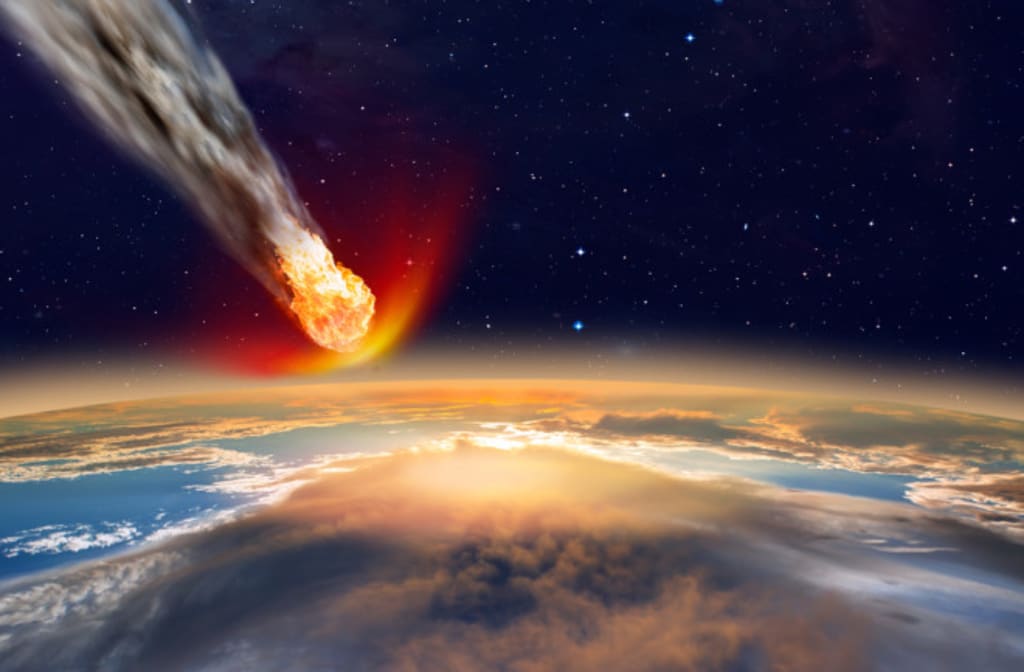
What would actually happen if an asteroid was on a collision course with our planet
If one is unaware, it is important to note that numerous fragments of celestial bodies descend through our atmosphere annually. Fortunately, these objects typically disintegrate upon entry and are of insufficient size to cause any significant consequences. Nevertheless, there exists evidence indicating that our planet has encountered several substantial impacts in its past, thus raising the possibility of a recurrence. In order to equip ourselves for the most unfavorable outcome, NASA has undertaken a sequence of examinations to assess our level of preparedness. Regrettably, the results indicate that we are inadequately prepared.
Every day, over one hundred tons of dust and small particles descend upon the earth. On average, an object the size of a car enters the atmosphere once a year and burns up, creating a spectacular fireball that streaks across the sky. Larger objects, approximately the size of a football field, collide once every two thousand years, and a potential extinction-level collision is believed to occur every few million years, making one long overdue. Generally, anything less than 82 feet across will burn up and cause only minor damage. Anything measuring up to half a mile across will cause significant damage to the impact site, and anything larger than that could have worldwide consequences. Currently, the largest known potentially dangerous object in space is Toutatis, which is just over three miles across. There is also an asteroid known as Apophis, which is expected to pass incredibly close to Earth in 2029 and is 1,213 feet wide. Although there are much larger objects in space, we are fortunate that they are not currently on a collision course with Earth. In the main asteroid belt between Mars and Jupiter, for example, there are some that are as much as 583 miles long. If one of these were to divert towards us, we could be in serious trouble. To prepare for such an event, NASA is collaborating with space agencies worldwide to simulate an impact, which they do every couple of years. Essentially, they want to learn how much warning we would receive, how people would react, and whether there is anything that could be done to protect people. To this end, a fictional scenario was created that began with the discovery of a near-earth object in March of 2019, with initial indications that it could impact the earth in 2027. In the lead-up to the planetary defence conference, which took place in early May of 2019, information was released about the asteroid.
This text provides details regarding the eccentric orbits of an asteroid, uncertainties about its composition, and refined predictions about its trajectory. These predictions suggest that there is a 1 in 100 chance of a collision with its orbital path. The asteroid will remain observable for the remainder of the year before fading from view, requiring larger telescopes for continued monitoring.
During the conference, delegates were assigned the task of planning how resources can be allocated to gather more information about the asteroid. The options discussed ranged from directing additional telescopes towards it to potentially launching a spacecraft for closer monitoring. In the event that a collision is confirmed, options for deflecting its path were also considered.
Some participants focused on the societal impact of such a discovery. With eight years of planning, governments could potentially construct safe zones, possibly underground, to protect people from the impact. However, the effectiveness of these measures would depend on the precise point of impact and the severity of the collision. This underscores the importance of acquiring more knowledge about the asteroid's trajectory and composition.
Furthermore, there is a question regarding the timing of releasing information about near-earth objects to the public. Given that the odds of a collision are calculated as 1 in 100, it is still a remote possibility. It could be deemed irresponsible to disclose this information to everyone, as it may cause widespread panic. Law enforcement and emergency services would need to be prepared for the public's reaction, and the timing of releasing such information would be crucial.
In essence, while it may appear that space agencies are engaging in science fiction-like endeavors, projects like these hold immense significance. There is always a chance that a large object could collide with our planet.
It is uncertain how much advance notice can be obtained in situations like this. However, such scenarios aid emergency planners, such as those at FEMA, in comprehending the information that would be at their disposal and the alternatives available to them. It is important to note that we have not yet reached the level of apprehension depicted in movies like Armageddon.
About the Creator
Enjoyed the story? Support the Creator.
Subscribe for free to receive all their stories in your feed.
Comments
There are no comments for this story
Be the first to respond and start the conversation.