
What Happens When A Blackhole Is Destroyed?
Unraveling Black Holes and the Limits of Destruction
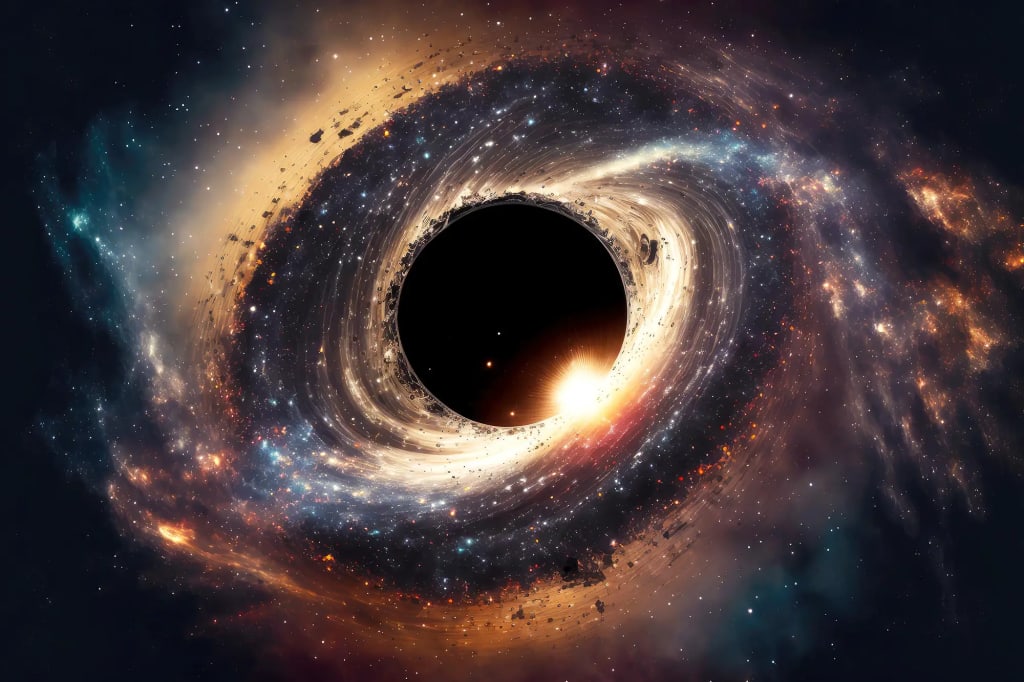
Black holes possess the power to obliterate everything in their path, but can they themselves be annihilated? If we were to push the boundaries of physics to their limits, perhaps even breaking them in the process, what would be the outcome for the universe?
Consider the scenario of creating a minute black hole, equivalent in mass to our moon, and then attempting to tear it apart.
The Initial Approach: Detonation
Explosive detonations have the potential to fracture matter. To establish the proper atmosphere, let's unleash the entirety of the world's nuclear arsenal around our black hole!
The Singular Appetite
Black holes are insatiable in devouring any substance that crosses their event horizon, whether it's matter or energy. With the relationship E = mc² in play, the energy consumed contributes to the black hole's mass.
The mass of a black hole is directly linked to its size, implying that detonating our tiny black hole with nuclear force results in its growth and heightened mass!
Engaging Antimatter
A collision between matter and antimatter triggers their mutual annihilation. So, what transpires when we launch an antimatter mass equivalent to that of a moon towards the black hole?
Curiously, when an object enters a black hole, its entire past identity is obliterated—regardless of whether it's composed of matter or antimatter. Black holes solely respond to gravity, determined by an object's overall mass-energy. Since the mass of a particle matches its corresponding antiparticle, introducing an anti-moon yields the same outcome as introducing a moon. Consequently, the black hole's mass intensifies.
This "erasing capacity" of black holes is intriguing, suggesting that despite their immense size and influence, black holes share similarities with fundamental particles. Much like an electron, which is characterized by its mass, spin, and charge, black holes are similarly defined by three attributes: mass, rotation, and electric charge. Upon forming, a black hole's origin—be it a collapsed star, an anti-star, or even something unrelated—is inconsequential. Its identity is encapsulated in these three descriptors alone.
Could a Black Hole Be Neutralized by an Anti-Black Hole?
Considering black holes as peculiar particles leads to a pondering: Could an anti-black hole annihilate a regular black hole?
The Alluring Anti-Black Hole
Particle-antiparticle pairs possess matching mass but opposite charge. For a black hole with mass and electric charge, its corresponding anti-black hole would possess matching mass but with opposing charge. Upon their collision, the charges would aggregate and negate each other. Consequently, a new black hole—twice as massive yet neutral in charge—would emerge.
Elevating the Challenge: Demolishing the Event Horizon
It holds true that black holes can possess spin and charge. However, even for these enigmatic entities, there exist thresholds. If the spin or charge exceeds certain limits, an intriguing phenomenon unfolds: the event horizon vanishes.
In simplified terms, black holes are conceived as concealing a singularity—an infinitely compressed mass with gravitational pull so potent that nothing, not even light, can escape its grasp. Visualized as a "black sphere of nothingness," the event horizon constitutes the outermost boundary of this cosmic jail.
However, excessive rotation or charge leads to the dissolution of the event horizon. In a sense, a spinning black hole repels nearby objects, endeavoring to expel them from its clutches. But the force of gravity prevents this. If rotation accelerates excessively, the event horizon weakens, allowing objects in close proximity to escape. The same principle applies to electric charge; an excessive charge disbands the event horizon.
However, even with the event horizon dispelled, the singularity remains, capable of exerting gravitational pull on surrounding matter. Although a collision with the singularity remains fatal, the absence of the event horizon enables escape from its immediate vicinity.
Overindulgence: Overfeeding the Black Hole
The strategy to destroy a black hole involves overcharging or over-spinning it. By introducing objects of small mass but significant charge or angular momentum, the charge or spin could surpass the mass, leading to the collapse of the event horizon.
However, the feasibility of this concept is a subject of vigorous debate among physicists. Challenges arise when considering charged black holes, where mutual electrostatic repulsion prevents further accumulation of charge. A threshold is reached beyond which the repulsion halts further entry. This principle applies similarly to spin.
The Radical Ramification: Shattering Physics
While this approach bears promise, it unveils a complication. The destruction of the event horizon reveals the singularity—a point of infinite gravity where spacetime ruptures. This upheaval presents a perplexing challenge to physics.
Contrary to popular belief, a black hole's singularity isn't precisely "at its center." Instead, it exists in the future of whatever ventures beyond the event horizon. The warping of spacetime is so profound that crossing the horizon entails a shift in the roles of space and time. Crossing the horizon propels one toward the future, akin to a journey through time. Consequently, the singularity emerges not "ahead" but in the observer's future.
This enigma presents a paradox: encountering the singularity requires traversing one's future, an impossible feat akin to defying time itself. The singularity lies ahead but is experienced when encountered. This complexity pertains to singularities within the future, which remain inaccessible and inconsequential.
The Peril of Naked Singularities
However, a naked singularity—a singularity devoid of an event horizon—raises alarms. Unlike future-bound singularities, a naked singularity resides "before us," visible to all. The repercussions remain uncertain.
A singularity denotes a region of infinite gravity, where spacetime's structure shatters. Space and time cease to be meaningful concepts. The unpredictability of this state results in a breakdown of causality and predictability. Objects could emerge from the singularity without cause or rationale—ranging from mundane items to entire systems.
However, the existence of naked singularities clashes with the essence of physics. These enigmas challenge fundamental principles, disrupting predictability and causality, heralding a breakdown of physics itself.
While nature seemingly prevents the emergence of naked singularities, the question endures. And while black holes are often While nature seemingly prevents the emergence of naked singularities, the question endures. And while black holes are often depicted as the universe's ultimate enigmas, they might actually serve as protectors, shielding us from the chaotic nature of singularities.
Considering the risks involved in dismantling the event horizon, a more secure approach emerges: patience. Black holes emit minuscule particles via Hawking radiation, a phenomenon causing gradual mass loss, leading to their eventual "evaporation." This slow process leaves no horizon or naked singularity, resolving the black hole without upheaval.
So, can we destroy a black hole? Yes, but it requires the virtue of waiting. Rest assured, the universe is filled with captivating mysteries waiting to be explored right here, right now.
About the Creator
Enjoyed the story? Support the Creator.
Subscribe for free to receive all their stories in your feed.
Comments