
What Happens if the Moon Crashes into Earth?
What if ?

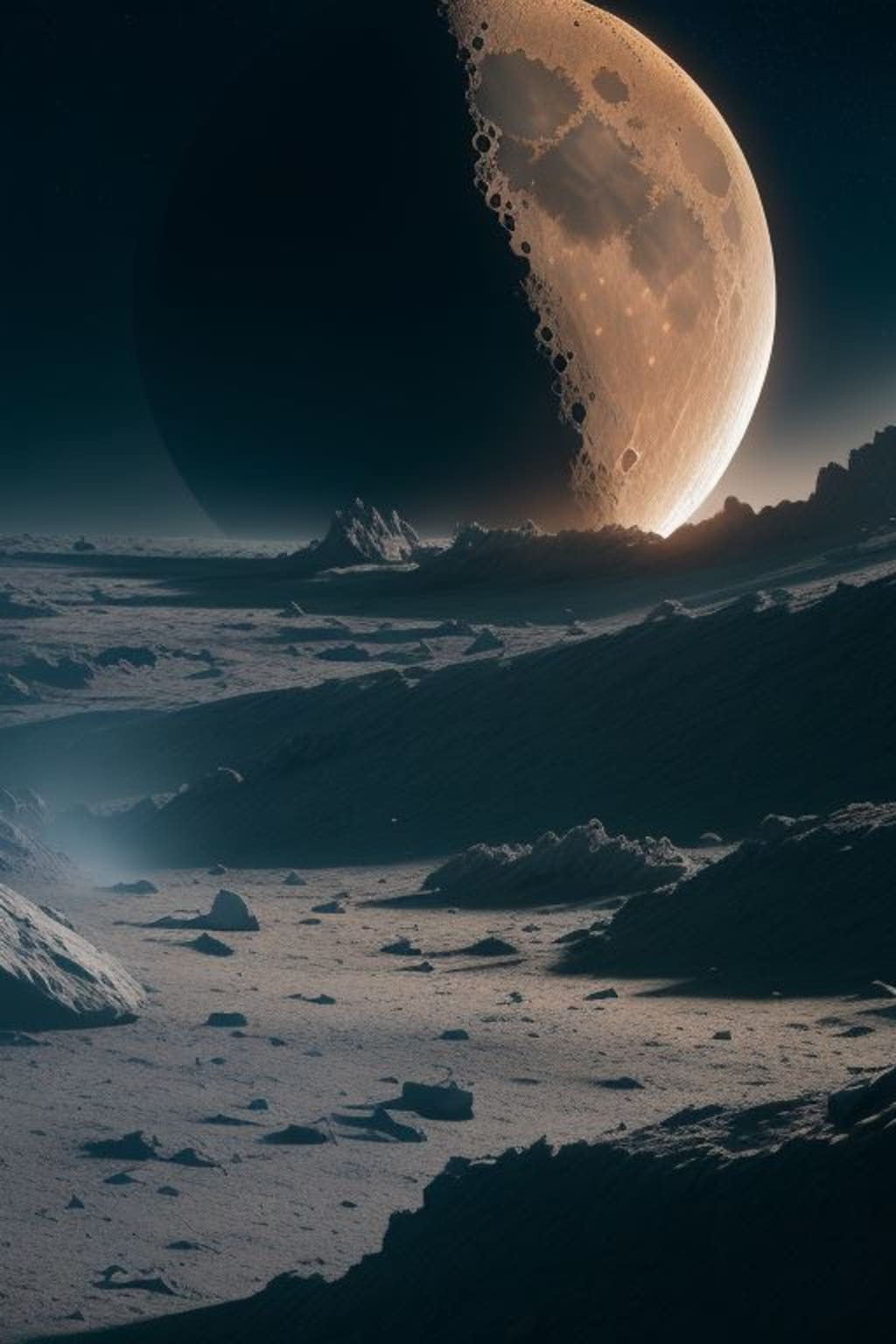
Today, we will explore a fascinating and thought-provoking scenario: What if the moon were to collide with Earth? The implications are more intriguing and unusual than you might initially think. Let's begin by examining the basics.
Firstly, why isn't the moon already on a collision course with Earth? We know that Earth's gravity attracts everything towards it, including the moon. However, the moon remains suspended in space, seemingly defying gravity. The secret lies in its sideways motion, which we call an orbit. Every day, when you throw a ball, it follows a small orbit. The key difference between the ball's orbit and the moon's is that the ball eventually falls to the ground. Essentially, the moon stays in orbit because of its speed. If you could throw a ball fast enough, it would loop around the Earth and return to you. In the absence of air resistance, it could orbit indefinitely. And that's precisely what the moon does—it orbits the Earth every 27 days at a speed of 3,600 kilometers per hour.
For the moon to suddenly abandon its orbit and crash into Earth, it would violate numerous laws of physics that we don't have time to explain. So, how could we make the moon collide with Earth? In essence, altering an object's orbit requires changing its speed, which, in turn, affects how gravity influences its trajectory. However, even the slightest changes in speed necessitate enormous forces. That's why large celestial bodies in our solar system tend to remain stable.
According to scientific understanding, the moon is significant and highly massive. Even if we were to ignite countless rocket engines across its surface, it would barely budge. It seems that nothing short of magic could make the moon fall. So, let's imagine a magical spell that drastically slows down the moon, altering its orbit and causing it to spiral towards Earth.
To heighten the experience, we'll assume it takes precisely one year for the moon to collide with Earth. Now, let's embark on this journey.
Month One:
In the initial days, not much changes. The moon appears slightly brighter, confusing scientists, though most people won't notice anything different. The only notable impact of the moon on Earth is the tides. Tides occur because while Earth pulls on the moon, the moon's gravity pulls back on Earth. As gravity weakens with distance, different parts of Earth experience a slightly varied pull, causing the oceans to bulge when the moon is overhead and contract when it's not. As Earth rotates daily beneath the moon, the moon's influence fluctuates, leading to the rise and fall of ocean water levels, resulting in tides about half a meter high, occurring twice a day.
However, as the moon draws closer, high tides gradually become more pronounced. Within a month, the moon has covered half the distance to Earth, and ocean tides have grown to four meters. Coastal cities begin to face flooding from the increasing high tides, with no end in sight.
Month Two:
By the end of the second month, the moon has covered two-thirds of the distance to Earth, and global infrastructure starts crumbling under tides exceeding 10 meters. Up to a billion people living near coastlines are displaced as tides inundate coastal areas. Ports become inoperable, severely disrupting shipping and impacting the delivery of goods and supplies, including food. Communication networks suffer as well, as 95% of the internet relies on ocean-crossing cables, and their land-based terminals are affected by the flooding.
Living inland doesn't guarantee safety either, as tidal waves cause rivers to flow backward, contaminating surface and groundwater supplies with saltwater. Gas shortages follow as coastal refineries are abandoned. Countries are left to rely on the supplies they have on their shelves, leading to strict rationing. Chaos reigns in cities during the scavenging hours of low tide, while survivors seek refuge in high-rise buildings when the water returns.
Month Three:
Three months in, the moon's proximity begins to disrupt communication and navigation satellites, warping their orbits as their fuel for orbital corrections runs out. The moon's gravitational influence, typically too distant to affect satellites significantly, becomes more pronounced as it draws nearer.
Months Four and Five:
During this period, tides rapidly grow, reaching heights of around 30 meters, with a projected peak of 100 meters in a few weeks. At low tide, the ocean recedes, exposing vast stretches of the continental shelf like desolate deserts. At high tide, walls of water inundate agricultural areas, houses, and skyscrapers.
After almost five months, the apocalypse's warm-up act concludes. Since the average depth of the oceans is only three kilometers, the tides reach their maximum effect. The Earth itself starts feeling the squeeze of the approaching moon. The immense weight of quintillions of tons of water sloshing on and off the tectonic plates, combined with the squeezing of the planet, generates tremendous stresses, leading to increasingly intense and magnitude earthquakes. The exact severity and locations of theseearthquakes are difficult to predict, but it's safe to assume that they would be catastrophic and widespread.
Months Six to Twelve:
As the moon nears its collision, the gravitational forces between the moon, Earth, and the sun become chaotic. The moon's gravity begins to disrupt Earth's rotation, slowing it down and causing erratic day-night cycles. The length of a day fluctuates wildly, with some days lasting only a few hours and others extending well beyond 24 hours.
The moon's proximity also affects Earth's climate. The gravitational tugs alter atmospheric circulation patterns, leading to extreme weather events like superstorms, hurricanes, and tornadoes on an unprecedented scale. The increased severity and frequency of these events further devastate the already struggling world.
Finally, after a year of mounting chaos, the moon collides with Earth. The impact releases an unimaginable amount of energy, equivalent to billions of nuclear bombs. The collision triggers a global cataclysm, causing massive earthquakes, tsunamis, and volcanic eruptions. The dust and debris thrown into the atmosphere would darken the skies, leading to a prolonged period of darkness, cold temperatures, and disrupted ecosystems.
The aftermath of the moon colliding with Earth would be a grim and inhospitable world. The destruction of cities, loss of life, and environmental devastation would be on an unprecedented scale. It's unlikely that any form of complex life would survive such an event.
However, it's important to note that this scenario is purely speculative and highly unlikely to occur naturally. The moon's orbit is stable and has remained so for billions of years. The laws of physics governing celestial mechanics make it exceedingly difficult for such a collision to occur.
Exploring hypothetical scenarios like this can be intriguing, but it's crucial to remember that they are purely imaginative exercises. The moon continues to be a beautiful and essential presence in our night sky, playing a crucial role in stabilizing Earth's axis and influencing our tides.
About the Creator
yusuf alanazi
Yusuf is a passionate reader, gamer, and movie lover. He finds joy in exploring different worlds through books, video games, and movies.
Enjoyed the story? Support the Creator.
Subscribe for free to receive all their stories in your feed.
Comments
There are no comments for this story
Be the first to respond and start the conversation.