
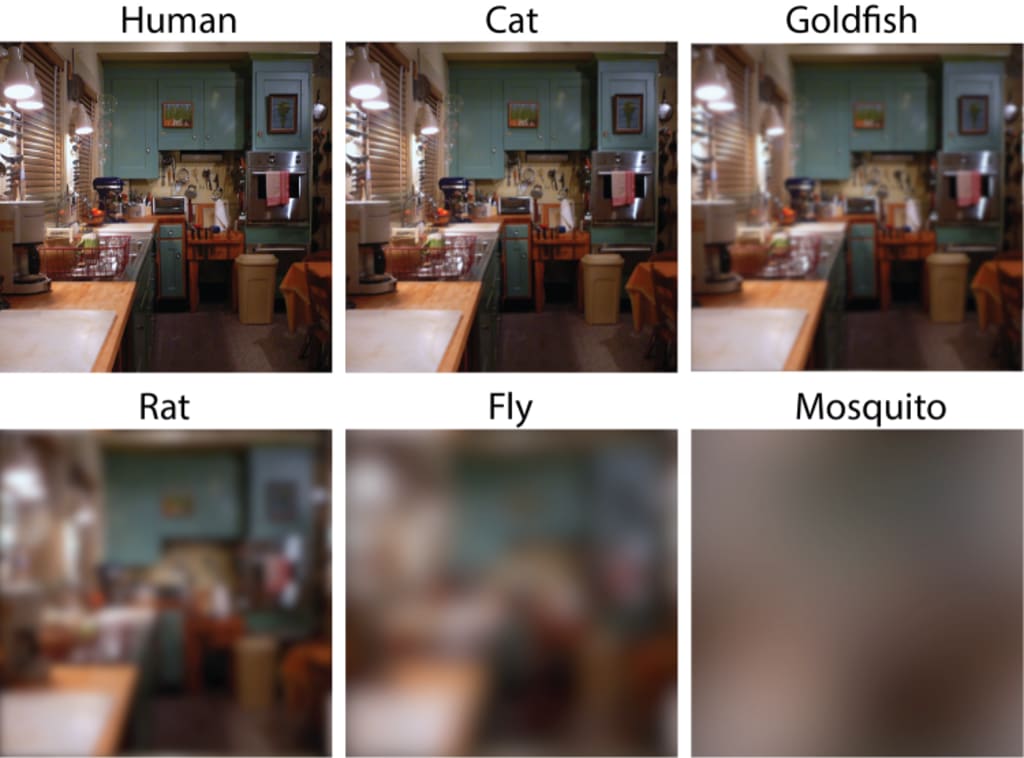
Absolutely, animals indeed see the world differently from us, and their vision is specialized to suit their specific needs and environments. Let's take a closer look at some of the unique visual abilities of the animals you mentioned:
Pigeons: Pigeons are known for their excellent vision and navigation abilities. They can see a broader spectrum of colors than humans, including ultraviolet light, which allows them to perceive patterns on flowers and other cues that are invisible to us. Additionally, pigeons have an exceptional ability to detect magnetic fields, which helps them navigate over long distances.
Snakes: Snakes have specialized infrared-sensitive receptors called "pit organs" located in their snouts. These pits allow them to detect the heat emitted by warm-blooded animals, even in complete darkness. This ability helps them locate potential prey and avoid predators efficiently.
Cows: cows have a limited color vision, primarily perceiving shades of blue and green. They are less sensitive to the color red because of the absence of specific cone cells responsible for detecting that color in their retinas. Additionally, their panoramic vision allows them to see a wide field of view but creates a blind spot directly behind them.
Horses: Horses also have a panoramic field of view, allowing them to see almost 360 degrees around them. However, they have a blind spot right in front of their faces and behind their heads. This is why it's important to approach horses carefully and avoid startling them.
These unique visual abilities showcase how different animals have evolved to adapt to their respective ecological niches and lifestyles. Understanding their sensory perceptions helps us appreciate the diversity and complexity of the natural world
Fish have evolved fascinating visual adaptations to thrive in their underwater environments. Let's explore some of these unique features:
Ultraviolet Receptors: Many species of fish have specialized ultraviolet-sensitive receptors in their eyes. These receptors allow them to perceive ultraviolet light, which is invisible to human eyes. Ultraviolet light plays a significant role in underwater communication, detecting prey, and even identifying potential mates.
Spherical Lens and 360-Degree Vision: Fish have a more spherical lens compared to humans, which allows them to focus better in water. This adaptation, combined with the positioning of their eyes on either side of their head, grants them an almost panoramic 360-degree field of view. This wide field of vision is essential for detecting predators and prey in the water.
Color Vision: While it is true that fish can see many of the same colors as humans, the way they perceive colors can differ due to the way light behaves underwater. Water filters out certain wavelengths of light, and this can affect how colors appear to fish. For instance, red light is rapidly absorbed in water, making it less visible to fish in deeper regions. However, fish can still see a range of colors, and color vision is crucial for various aspects of their behavior, such as mating displays and recognizing food sources.
Dark Adaptation: Some deep-sea fish have specialized adaptations that enable them to see effectively in the darkness of the ocean depths. They often have large eyes and an abundance of light-sensitive cells (rods) in their retinas, allowing them to capture even the faintest traces of light.
The diversity of visual adaptations among fish species demonstrates their remarkable ability to thrive in a variety of aquatic habitats. These adaptations have evolved over time to meet the specific challenges and opportunities presented by life underwater. It's indeed fascinating to learn about how different animals, including fish, perceive and interact with their environments.
Indeed, insects and other animals have fascinating visual capabilities shaped by their evolutionary history and environmental adaptations. Here's a summary of the interesting vision patterns mentioned in the text:
Flies: Flies have compound eyes with thousands of eye receptors called ommatidia. This structure allows them to have a panoramic view of their surroundings. They can process visual information quickly, which gives them the perception of slow-motion. Additionally, flies can see ultraviolet light, which aids in communication and detecting certain objects.
Bees: Bees cannot perceive the color red; instead, they see it as dark blue. This is due to the specific photoreceptors in their eyes. They are, however, sensitive to ultraviolet light, which helps them identify patterns on flowers, locate nectar, and navigate.
Rats: Rats also lack the ability to see the color red. One peculiar aspect of their vision is that each eye can move independently of the other, resulting in a somewhat disjointed view, yet they manage to function effectively with this characteristic.
Cats: Cats have a reduced ability to distinguish between shades of red and green. However, they excel in identifying colors like brown, yellow, and blue. Their eyes have a wide field of view, allowing them to see more on the sides than humans can. Cats' night vision is extraordinary, enabling them to see in low-light conditions about six times better than humans. Their pupils can rapidly adjust to varying lighting levels.
Dogs: Dogs, like bees, are unable to see red or orange colors. Instead, they can perceive blue and violet hues. Interestingly, dogs have a remarkable ability to differentiate between shades of gray, making them well-suited for certain tasks.
Frogs: Frogs are highly selective eaters, and they prefer moving prey. If something isn't in motion, like a non-moving bug, they may not even pay attention to it. Similarly, they may not be observant of objects or shadows that are not relevant to their survival.
Chameleons: Chameleons have unique eyes that can move independently of each other. This ability allows them to have a 360-degree view of their surroundings without needing to turn their heads. They can focus on two different objects at the same time, one with each eye.
If humans were to suddenly acquire 360-degree vision like chameleons, it would be a revolutionary transformation in our perception. It might significantly alter our spatial awareness and improve multitasking capabilities. However, it could also come with its own set of challenges, as our brains would need to adapt to process such vast amounts of visual information effectively.
It's important to note that the information provided in the text might not be entirely accurate or might be oversimplified. Animal vision is a complex and fascinating topic, and researchers continue to make new discoveries about the visual capabilities of various species.
About the Creator
Enjoyed the story? Support the Creator.
Subscribe for free to receive all their stories in your feed.
Comments
There are no comments for this story
Be the first to respond and start the conversation.