
We Are the Last Generation That Can Avoid Climate Catastrophe
The carbon budget is down to single-digit years, four climate systems have already crossed their tipping thresholds, and the money to fix it is stuck in a deadlock.
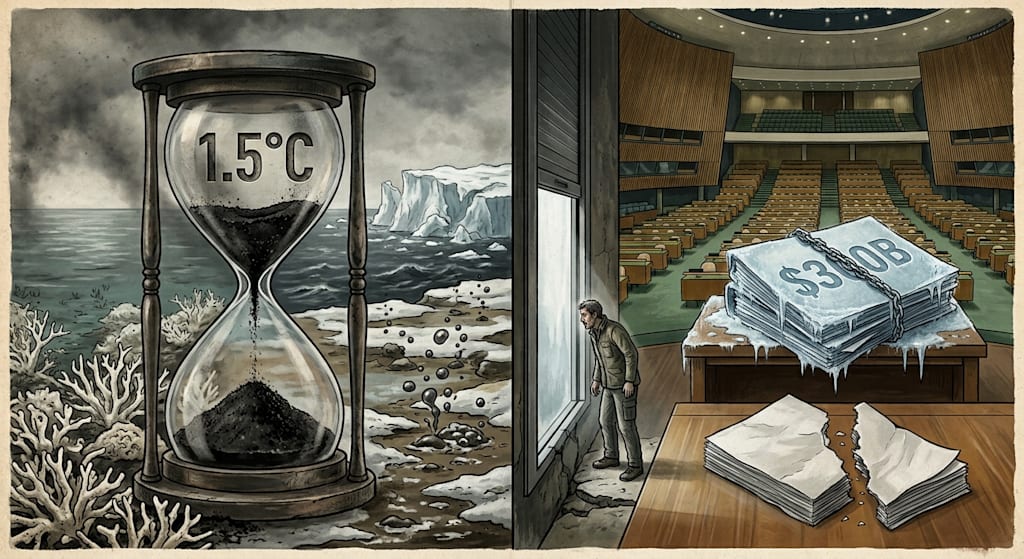
Before the Carbon Budget Runs Out
On September 23, 2026, at the climate action and transition meeting during the high-level week of the 81st UN General Assembly, UN Secretary-General António Guterres said: “We are the first generation with the tools to end the fossil fuel era, and the last generation that can avoid a climate catastrophe.”
The statement deserves attention because it matches current climate science. The carbon budget is counted in single-digit years. Four climate subsystems have already crossed self-sustaining decline thresholds. International climate finance negotiations are still ending in deadlock. “The last generation” is no longer a rhetorical judgment.
The carbon budget: a countdown to zero
The most direct measure of urgency is the carbon budget: how much carbon dioxide humanity can still emit without breaching a given warming target.
According to the 2026 update of the Global Carbon Budget, as of the start of 2026, the remaining carbon budget for limiting warming to 1.5°C is about 170 billion tonnes of CO₂. At current global emission rates, that is roughly four years. The budgets for 1.7°C and 2°C are 52.5 billion tonnes, about 12 years, and 105.5 billion tonnes, about 25 years. The differences come from methodological choices, such as whether to include natural-source feedbacks like abrupt permafrost thaw and wildfire emissions. The direction is the same: the budget is draining faster than expected.
Emissions show no inflection point. Global fossil CO₂ emissions reached 38.1 billion tonnes in 2025, up 1.1% from the year before and a record high. Pierre Friedlingstein, who leads the Global Carbon Project, put it plainly: “With CO₂ emissions still rising, keeping global warming below 1.5°C is no longer feasible. The remaining carbon budget for 1.5°C, 170 billion tonnes of CO₂, will be exhausted before 2030 at current emission rates.”
The 2°C target faces similar constraints. Staying within the 2°C budget would require global annual emissions to fall by more than 7% per year starting in January 2026. The actual trend is growth of about 1% per year. One trajectory falls. The other rises. That gap is about direction.
One underappreciated variable is accelerating the drain. The 2025 Global Carbon Budget report quantified for the first time how climate change weakens natural carbon sinks. Since 1960, 8% of the rise in atmospheric CO₂ concentration can be attributed to climate change reducing the efficiency of land and ocean sinks. The land sink has weakened by about 23%, or 0.8 ± 0.9 GtC per year. The ocean sink has weakened by about 6%, or 0.18 ± 0.1 GtC per year. Carbon budget estimates based on linear extrapolation from historical sink efficiency may already be too optimistic. If abrupt permafrost thaw and wildfire emissions are included, the remaining 1.5°C budget shrinks by another 25%, and the 2°C budget by 17%.
The budget does not drain at a steady rate. Once natural systems shift from carbon sinks to carbon sources, the drain can accelerate.
Warming projections: 2°C is already quite difficult, but the direction is not predetermined
The World Meteorological Organization’s annual to decadal climate update, released in May 2026, projects global annual mean near-surface temperatures from 2026 to 2030 between 1.3°C and 1.9°C above the pre-industrial level. There is a 91% chance that at least one year will temporarily exceed 1.5°C. There is a 75% chance that the five-year mean will exceed 1.5°C. In 2024, the global mean temperature reached about 1.55°C, the hottest year on record.
A temporary single-year exceedance is not the same as failure of the long-term target. The 1.5°C and 2°C thresholds in the Paris Agreement refer to warming sustained over more than 20 years. A single year above the line does not mean the long-term target has collapsed. But as baseline warming approaches these thresholds, temporary exceedances will become more frequent. That is itself a sign of a narrowing window.
The UN Environment Programme’s 2025 Emissions Gap Report projects longer-term warming. If countries fully implement their nationally determined contributions, global warming by the end of this century is projected at 2.3°C to 2.5°C. If only current policies are implemented, it is 2.8°C. The numbers improved compared with the 2024 edition, which projected 2.6°C to 2.8°C. UNEP notes that about 0.1°C of the improvement comes from methodological updates. Another roughly 0.1°C of improvement will be offset by the United States’ withdrawal from the Paris Agreement. The new NDCs have had almost no real impact.
The implication is clear. The 2°C target is still feasible, but only if emission reductions achieve a structural leap within the next decade. Current policy is far from that.
The shift in agenda: from setting targets to managing overshoot
The agenda has moved away from long-term vision. The 2026 Bonn climate negotiations confirmed it. WWF’s summary of the Bonn meeting concluded that the climate agenda “is beginning to move from talk to delivery.”
The clearest signal is the global fossil fuel transition roadmap led by Brazil, the COP30 presidency. The roadmap failed to gain formal consensus at COP30, with Saudi Arabia, Russia, and others opposed. Brazil then pledged to advance it voluntarily outside the official process. In the June 2026 Bonn negotiations, nearly 20 countries and negotiating groups of small island states and the poorest countries formally submitted views. The discussion focused on practical obstacles: fossil fuel subsidies, dependence on fossil fuel revenues, and unequal distribution of clean energy technologies. It did not focus on reaffirming long-term emission targets. Switzerland, representing a group that included South Korea and Mexico, stated that the roadmap “must be a continuing process, not a one-off report.”
The shift has a scientific rationale. When the UNEP report was released, the UN Secretary-General set the tone for managing overshoot: “Scientists tell us that temporarily exceeding 1.5°C at least in the early 2030s is now unavoidable... But this is not a reason to give up. It is a reason to redouble efforts and accelerate.” Once a temporary overshoot of 1.5°C is unavoidable, the reasonable focus is no longer how to avoid the breach. It is how to minimize the size and duration of the overshoot.
Feedback loops and tipping points: why delay costs grow nonlinearly
Linear carbon budget calculations assume that the Earth system responds gradually and reversibly. Climate science over the past decade has shown that this assumption fails once warming passes a certain level.
A study published in March 2026, using observational data up to that time, about 1.4°C of warming, confirmed that four major subsystems have crossed self-sustaining decline thresholds: the West Antarctic Ice Sheet, coral reef systems, the Amazon rainforest, and permafrost carbon. Self-sustaining decline means that even if global emissions fell to zero immediately, these systems would continue to degrade under their own internal dynamics. Emission reductions could no longer save them. They could only slow the degradation.
Coral reefs show the pattern most clearly. The central estimate of the thermal tipping point for tropical coral reefs is 1.2°C, with a range of 1°C to 1.5°C. Current global temperature has already risen by about 1.4°C, above the central estimate. Coral reefs support the livelihoods of nearly 1 billion people and 25% of marine species. Their thermal degradation at 1.4°C of warming has been confirmed as irreversible. Even under the most optimistic warming scenarios, tropical coral reefs are almost certain to face widespread irreversible loss.
The permafrost feedback is harder to see. Arctic circumpolar permafrost stores about 1,700 Pg of soil carbon, more than twice the carbon currently in the atmosphere. Under the RCP8.5 high-emissions scenario, methane released by permafrost thaw in the 21st century is estimated at 836 to 2,614 Tg. Between 2100 and 2300, the estimate is 2,800 to 7,400 Tg. Methane’s 100-year global warming potential is about 28 times that of CO₂. Its release is driven by warming, which creates a loop: warming, thaw, methane release, further warming.
These systems are connected. Loss of Arctic sea ice changes atmospheric circulation and may accelerate melting of the Greenland ice sheet. Meltwater from Greenland flowing into the North Atlantic weakens the Atlantic Meridional Overturning Circulation, or AMOC. A weakened AMOC may shift tropical rain belts southward, intensifying drought stress on the Amazon rainforest. A study published in 2026 modeled that if Greenland ice sheet melting continues to release freshwater, AMOC may be “temporarily pushed past its tipping point, but recovers before complete collapse.” Temporarily means the system may enter a reversible but extremely fragile intermediate state. Any additional disturbance could trigger an irreversible transition.
This is the physical meaning of nonlinear delay costs. Each additional year of delay makes the required emission reduction curve steeper. More tipping points have already been crossed. Recovery becomes harder and more expensive.
Climate finance: a history of promises and a deadlock in reality
At the 81st UN General Assembly, Guterres reiterated the climate finance target of $300 billion per year. He also called for total global climate finance to reach $1.3 trillion per year by 2035. The foundation for this target is not solid.
The history of developed countries’ climate finance promises is a history of delay. The 2009 Copenhagen Accord pledged to mobilize $100 billion per year by 2020. That target was first met only in 2022, two years late. From 2016 to 2019, actual mobilization was $58.5 billion, $71.1 billion, $78.3 billion, and $79.6 billion. All were below target. In 2024, COP29 raised the target to $300 billion per year and set an overall financing goal of $1.3 trillion per year by 2035.
The June 2026 Bonn mid-year negotiations ended in deadlock over climate finance. Developing countries demanded that developed countries deliver the $300 billion commitment. Developed countries took hard positions on sources of finance, burden-sharing, and eligibility of recipient countries. Bangladesh’s prime minister said at the World Economic Forum that the $300 billion target was far from sufficient and called on wealthy countries to increase funding and technical support.
The tension between the financing deadlock and the exhausted carbon budget is the core contradiction of current climate governance. Science calls for accelerated emission reductions and adaptation investment. Politics delivers continued delay and conditionality.
What the window means
Guterres’s statement has a clear scientific basis. The 1.5°C carbon budget is counted in single-digit years. Emissions are still setting records. Four climate subsystems have already crossed self-sustaining decline thresholds. Natural carbon sinks are being weakened by climate change itself. The political reality is also clear. Climate finance negotiations are deadlocked. The fossil fuel transition roadmap remains voluntary. There is a huge gap between countries’ NDC commitments and the 2°C target.
The window is closing at a measurable rate. That is what “the last generation” means. Each year of delay makes the required emission reduction curve steeper. It crosses more tipping points. It reduces the possibility of recovery.
When he released the 2026 carbon budget data, Friedlingstein gave the closing line: “We are not seeing any sign that global emissions will fall at the pace urgently needed.” The sentence has no exclamation. It has no elevation. It marks the current position more clearly than any rhetorical flourish.
About the Creator
Jin
Writer of reamstories
https://reamstories.com/jin
Enjoyed the story? Support the Creator.
Subscribe for free to receive all their stories in your feed. You could also become a paid subscriber, letting them know you appreciate their work.
Comments
There are no comments for this story
Be the first to respond and start the conversation.