
Venezuela Earthquake Leaves 164 Dead After Twin Quakes Strike
Venezuela Earthquake Leaves 164 Dead in Devastating Twin Shock Disaster

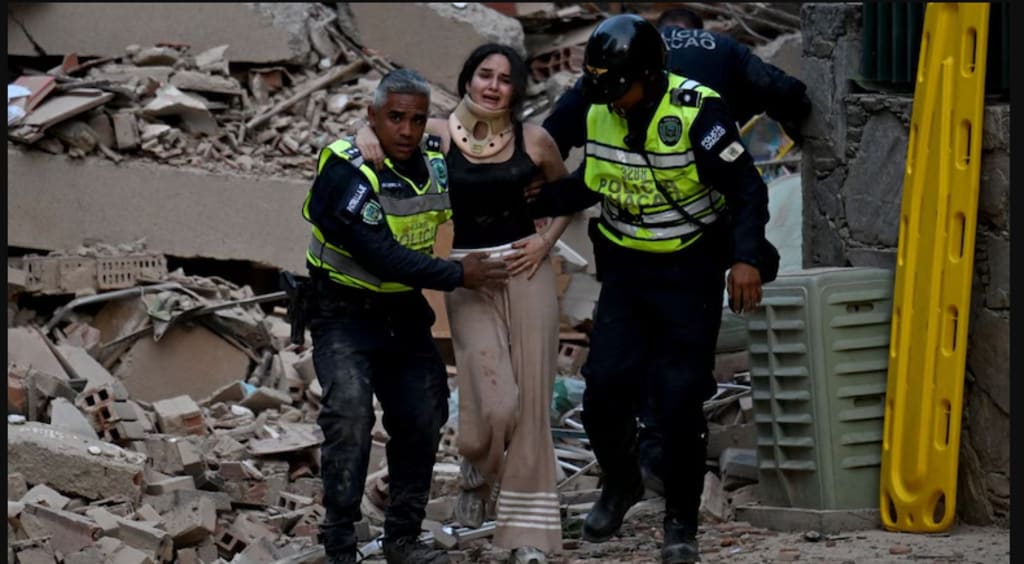
A devastating Venezuela earthquake doublet (magnitudes 7.2 and 7.5) has left at least 164 dead. Read our comprehensive news update on the damage across Caracas and La Guaira.
Venezuela Earthquake Leaves 164 Dead in Devastating Twin Shock Disaster
The South American nation of Venezuela is reeling today after a catastrophic, rapid-fire seismic event brought widespread ruin to major metropolitan areas and coastal communities. A powerful venezuela earthquake disaster—manifested as a rare and violent "doublet" event—struck the northern region of the country, collapsing high-rise residential buildings, shattering critical infrastructure, and sending panicked citizens fleeing into dust-choked streets.
According to a national address by Acting President Delcy Rodríguez, at least 164 people are confirmed dead, and more than 971 others have sustained serious injuries. Emergency rescue teams, operating under a newly declared national state of emergency, are currently working around the clock to locate thousands of citizens feared trapped alive under heavy concrete rubble. With communication lines severed and hospitals completely overwhelmed, international relief organizations warn that the current death toll is a preliminary figure that could rise significantly as more remote disaster zones are cleared.
The Science Behind the Disaster: A Rare Seismic Doublet
The structural devastation observed across north-central venezuela stems from the specific geologic nature of the event. Rather than a singular mainshock followed by smaller aftershocks, the region suffered what seismologists call a "doublet earthquake."
On the evening of Wednesday, June 24, 2026, the first major tremor, registering a preliminary magnitude of 7.2, struck at 6:04 PM local time. While a localized earthquake venezuela event of this scale is already capable of causing severe damage, the situation turned profoundly catastrophic exactly 39 seconds later. A second, even larger mainshock measuring magnitude 7.5 tore through the exact same fault system line.
Both of these massive venezuela earthquakes were centered in the Veroes municipality of Yaracuy State, along the highly active strike-slip boundary where the Caribbean and South American tectonic plates grind past one another. Because the tremors occurred at a relatively shallow depth of 10 to 20 kilometers, the energy transferred directly to the surface with violent intensity. The back-to-back configuration meant that buildings already structurally compromised by the first 7.2 shock were entirely defenseless when the 7.5 wave hit less than a minute later, triggering instant structural collapses across multiple states.
Severe Structural Destruction in Caracas and Surrounding States
The capital city of caracas bore a heavy burden of the seismic energy. Witnesses described scenes resembling a horror movie as the ground shook violently for nearly two continuous minutes, sending columns of dust billowing from fracturing brick walls and swaying concrete towers.
Worst-Affected Regions Reported by Civil Protection:
- Caracas (Capital District)
- La Guaira (Coastal Zone)
- Carabobo (Near Epicenter)
- Yaracuy (Epicenter Origin)
- Aragua & Miranda (Central Belt)
In the upscale eastern neighborhoods of Altamira and Los Palos Grandes within Caracas, the damage is severe. Interior Minister Diosdado Cabello confirmed that dozens of structures have sustained total failures, including a prominent 22-story residential high-rise in Altamira that completely pancake-collapsed into a mountain of broken concrete slabs.
Outside the capital, the coastal state of La Guaira was immediately designated an official disaster zone by the interim administration. Entire residential blocks in La Guaira have been reduced to splinters and dust. Compounding the local crisis, the vital maiquetia airport (Simón Bolívar International Airport), which serves as the primary aviation gateway to Caracas, suffered severe structural damage to its terminals and runways. Authorities were forced to issue an indefinite closure of the facility, cutting off immediate air-bound international logistics and forcing inbound civilian flights to divert.
Inside the Search for Survivors: A Race Against Time
For families living in the affected zones, the venezuela earthquake today has transformed daily life into an agonizing race against time. Neighbors and local youth are using bare hands, pry bars, and makeshift shovels to dig through crushed masonry, listening closely for the faint voices of loved ones crying out from deep within the subterranean voids of collapsed apartment structures.
In La Guaira, local reporters chronicled harrowing efforts to reach trapped survivors. Residents have managed to establish voice contact with isolated individuals pinned deep beneath heavy concrete slabs, instructing them to take short breaths and conserve their voices while awaiting specialized heavy lifting machinery.
The logistical reality on the ground is incredibly challenging. Power grids are entirely dark across north-central Venezuela, and municipal water systems are broken. Cellphone tower arrays are similarly offline, creating a dangerous information vacuum that leaves thousands unable to verify if their relatives are safe. The lack of communications has led United Nations experts to urge the interim government to unblock access to social media platforms and independent digital news outlets, calling the flow of open public information a matter of life and death.
How the Shockwaves Reeled Across the Caribbean Basin
The massive release of tectonic energy from the earthquake in venezuela was felt far beyond the country's sovereign borders. Due to the high magnitude and shallow crustal nature of the strike-slip fault rupture, noticeable tremors rippled out thousands of kilometers across the South American continent and Caribbean islands.
High-rise commercial office buildings were evacuated as far south as Manaus, Belém, and Macapá in the Brazilian Amazon, roughly 1,700 kilometers away from the primary epicenter. Significant ground motion also shook Bogotá and various northeastern departments of neighboring Colombia.
Across the Caribbean Sea, the event triggered immediate panic. Pronounced tremors shook the ABC islands (Aruba, Bonaire, and Curaçao), prompting localized evacuations. In the immediate aftermath of the second 7.5 tremor, the U.S. Tsunami Warning Centers placed coastal communities within 300 kilometers of the epicenter on alert, warning that hazardous tsunami waves were possible along low-lying shorelines. While those specific marine threats have since subsided without major coastal inundation, the sheer scale of the warning highlighted the regional gravity of what is now classified as Venezuela's most powerful seismic event since 1900.
International Aid and Regional Mobilization
Faced with a humanitarian disaster of historic proportions, international governments and aid organizations have initiated a massive, coordinated relief pipeline. UN Under-Secretary-General for Humanitarian Affairs Tom Fletcher stated that the global body is "fully mobilized" to deploy emergency resources, noting that repairing the shattered infrastructure will require an unprecedented, massive collective effort.
Initial International Rescue Shipments (As of June 25, 2026):
- Switzerland: 80 specialized rescue workers and tons of structural clearance equipment.
- France: 85 search-and-clearance personnel deployed immediately.
- Vatican: €100,000 in direct emergency funds from the Apostolic Almonry.
- United States: "Whole-of-government" support logistics coordinated via Secretary of State Marco Rubio.
In addition to state-sponsored assistance, international financial institutions like the International Monetary Fund (IMF) are actively monitoring the situation, remaining engaged with Venezuelan economic authorities to assess macroeconomic stability and infrastructure financing needs. On a grassroots level, NGOs based in South Florida have already activated disaster response warehouses, packing cargo containers filled with clean drinking water, shelf-stable food rations, medical hygiene kits, and emergency field tools to be shipped directly via alternative maritime ports while the main airport remains closed.
Critical Emergency Preparedness and Historical Context
To understand the sheer shock value of what happened in venezuela today, one must look to the region's complex seismic history. The northern coast of the country sits directly on top of a highly volatile plate interface. The most notorious historical precedent occurred in 1812, when a massive earthquake decimated Caracas and killed an estimated 30,000 people—an event that fundamentally altered the course of the nation's early war for independence.
While modern engineering codes are designed to handle moderate tremors, many older residential blocks and informal settlements built along the hillsides of the Capital District lack structural reinforcing. Seismologists warn that the region must brace for an extended sequence of significant aftershocks over the coming weeks. Civil protection agencies are instructing the public to avoid entering structures showing visible wall fractures, to sleep in open parks or plazas if their homes feel unstable, and to closely monitor official emergency channels for safety updates.
Conclusion: The Path Forward for a Broken Nation
As the initial dust settles over the ruins of Caracas and La Guaira, the true human cost of this catastrophic caracas earthquake continues to unfold. With 164 individuals confirmed deceased, nearly a thousand injured, and tens of thousands officially registered as missing or unaccounted for on local tracking networks, the coming days are critical.
The immediate priority remains the locating and extraction of survivors trapped inside structural air pockets before dehydration and exposure take a heavier toll. Once the initial rescue phase concludes, the nation faces a prolonged, multi-billion-dollar reconstruction process to rebuild its primary airport, restore its power grids, and provide permanent housing for families who watched their homes crumble in less than a minute. This historic doublet disaster will test the resilience of the Venezuelan people and demand the sustained, compassionate support of the global community for months to come.
Stay Updated on the Structural Crisis
For real-time local updates, verify information via the red cross networks, and follow emergency civilian broadcast channels. If you have family members currently missing in north-central provinces, utilize the official international civil registry portals to submit names to local search teams.
About the Creator
Vincent Otiri
I'm a passionate writer who crafts engaging and insightful content across various topics. Discover more of my articles and insights on Vocal.Media.
See Guide: How to Rebuild Trust After Cheating
Enjoyed the story? Support the Creator.
Subscribe for free to receive all their stories in your feed.
Comments
There are no comments for this story
Be the first to respond and start the conversation.