
US Army Desperate Attempt to Bomb a Live Volcano and Save a Hawaiian Town
Vulcano Story

US Army Desperate Attempt to Bomb a Live Volcano and Save a Hawaiian Town
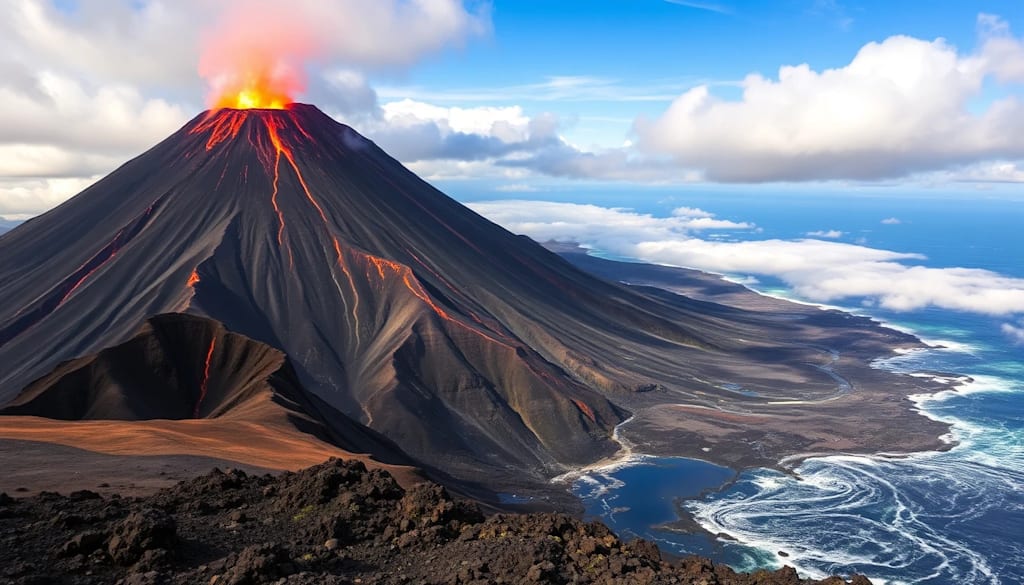
In late 1935, residents of Hilo, Hawaii, watched with growing fear as glowing rivers of lava from Mauna Loa, one of the largest and most active volcanoes on Earth, slowly advanced across the island toward their community. The eruption would eventually trigger one of the strangest and most desperate military operations in American history: a real aerial bombing campaign against an active volcano. Scientists, soldiers, pilots, and government officials all became involved in a high-risk effort to alter the course of nature itself. Although the operation remains controversial to this day, it represented one of humanity’s earliest attempts to directly intervene in volcanic activity using military force.
Mauna Loa dominates Hawaii’s Big Island both physically and geologically. Rising more than 13,000 feet above sea level and extending thousands of feet below the Pacific Ocean floor, it is considered the largest volcano on Earth by volume and area. Formed by the movement of the Pacific tectonic plate over a volcanic hotspot deep beneath the ocean crust, Mauna Loa has been erupting for hundreds of thousands of years. Unlike explosive volcanoes such as Mount St. Helens, Mauna Loa is a shield volcano, producing highly fluid basaltic lava capable of traveling long distances at relatively high speed. By the early twentieth century, scientists at the Hawaiian Volcano Observatory closely monitored Mauna Loa because of the danger its lava flows posed to communities on the island.

The observatory itself had been founded in 1912 by geologist Thomas Augustus Jaggar, a pioneering volcanologist from Massachusetts who believed volcanic disasters could be studied scientifically and possibly mitigated through human intervention. Jaggar spent years studying Hawaiian eruptions and became convinced that people should not simply accept volcanic destruction as unavoidable. On November 21, 1935, Mauna Loa erupted from vents high on its northeastern rift zone. Initially the eruption did not appear unusually dangerous, but within days scientists realized that lava was moving northward toward the headwaters of the Wailuku River. The river system supplied fresh water and hydroelectric power to Hilo, then home to approximately 20,000 residents and one of Hawaii’s most important economic centers. If lava entered the watershed, it could disrupt or destroy the town’s water supply, potentially forcing evacuations and causing major economic collapse. At the time, there were no proven methods for stopping lava flows. Modern volcanic engineering techniques did not exist, and scientists had little understanding of whether human intervention could meaningfully alter the movement of molten rock. Nevertheless, Jaggar believed the lava flow could potentially be redirected. He developed a bold proposal: use aerial bombardment to collapse lava tubes and channels feeding the advancing flow. Lava tubes are tunnel-like structures that form when the surface of flowing lava cools and hardens while molten lava continues moving beneath. These tubes can efficiently transport lava over long distances while insulating it from cooling. Jaggar theorized that if bombs destroyed the tubes or blocked the channels, the lava would spill out earlier, lose momentum, cool faster, and stop before reaching the river system. The idea was highly experimental and lacked any scientific precedent. Still, Jaggar persuaded Hawaiian territorial officials and the U.S. Army Air Service that the threat justified extreme measures.

The military agreed to assist, and the mission was assigned to bomber aircraft stationed at Luke Field on Ford Island in Pearl Harbor. Planning for the operation involved Lieutenant Colonel George S. Patton, who decades later would become one of the most famous American generals of World War II. At the time, Patton was serving in Hawaii and helped organize the logistics for the unusual mission. On December 27, 1935, ten Keystone B-3A and B-4A bombers took off from Oahu for the dangerous mission. These aircraft were large biplane bombers already considered somewhat outdated even in the 1930s. Flying more than 200 miles over the Pacific Ocean to the Big Island, the bombers carried both high-explosive demolition bombs and white phosphorus smoke bombs used to mark impact points. The crews faced difficult conditions including volcanic gases, unpredictable winds, and the challenge of accurately bombing narrow lava channels from the air. During the attack, the aircraft dropped approximately forty bombs onto the lava flow near the source vents. Reports indicated that twenty of the bombs were high explosives weighing around 600 pounds each, while the others were smoke bombs. Several direct hits struck the lava tubes and channels scientists had identified as critical to feeding the advancing flow. Witnesses on the ground observed explosions blasting apart sections of hardened lava crust while molten rock sprayed into the air. Jaggar personally watched the operation through telescopes from the slopes of nearby Mauna Kea volcano. After the bombing, he reported that the lava appeared to slow significantly. Prior to the attack, the flow had reportedly advanced at rates exceeding one mile per day in some areas. Within days the movement diminished, and by January 2, 1936, the flow had stopped completely before reaching the Wailuku watershed. Jaggar triumphantly declared the operation a scientific success and argued that the bombing had disrupted the lava transport system exactly as intended. Newspapers across the United States celebrated the mission as a remarkable victory of science and military ingenuity over nature. However, skepticism emerged almost immediately among other scientists and officials.

Geologist Harold Stearns of the U.S. Geological Survey, who participated in the mission, doubted the bombs had any meaningful effect. He believed the eruption was naturally losing strength and that the slowdown would have occurred regardless of military intervention. The superintendent of Hawaii National Park also expressed doubts shortly after the operation, stating that there was no clear evidence the bombing had actually diverted the lava. Modern volcanologists remain divided about the effectiveness of the 1935 bombing. Most experts today believe the eruption was already waning when the bombs were dropped and that the military strike likely had limited influence on the eventual stoppage of the flow. Nonetheless, some researchers acknowledge that the explosions may have disrupted smaller lava channels temporarily, even if they did not fundamentally alter the eruption. The operation remains scientifically significant because it represented one of the earliest attempts to use engineering methods to control volcanic hazards. The 1935 Mauna Loa bombing also influenced later efforts to combat lava flows in other parts of the world. In 1973, during an eruption on the Icelandic island of Heimaey, crews successfully pumped enormous quantities of seawater onto advancing lava flows to cool and slow them, helping save the town’s harbor. In 1983, Italian authorities considered using explosives to divert lava during an eruption of Mount Etna. Similar techniques involving barriers, trenches, and controlled explosions have occasionally been attempted in volcanic emergencies since then. Beyond its scientific implications, the bombing mission became part of military and Hawaiian folklore. In 2015, the U.S. Air Force’s 23rd Bomb Squadron commemorated the eightieth anniversary of the operation with a ceremonial B-52 flight over Hawaii. The squadron’s insignia still includes bombs falling onto a volcano, preserving the memory of the extraordinary mission. The event also cemented Thomas Jaggar’s reputation as a visionary scientist willing to pursue radical ideas to protect lives and communities.

Today, Mauna Loa continues to erupt periodically and remains under constant monitoring by the United States Geological Survey. Advances in satellite imaging, seismic monitoring, thermal sensors, GPS deformation measurements, and computer modeling now allow scientists to predict lava flow behavior far more accurately than in 1935. Yet despite all modern technology, humanity still has very limited ability to stop or redirect large volcanic eruptions. The desperate bombing campaign against Mauna Loa remains a dramatic reminder of how vulnerable even advanced societies are when confronted with the immense power of Earth’s geology.
About the Creator
History Seeker
I like the metal music I like the good food and the history...
Enjoyed the story? Support the Creator.
Subscribe for free to receive all their stories in your feed.
Comments
There are no comments for this story
Be the first to respond and start the conversation.