
Unimaginable Phenomena in the Cosmos
The Cosmos is Truly Unimaginable... Especially for Us Ordinary Folks
"In the vacuum of outer space, two exposed pieces of similar metals, upon contact, can bond together as if welded. This phenomenon is known as 'Cold Welding.'
The humorously inclined physicist Richard Feynman explained this occurrence by saying, 'In a vacuum, there is no substance between the metal atoms on the contact surfaces, so these metal atoms "don't know" that they actually belong to two separate pieces of metal.'
However, in the presence of an atmosphere, the existence of air and the presence of metal surface oxides prevent two metals from sticking together, even upon contact.
In the process of human exploration of space, overlooking this small detail has led to significant troubles.
On October 8, 1989, NASA launched a probe named 'Galileo,' with its primary mission being the observation of Jupiter and its moons.
As mentioned in many other answers, the distances between planets in the typical solar system diagrams we see are not drawn to scale. The distance between Jupiter and Earth is much larger than depicted in these illustrations. If we were to draw a realistic-scale representation of the solar system, with Earth portrayed as a one-dollar coin, the Moon would be about 0.75 meters away, and Jupiter would be approximately 1.5 kilometers distant. Even traveling at the speed of light, it would take 43 minutes to reach Jupiter from Earth.
To reach such a remote destination, scientists designed a highly complex trajectory for the Galileo probe."
"After its launch from Earth on October 18, 1989, the Galileo spacecraft passed near Venus in February 1990, utilizing Venus's gravity for its first acceleration. Subsequently, it made two flybys of Earth in 1990 and 1992, receiving two additional accelerations. Following these maneuvers, it embarked on a three-year journey to reach the orbit of Jupiter.
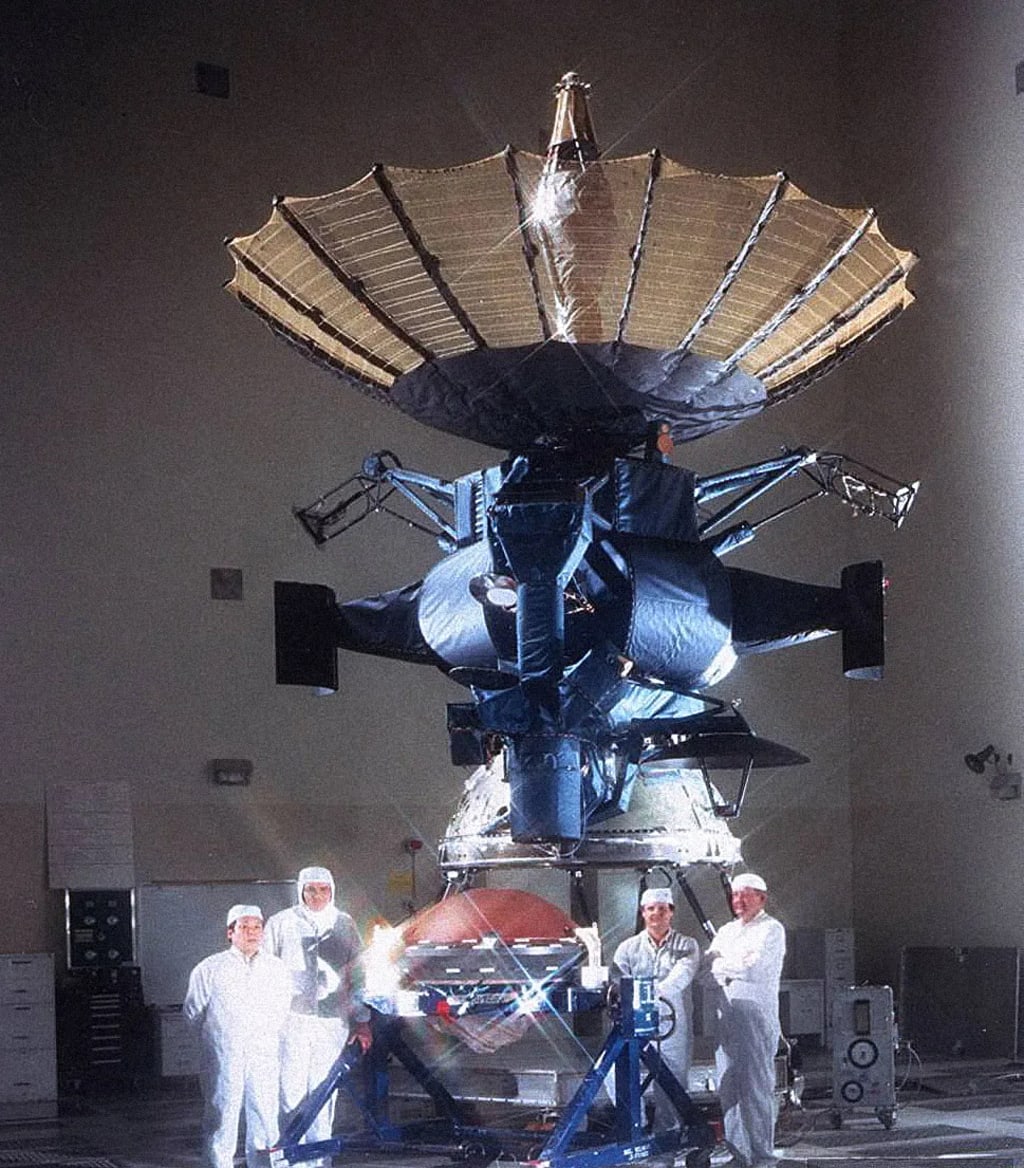
To enable data transmission over such vast distances between Earth and the Galileo spacecraft, engineers equipped it with a massive High-Gain Antenna."
"Due to the initial segment of Galileo's trajectory bringing it close to the Sun, there was a concern about potential damage to its High-Gain Antenna from solar exposure. Consequently, during the first half of its journey, the antenna remained stowed, resembling a folded umbrella. According to the plan, it was only in April 1991, when Galileo reached a more distant position from the Sun, that the ground control center would remotely command the deployment of the main antenna."
On April 11, 1991, when the control center sent the command to open the main antenna of the Galileo spacecraft, they discovered that the main antenna did not fully deploy. By this time, Galileo had been away from Earth for a year and a half, and scientists on the ground only knew that the antenna did not open as planned. The actual malfunction couldn't be directly observed.
Scientists had to rely on limited data transmitted by Galileo, such as its flight attitude, and use an identical replica on Earth for analysis and simulation. After eliminating various possibilities, scientists eventually identified the cause of the malfunction: before Galileo's launch, it underwent several transports and tests on the ground, during which the lubricants covering several frames and the oxidized layer wore off prematurely due to friction. In space, three frames and other metal components cold-welded together, and the antenna deployment mechanism on Galileo no longer had enough power to open them.
This probe, costing over a billion dollars and taking 25 years from design to the expected end of the mission, was on the verge of becoming space debris.
At this point, it was impossible for anyone or any machine to catch up with the probe for repairs. Engineers on Earth had to find ways to open the antenna using the existing components on the probe.
First, they attempted to rotate the probe through remote commands, making the antenna face and turn away from the Sun alternately, hoping that the stress from temperature differences could cause the frames to spring open. However, after seven cycles, the main antenna still did not open.
Next, engineers tried rotating another smaller antenna on Galileo to strike the probe, expecting the vibrations generated to pop the frames open. After six impacts, this method also failed.
Finally, engineers repeatedly opened the drive of the main antenna, which was meant to open it, at a specific frequency to increase the maximum power it could provide. Unfortunately, this method also failed.
In the end, the main antenna could not fully deploy.
Fortunately, Galileo still had a backup low-gain antenna. Although its transmission bandwidth was only about one-thousandth of the main antenna (8 to 16 bits per second), people had no choice but to use it for data transmission. However, due to advancements in ground receiving technology and information compression techniques, the bandwidth was eventually increased to about one-hundredth of the main antenna (1,000 bits per second). From 1991 until the end of the Galileo mission in 2003, people could only use this heavily discounted low-gain antenna for data transmission, although NASA claimed that Galileo still accomplished 70% of its scientific objectives.
The culprit behind this major trouble was the small phenomenon mentioned earlier, known as "cold welding."
About the Creator
Enjoyed the story? Support the Creator.
Subscribe for free to receive all their stories in your feed.
Comments
There are no comments for this story
Be the first to respond and start the conversation.