
Under Antarctica, a robot submarine discovers unidentified constructions before losing communication and vanishing.
The mission of Ran beneath the Dotson Ice Shelf

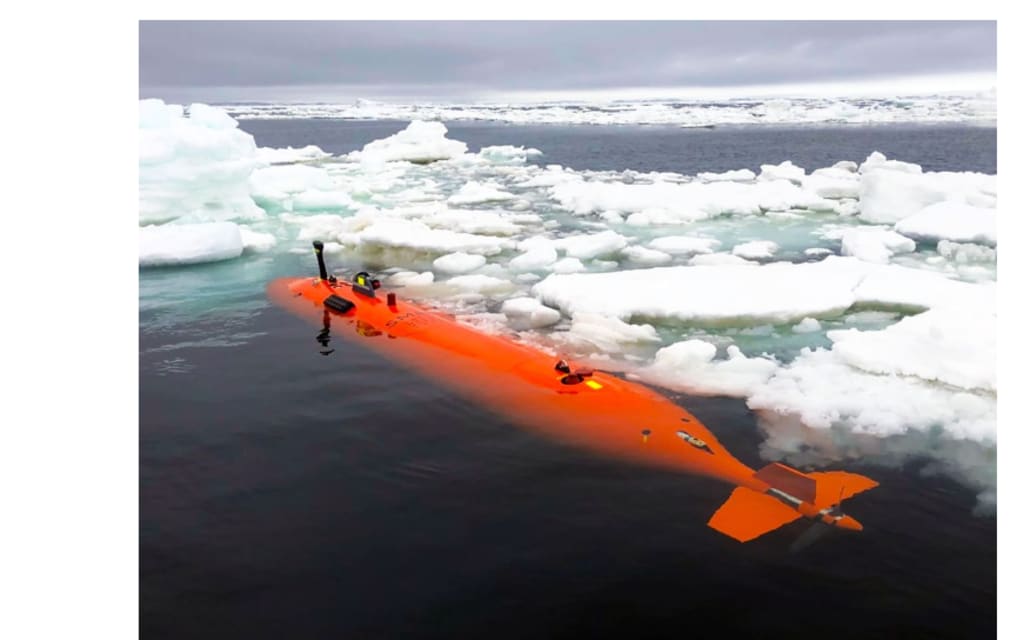
After travelling underwater for about 10 miles into the centre of the Dotson Ice Shelf in West Antarctica, an autonomous submarine investigating the shelf reported odd under-ice features before going silent. After spending weeks examining a region of about fifty square miles of ice, the vehicle known as Ran discovered patterns that defied basic melt models.
The mission of Ran beneath the Dotson Ice Shelf
Anna Wåhlin, an oceanographic physics professor at the University of Gothenburg, oversaw the Ran missions in West Antarctica. Her research focuses on how ocean currents alter glacier stability and future sea level by eroding ice shelves from below. Ran is a robot submarine that can navigate under ice by itself for hours on end.
Ran weaved beneath Dotson's floating ice for 27 days during a 2022 campaign, eventually travelling almost eleven kilometres into the concealed hollow. The goal of the trip was to provide an explanation for the stark difference between the thinner, faster-melting western side of Dotson and its thicker, slower-melting eastern side.
Ran disappeared after seeing weird stuff.
Ran studied the underside of 54 square kilometres of ice beneath the Dotson Ice Shelf using sonar. The maps showed teardrop-shaped holes, terraced steps, and flat plateaus all sculpted by basal melt, which melts the ice from below.
Ran noticed that the west appeared smoother, with channels and scooped depressions, while the east and center had frozen terraces stacked like steps. Until Ran's mission, none of these terraces or teardrop pits could be seen on satellite photos.
Uneven melting in warm, deep water
A warm, salty river from the Southern Ocean called Circumpolar Deep Water travels around Antarctica and melts ice shelves from below. Melt channels lose ice at a rate of roughly 40 feet annually, according to satellite altimetry over Dotson; this thinning trend is associated with warm water.
This ice shelf raised sea level by 0.02 inches between 1979 and 2017, according to measurements taken under Dotson. According to the under-ice maps, this warm influx concentrates erosion on the western side of Dotson, while the eastern flank is shielded by colder water.
Turbulence, teardrops, and terraces
The base of the ice resembles piled ledges where currents flow slowly because melting removes flats and leaves behind tiny steps. Currents provide smoother, grooved surfaces in the fast outflow region, where shear-driven turbulence and mixing from sliding water layers accelerate melting.
Currents at the ice base carved some teardrop-shaped pits that are 984 feet long and 164 feet deep. In other places, bursts of somewhat warmer water entering the hollow are likely recorded by the terraced plateaus. gradually removing ice layers over a long period of time.
Widening fractures from below
Ran also captured full-thickness fissures that cut through the ice shelf, several of which had melted and spread at their bases. Some of these fissures have been open since the 1990s, according to satellite records, and the oldest fractures have the deepest melt scars.
Faster-moving water can direct additional heat against the ice walls in these small openings, transforming fissures into covert routes for ice loss. The majority of computer models frequently ignore how fractures and channels direct warm water and concentrate damage since they handle melt in general terms.
Future sea level implications
Since 1979, Antarctic ice loss has raised sea levels by roughly 0.55 inches, according to combined satellite and climatic data. West Antarctica, where ice shelves like Dotson float over deep basins that warm currents can reach, accounts for a large portion of that loss.
Glaciers accelerate and sea levels rise more quickly when the floating shelves shrink or shatter because they are no longer supporting the land-based ice behind them. Researchers can now estimate how rapidly distant glaciers might react to climate change by understanding how warm water erodes Dotson's base.
Problems with the Dotson Ice Shelf
Because radio waves and GPS signals cannot travel through hundreds of feet of solid ice, Ran operated without real-time communication. Rather, the vehicle tracked its position against the bottom and the underside of the ice using acoustic equipment and navigation systems.
Issues beneath the ice were undetectable until Ran reappeared because typical expeditions lasted anywhere from a few hours to over a day. Despite these risks, the crew and Ran successfully completed 14 under-ice missions in 2022, returning with a dataset for oceanographers and glaciologists.
When the Ran submarine vanished
Ran was tasked with extending maps and observations under ice when the researchers returned to Dotson. "It is obviously intimidating to witness Ran vanish into the dark, uncharted depths beneath the ice, carrying out her duties without communication for more than twenty-four hours," Wåhlin remarked.
Attempts to get in touch with the car failed when Ran failed to show up at the pickup location, and searches turned up no signals or debris. The team can hypothesise about the cause, which might be anything from a collision with ice ridges to mechanical failure, because there was no feed.
The Dotson Ice Shelf and Ran
Ran's previous excursions changed the team's understanding of how the ocean and ice interact in this far-off hole, despite the loss. These maps demonstrate the presence of terraces, channels, fractures, and teardrops on the underside of an ice shelf, each of which reacts differently to currents.
Predictions of how quickly West Antarctica might lose ice in future temperatures should be more accurate when terraces, cracks, and melt channels are included in models.
About the Creator
Enjoyed the story? Support the Creator.
Subscribe for free to receive all their stories in your feed.
Comments
There are no comments for this story
Be the first to respond and start the conversation.