
Ukraine Has Built the World's Most Advanced Drone Defense System Under Fire. Now It's Sharing the Secrets With the Gulf. Here Is How It Actually Works.
Thousands of acoustic sensors. AI-powered threat identification. Ground robots completing 343 missions a day. Electronic warfare networks that turned the tide against Russian Shahed drones. Ukraine has become the world's most battle-tested drone defense laboratory — and it's now exporting that knowledge to countries facing the same Iranian threat.
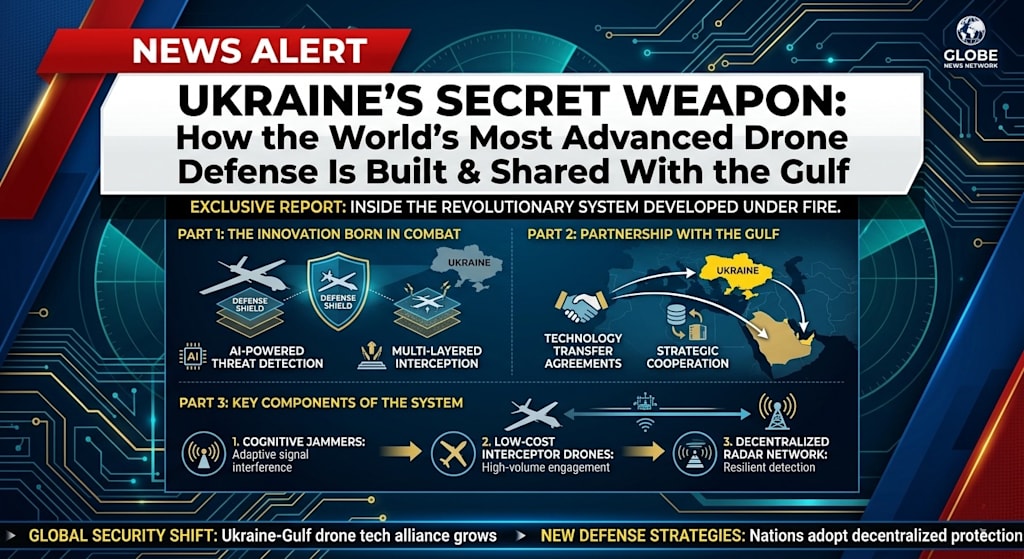
There is a technology story embedded in the Ukraine war that has been almost entirely overlooked by media coverage focused on death tolls, territorial maps, and diplomatic headlines. It is the story of how a country, facing an existential aerial threat with insufficient conventional air defense, developed — under fire, in real time, at enormous human cost — the most sophisticated drone detection and interception system the world has ever seen. And it is now sharing that knowledge with Gulf states facing the same threat from the same source: Iran's arsenal of Shahed-series attack drones, cruise missiles, and ballistic weapons.
Ukraine's drone defense architecture began as improvisation and became a science. In the first months of Russia's full-scale invasion in 2022, Ukraine lacked the Patriot air defense systems, the NASAMS networks, and the advanced radar installations that would eventually arrive from Western partners. What it had was necessity — and an engineering community that treated the problem as a design challenge. The result, developed over four years of continuous refinement under combat conditions, is a layered system that combines passive acoustic detection with active electronic warfare, mobile interceptor drones, ground-based anti-aircraft units, and AI-powered threat classification software that distinguishes between Shahed drones, Iskander ballistic missiles, Kh-101 cruise missiles, and decoy systems in real time.
"Ukraine doubled its midrange strikes on Russia in April compared to March and quadrupled them compared to February." — Ukrainian Defence Minister Mykhailo Fedorov, May 5, 2026
The scale of the system's output in April 2026 alone is staggering. Ukraine's Defence Minister Mykhailo Fedorov published a monthly battlefield report on May 5 confirming that Ukraine doubled its midrange strikes on Russia in April compared to March and quadrupled them compared to February. The midrange attack campaign focused on Russian warehouses, command posts, air defense systems, and supply lines up to 160 kilometres behind the front line. Ukrainian ground robots — autonomous and semi-autonomous vehicles designed for resupply and casualty evacuation — completed 10,281 missions in April, an average of 343 per day. These numbers reflect not just an effective fighting force but an industrialised, technology-intensive approach to warfare that is producing results at a rate and efficiency that Russia, with its far larger conventional army, has been unable to match or suppress.
Ukraine's acoustic sensor network deserves particular attention as a technological innovation. The system, described in a recent Al Jazeera analysis of Ukraine's air defense, uses thousands of sensors distributed across the country — in fields, on buildings, along road networks — that detect the acoustic signature of incoming drones long before they appear on radar. Shahed drones fly low and slow, specifically to evade conventional radar. Acoustic detection, combined with thermal imaging and electromagnetic signature analysis, allows Ukrainian operators to identify and track them from launch to interception. The data is processed by AI systems trained on four years of real engagement data — a training dataset that no other country possesses and that cannot be replicated in a laboratory.
This is precisely what Gulf states are buying when they partner with Ukraine on drone defense. They are not just buying hardware. They are buying four years of hard-won experiential data on how Iranian drone systems actually behave in real engagements — the flight paths, the jamming resistance, the targeting logic, the countermeasures that work and those that do not. The UAE has been absorbing this knowledge since at least late 2025, according to Zelensky's own statements. Saudi Arabia, Qatar, Kuwait, and Jordan are all receiving Ukrainian technical briefings. The Bahrain bilateral drone defense partnership that Zelensky proposed on Tuesday represents the most recent and most public step in what has become a systematic transfer of Ukrainian battlefield expertise to the Gulf region.
For Ukraine, this technology transfer serves multiple strategic purposes. It generates revenue and political goodwill at a moment when Western military support has become less predictable. It builds a network of states with a vested interest in Ukraine's continued survival and military capability. And it demonstrates — to domestic audiences in Kyiv as much as to international partners — that Ukraine is not merely a recipient of Western charity but a producer of military innovation that the world needs. The country that has been defending itself from Iranian drones for four years is now helping the countries that Iranian drones are currently attacking. The technology forged in Ukrainian fields under Russian bombardment is protecting oil facilities in Fujairah and airports in Dubai. War, in its terrible efficiency, has made Ukraine the world's most valuable laboratory for surviving the threat that is now keeping the Gulf awake at night.
About the Creator
Enjoyed the story? Support the Creator.
Subscribe for free to receive all their stories in your feed.
Comments
There are no comments for this story
Be the first to respond and start the conversation.