
They Dumped 20,000 Fish Into a River and Called It Kindness
A Guangzhou group skipped a required report, then asked, “Why should doing a good deed require a report?” Here is what 20,000 farmed mud carp do to native fish, water quality, and the idea that good intentions are enough.
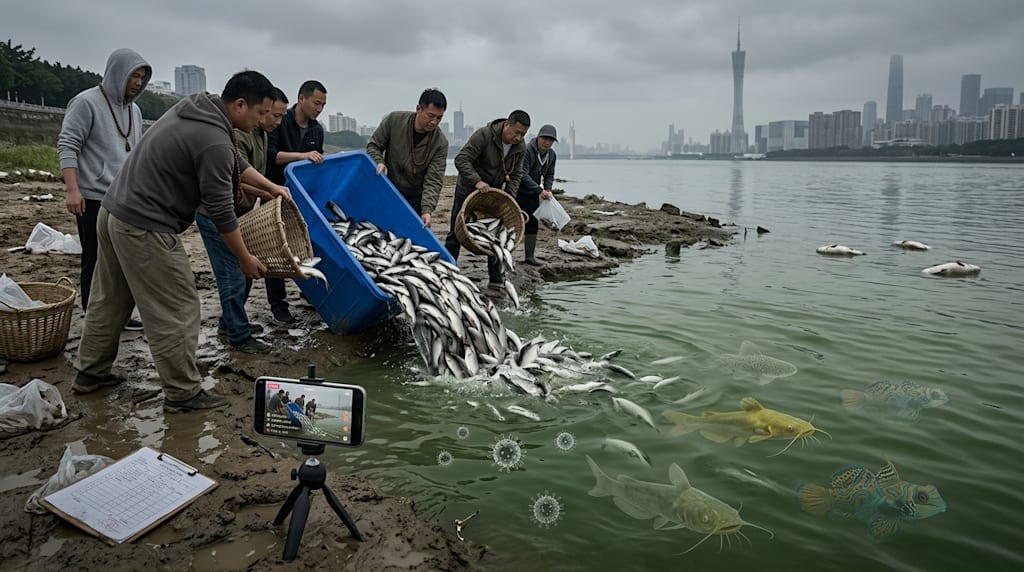
An animal-release group in Guangzhou found the official reporting rules too strict. The group released 20,000 mud carp directly into a river. One person said, “Why should doing a good deed require a report?”
That line sounds bold. It treats rules as something for ordinary people, while good intentions stand above them. Ecology does not work that way. Dumping 20,000 mud carp into open water does not become merit because someone chanted sutras and made vows. The fish compete for food. They excrete. They die. They carry pathogens. They may breed with wild relatives and push captive-bred genes into natural populations.
Reporting exists to assess ecological risk. It does not exist to approve your kindness.
Many people would rather believe “my heart is in the right place” than admit “my action may cause harm.”
1. Twenty Thousand Mud Carp Have About as Much Genetic Diversity as Seven or Eight Fish
Mud carp is not an invasive species like the pleco or the red-eared slider. It is a native fish in southern China and has lived in the Pearl River basin for a long time. The problem is not the species. The problem is 20,000 farmed mud carp dumped into open water all at once.
Farmed fish usually come from a small number of parents and many generations of inbreeding. Their genetic diversity is very low. Twenty thousand mud carp may look like a crowd, but genetically they may be copies of a few families. Pick seven or eight, and you can roughly cover the genetic diversity of all 20,000.
This does not supplement the wild population. It introduces a batch of genetically uniform fish into a natural water body. If they breed with wild mud carp or close relatives, they can dilute the genetic diversity that wild populations built through natural selection. Genetic diversity is what lets wild fish adapt to environmental change and resist disease. Pouring 20,000 near-clones into a river is like pouring 20,000 spoons of water into a pot of old broth.
Farmed fish can also carry genetic damage from repeated inbreeding. After largemouth bass was introduced to China, some farmers used unsold fish as broodstock. After several generations, the population showed early maturity, small size, slow growth, and poor feed conversion. Releasing fish like that into a river is not charity. It is genetic poisoning.
2. Farmed Fish Are Not Clean Fish
Many people think farmed fish are cleaner than wild fish because they eat feed and live in tanks. The opposite is often true. High-density farms are breeding grounds for disease. In a pond, medication can hold a disease down. In a river, there is no medication. Pathogens can spread to native fish.
One example is the channel catfish. After it was introduced to China from the United States, some individuals carried Edwardsiella ictaluri, a bacterium native to North America. It infects China’s native yellow catfish. In some farming areas, the bacterium spread and killed more than half the yellow catfish in the region. If channel catfish carrying that bacterium are released into natural water, native yellow catfish face a devastating outbreak.
You say you are doing a good deed. The yellow catfish that die in an outbreak have a different view.
Releasers see the fish in their hands. They do not see the microbes, parasites, and pathogens in the water. They think they are releasing life. They may be releasing disease.
3. Water Has Limits
How many fish a river can support depends on oxygen, food, spawning grounds, shelter, water quality, and the relationships between species. More fish is not automatically better. When 20,000 mud carp enter the same water body, they compete for food, oxygen, and space. They push out native fish, especially species with similar diets and overlapping habitats.
Large releases can also raise nutrient levels. Fish waste adds ammonia, phosphorus, and other nutrients. Algae bloom. Oxygen drops. If many fish die, the bodies decay, consume more oxygen, and release more nutrients. The cycle gets worse. What remains may be less life, not more. It may be stinking, oxygen-starved water.
The releasers think they are bringing blessings to the river. The river receives an overload.
4. Invasive Species and Off-Site Releases
When people release invasive species, the harm is direct. Red-eared sliders, tilapia, plecos, crayfish, and golden apple snails have all damaged native ecosystems. Plecos eat fish eggs and can consume thousands in a day. Red-eared sliders and tilapia have few natural predators and crowd out native species. Crayfish damage banks, eat aquatic plants, and change wetlands.
Even native species cannot be released anywhere. Moving a native fish to a water body where it did not previously live can create an out-of-range invasion. In Taiwan, the predatory striped snakehead was introduced and pushed native snakeheads such as Channa maculata and Channa asiatica into a few remaining waters.
A native species is not a free pass for any individual, any number, or any location. Release is not pouring fish from a scale into a river. It is putting artificially bred, possibly diseased, genetically uniform organisms into a complex ecosystem. That ecosystem does not owe your good intentions a favorable outcome.
5. The Law Sets a Boundary
The Ecological Environment Code of the People’s Republic of China, which took effect this year, states that no unit or individual may introduce, release, or discard invasive species without authorization. It also prohibits releasing aquatic invasive species, hybrids, and other organisms that do not meet ecological requirements into open water. The Ministry of Agriculture’s Regulations on the Administration of Aquatic Organism Stock Enhancement and Release require individuals and units conducting large-scale releases on their own to report to the county-level or higher competent department 15 days in advance and accept supervision.
These rules are not harassment. Large-scale release is ecological intervention. Scientific stock enhancement requires an assessment of the water body’s carrying capacity, local original stock or first-generation offspring, quarantine, and supervision. When releasers skip the work, the ecosystem absorbs the cost.
Illegal release is not a minor matter. Under the law, unauthorized release of invasive species or organisms that do not meet ecological requirements can lead to fines, ecological restoration payments, and criminal liability in serious cases. “Doing a good deed” is not a legal defense.
6. Merit Logic and the Release Business
Many releasers do not care about ecology. They care about merit. Releasing 20,000 fish feels like a large donation to a merit box. Then they leave with a clear conscience. They do not ask whether the fish survive, spread disease, or crowd out native species.
Release has become a business. Online proxy-release services exist. Some people livestream releases. You pay. Someone else releases. You get comfort. The seller gets money. The river and native species get the consequences.
Responsible action means accepting the outcome. Releasing 20,000 fish may fill a hole in your heart. The river should not have to fill that hole for you.
7. What Protecting a River Actually Requires
Ecological protection means protecting habitats and the integrity of native populations. It does not mean dumping life into nature and walking away.
If you want to help:
Support professional stock enhancement projects that use local original stock or first-generation offspring, with quarantine and assessment.
Join habitat work: clean river trash, reduce pollution, protect wetlands.
Do not buy, release, or pay for proxy releases. Do not release invasive species.
Report illegal releases to agriculture, ecology, environment, or fisheries authorities.
Explain to others that release is not protection.
Good intentions without knowledge help the harm. Release without science is willfulness and damage, not compassion or merit.
The long river still flows. The spotted mandarin fish of the old days are gone. That is not a slogan. It is a warning.
Dumping 20,000 mud carp into the water will not make the world better. It will make the river more crowded, native fish more vulnerable, pathogens more mobile, and the releasers more comfortable with themselves. The responsible line is “I take responsibility.” If reporting feels too strict, release nothing. The river does not need your merit. It needs you to stop adding to the mess.
About the Creator
Jin
Writer of reamstories
https://reamstories.com/jin
Enjoyed the story? Support the Creator.
Subscribe for free to receive all their stories in your feed. You could also become a paid subscriber, letting them know you appreciate their work.
Comments
There are no comments for this story
Be the first to respond and start the conversation.