
They Can Dive 70 Meters Without Gear. The Law Says They Don’t Exist.
The Bajau have spleens 50% larger than their farming neighbors and no birth certificates. When the sea nomads are forced onto land, what happens to a people the state never recorded?
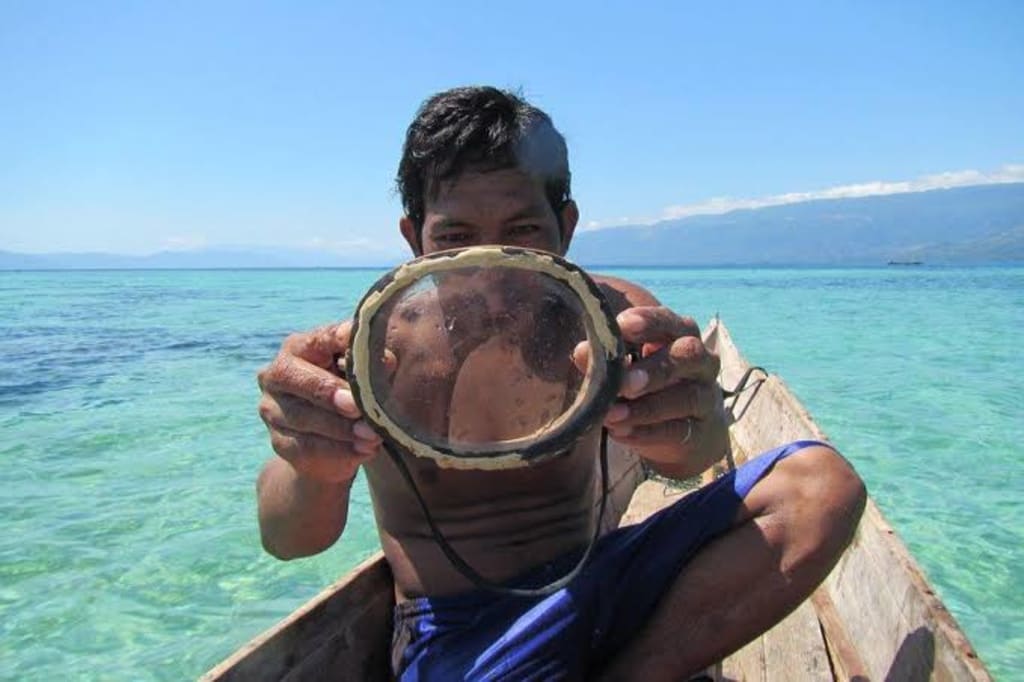
At five in the morning, the sky was not yet fully light. Amir pushed the lepa boat out from the shore. The wooden hull scraped across the sand of the shallows with a dry, rasping sound. He stood barefoot on the boat’s planks, his toes gripping the grain of the wood as if gripping a familiar stone. There was no diving equipment on board. No fins, no tank, no wetsuit. Only a pair of wooden goggles, the lenses old plastic, the edges wrapped in tape, and a spear gun, its shaft forged by a blacksmith, its head bound with rubber bands.
He put on the goggles, dipped his face into the water, and took a look at the seabed. Then he inhaled. Not deeply, just filling his lungs. He went down.
The water closed over his head. No bubbles rose. He swam downward, hands at his sides, feet kicking like a frog. Ten meters, twenty meters, thirty meters. The water pressure pressed against his eardrums. He pressed his palms to his ears and swallowed. Forty meters. Fifty meters. Sixty meters. The seabed spread out beneath him, coral like a pile of gray stones, fish moving between the stones. He fixed his eyes on a grouper. The rubber band of the spear gun pulled taut. The iron arrow shot out. The fish struggled once, then stopped moving.
He kicked upward. The surface appeared above him like a gray ceiling. He broke through, and when the first breath went in, a sound came from his throat like wind passing through dry bamboo.
His time at seventy meters was about two minutes. He did not wear a watch. His body knew.
Amir took the fish off the spear and threw it into the bucket at the stern. There were already four fish in the bucket. He sat on the boat’s planks and pressed his ears with his palms. His eardrums hurt a little. When he was a child, his father had pierced his eardrums with a sharp wooden stick. His father said that this way, the water pressure would not hurt when he dived. He did not know whether that was true. His hearing had been poor since he was thirty. But he could feel the water pressure pushing in through his ear canals, like a hand squeezing his skull.
His son watched him from the stern. The boy was eight. The day before, Amir had taught him to swim. The boy thrashed in the water, swallowed a few mouthfuls, and cried. Amir said nothing. He pulled the boy out of the water and set him on the planks. The boy cried for a while, then stopped. That morning, the boy jumped into the water by himself and swam five meters.
Amir looked at his son and said nothing. He picked up the oar and rowed toward shore.
In a village near Sulawesi, Melissa Ilardo placed an ultrasound probe against a man’s ribs. The man was called Rahman, in his forties, a Bajau. He lay on a wooden bed covered with plastic sheeting, looking at the ceiling. Gel had been spread on the probe. It was cold. Ilardo watched the screen.
A gray shape appeared on the screen.
“What is that?” Rahman asked.
“Your spleen,” Ilardo said.
Rahman lifted his head and glanced at the screen. He did not recognize the shape. He only knew that the left side of his belly sometimes felt swollen. He asked, “Is it big?”
Ilardo said, “Bigger than average.”
Ilardo’s team measured fifty-nine Bajau villagers and thirty-four Saluan people. The Saluan lived twenty-five kilometers away, farmed, and did not dive. The Bajau spleen was on average fifty percent larger than the Saluan spleen. Among the Bajau, the divers and non-divers had spleens of about the same size. The difference was not from diving. It was written in the genes.
Genetic comparison found a variant called PDE10A. This gene affects the thyroid. The thyroid affects the spleen. Another variant, BDKRB2, affects the diving reflex. During a dive, the blood vessels in the limbs constrict, and blood is squeezed from the hands and feet back into the core organs. The spleen contracts and squeezes its stored oxygen-carrying red blood cells into the bloodstream. The Bajau have larger spleens and store more red blood cells. When they dive, they have ten percent more oxygen than other people.
Ilardo removed the probe from Rahman’s ribs and wiped off the gel with a tissue. Rahman sat up and pulled down his shirt. He asked, “Can this spleen be sold for money?”
Ilardo did not answer. She packed the ultrasound machine into its case.
Nico Ansboy stood in court. He was eighteen. He had been born in Sabah. His parents were Bajau Laut, without documents. He also had no documents. He had never left Sabah.
The judge asked, “Where were you born?”
Nico said, “Sabah.”
The judge asked, “Do you have a birth certificate?”
Nico said, “No.”
The judge asked, “Do you have an identity card?”
Nico said, “No.”
The judge asked, “Do you have a passport?”
Nico said, “No.”
In Nico’s pocket was a piece of paper. It was a statutory declaration signed by the village head, certifying that he had been born in Sabah and that his parents were Bajau Laut. He took out the paper. The judge glanced at it and said, “This is not an official document.”
Nico was charged with illegal entry into Sabah. If convicted, he faced a fine of up to ten thousand ringgit, five years in prison, or whipping. His lawyer said he had been born here. He had never entered anywhere. But in legal terms, without documents, he had no place of birth. He stood in court. The slippers on his feet were borrowed. He looked at the judge. The judge looked at him. Between them was a table, and on the table was a law book.
The court allowed him to be released on two thousand ringgit bail. When he walked out of the court, the sun outside was very bright. He squinted. He had nowhere to go. He had been born in Sabah, but in the eyes of the law, Sabah did not know he existed.
At the Semporna jetty, boats set out every morning. Tourists carried oxygen tanks, wore wetsuits, and strapped on dive watches. They went to Mabul Island, to Kapalai, to Sipadan. As a boat passed a cluster of stilt houses, a tourist raised a camera. The houses were built of wood, their pillars driven into the sea, their roofs made of corrugated iron. In front of one house, a child sat on a plank, feet in the water. The tourist pressed the shutter.
The boat moved on. The wake rolled back and struck the wooden pillars of the stilt house. The pillars swayed. The child watched the boat. On the boat, the tourist was looking at a phone, checking the photo just taken. In the photo, the stilt house was very small, the child was very small, and the sea was very blue.
The child pulled his feet out of the water. He stood up and went inside. Inside were a hammock, a pot, and a few clothes. He picked up a plastic bag. Inside it was glue. He sniffed it.
The tourists kept coming. Nearly two thousand came here every day to look at the sea, the coral, and the Bajau stilt houses. The Bajau Laut lived on the outskirts of the tourist area, without clean water, without electricity, without garbage disposal. The tourist area’s trash drifted under their houses. When tourists saw the trash, they said the Bajau had dirtied the sea.
The Regatta Lepa was held every year. Bajau boats were decorated, strung with colorful flags, and paraded on the sea. Tourists took photos. Government officials gave speeches. The Bajau rowed. When the race ended, the flags were taken down. The boats returned to shore. The Bajau returned to their stilt houses. The tourists returned to their hotels. No one picked up the trash on the beach.
On Omadal Island, the afternoon sun was very hot. In a classroom built of wooden planks, a dozen children sat on the floor. The walls were wooden boards. The roof was corrugated iron. On the blackboard were a few words: My Name. A girl walked to the blackboard and picked up a piece of chalk. The chalk broke. She picked up the broken half and wrote her name on the blackboard. The letters were crooked. When she finished, she looked back. A boy a few years older nodded. His name was Bilquin, and he was a young teacher at the school.
The school was called Iskul Sama DiLaut Omadal. Iskul meant school in the Bajau language. The school had been founded in 2015. The people who founded it were Bajau children and women on the island. They taught in Bajau and Malay. Bilquin had previously studied at a Malaysian school. After class, he returned to the island to teach children who had no documents. The children had no documents and could not go to Malaysian schools. They could only stay on the island and learn from Bilquin.
Bilquin said, “I hope more children will master reading, writing, and arithmetic, so they won’t be easily cheated by those who always look down on our community.”
He paused, then said, “I do admit that one of the social ills many people here face is glue sniffing. That is why I feel it is important for young people like me to do what we can to help uncover the potential of the children here. How long can this life of ours, uneducated, bullied, cheated, go on?”
In the classroom, the girl finished writing her name and sat back down on the floor. The next child stood up and walked to the blackboard. The chalk broke again.
In June 2024, bulldozers came to seven islands in Sabah. The Bajau Laut stilt houses were demolished. More than five hundred people were displaced. The authorities said the houses were illegally built. The authorities said it was for national security. The authorities said it was for the environment.
The bulldozer tracks rolled over the wooden planks. The sound of the planks splitting was like bones breaking. An old man sat on the shore, watching. His house had still been there ten minutes earlier. Now wooden planks and corrugated iron drifted on the sea. His pot was in the water. His hammock was in the water. His clothes were in the water. He sat on the shore, feet on the sand. The sand was wet. He did not move.
The Human Rights Commission of Malaysia later conducted an investigation. The investigation said the eviction had caused serious consequences, including displacement and major disruption to livelihoods. Amnesty International Malaysia said the government should stop the eviction of Bajau Laut people, address the human rights violations, and not punish those who expose what is happening.
The old man sat on the shore. The bulldozer drove away. On the sea, the wooden planks drifted into the distance. He stood up, walked into the shallow water, and pulled out a plank. He dragged it onto the shore and laid it on the sand. Then he walked back into the water and pulled out another. He went back and forth many times. The planks piled up on the shore. He did not know whether these planks could still be used to build a house. He walked back into the water.
Amir rowed the boat back to shore. The sun had risen. He poured the fish out of the bucket: five groupers, two snappers. He put the fish into a plastic bag and handed it to his wife on the shore. She took it without speaking. She crouched down and began scaling the fish. The scales glittered silver in the sunlight. Amir sat on the boat’s planks and took off his goggles. The tape on the lenses had come loose. He pressed it with his fingers.
His son sat at the stern, feet in the water. The boy asked, “Dad, when can I go down with you?”
Amir said, “When you can hold your breath for two minutes.”
The boy said, “I can do one minute now.”
Amir said, “Practice more.”
The boy pulled his feet out of the water, stood up, and walked to the bow. He picked up the spear gun, copied Amir’s posture, pulled the rubber band taut, and shot at the air. The iron arrow flew out and fell into the water. The boy watched the arrow sink. Amir watched his son. He said nothing. He picked up the oar and pulled the boat a little closer to shore.
The lepa boat lay at the shore. The sail was not raised. The wood had been bleached pale by the sun. The sea swayed beneath the hull. In the distance, a tourist boat came over from the island, people on board taking photos. Amir put the goggles into a plastic bag and sealed it. He stood up, stuffed the bag into a gap beneath the boat’s planks. He stepped ashore. His footprints remained in the wet sand. The seawater rose and filled them in.
About the Creator
Jin
Writer of reamstories
https://reamstories.com/jin
Enjoyed the story? Support the Creator.
Subscribe for free to receive all their stories in your feed. You could also become a paid subscriber, letting them know you appreciate their work.
Comments
There are no comments for this story
Be the first to respond and start the conversation.