
Theories on the formation of Earth's crust are being rewritten by an underwater volcano in the Pacific Ocean.
When the crust consumes itself

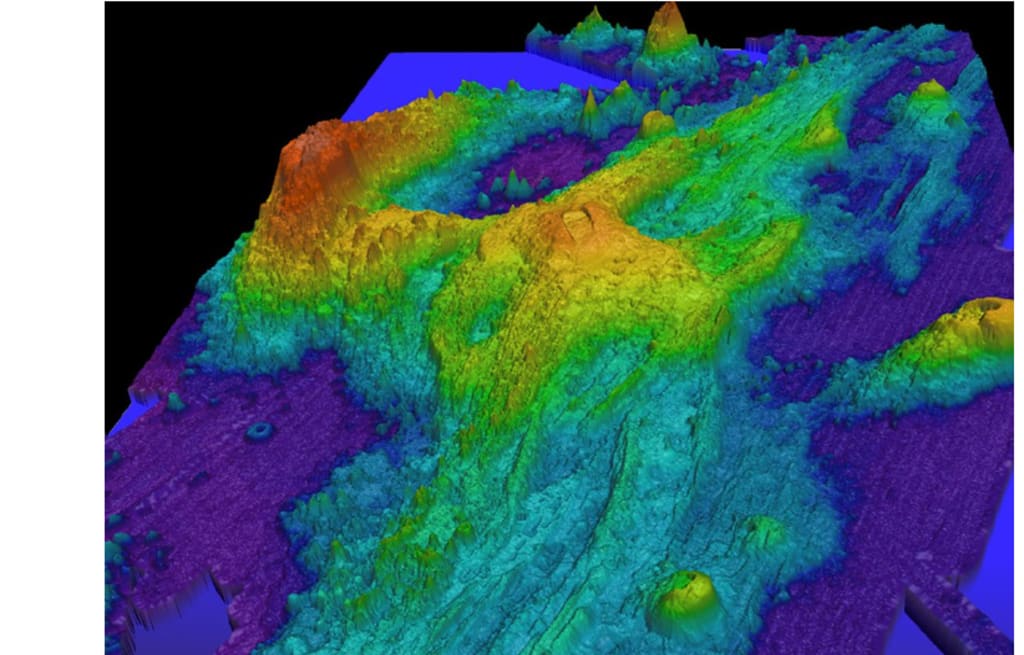
Axial Seamount is a restless undersea volcano off the coast of Oregon that has been seen for decades. Seafloor instruments are used by scientists to monitor its inflation, trembling, and approximate eruption time. However, nobody had seen what was truly inside.
The structure didn't match what textbooks predicted when a team eventually created a three-dimensional map of the volcano's interior. Something that geologists believed to be universal was absent.
The typical model
Geologists have relied on a clear template for decades. Two separate layers are located above a deep magma chamber: a thicker zone of vertical fissures filled with hardened magma lies below the lava flows on top.
It was supported by drill samples and exposed ancient seabed on land. Each eruption was fuelled by the fractures, the lava cooled, and new oceanic crust formed, slab after slab.
That functions well at many ridges. However, what about regions where magma is pumped into the same area for hundreds of thousands of years by a hotspot, a continuous heat source originating from deep under the Earth? This beast is very different. At the Institut de Physique du Globe de Paris (IPGP), Satish C. Singh, Ph.D., and a group of U.S. Colleagues searched for proof.
Axial Seamount Mapping
Axial Seamount is situated at the intersection of the Cobb hotspot and the Juan de Fuca Ridge, a Pacific seafloor rift, about 300 miles (480 kilometres) off the coast of Oregon. 4,600 feet (1,400 meters) below the surface is a horseshoe-shaped crater.
In recorded history, the seamount has erupted three times: in 1998, 2011, and 2015. 2019 saw the towing of sound-receiving cables over a 25-by-10-mile (40 by 16-kilometer) area of seafloor above Axial by a research vessel. It recorded the echoes of sound waves bouncing off the rock.
In order to map the inside of the volcano down to the molten rock below, Singh's team reprocessed those recordings using more precise techniques than had been used in a previous study.
An absent layer
The new 3D pictures reveal something that was not anticipated in the textbook. Between the lava and magma should be a thick area of vertical fissures known as sheeted dikes. It's not present. Over 9,800 feet (3,000 meters) of lava flow layers drop to the top of the magma reservoir. There is nothing separating them.
Since lava must somehow reach the surface during eruptions, there must still be some vertical fractures. However, the traditional dike layer is absent in the majority of the survey region.
Another strange thing is done by the layers of lava. They curve down toward the core crater and lean inward rather than laying flat. Near the magma below, the deeper layers tilt more sharply—up to 18 degrees.
Singh's group identified two probable reasons for this. The volcano's flanking fissures gradually widened, creating room below. The seafloor may slump as a result of large eruptions draining the reservoir. The hollow is then filled with fresh lava.
Magma moves sideways.
This is when the surprise increases. Molten rock is seen moving outward along the lava layers themselves in the three-dimensional pictures. Instead of erupting as vertical fissures, these flat sheets of magma, known as melt sills, inject horizontally into the earlier lava.
Until date, no one has seen this type of sideways intrusion inside the upper crust of an active volcano. The sideways movement implies that the plumbing of the volcano operates in a manner that the conventional model never took into consideration. Its architecture is completely different.
When the crust consumes itself
The 3D photos demonstrate the direct interaction between the hot magma reservoir and the deeper lava layers. Ocean rock that has been soaked in water melts at about 1,470°F (800°C), which is much lower than the temperature of fresh magma, which is higher than 2,000°F (1,093°C).
According to Singh's research, contact is sufficient to melt the old lava and draw it back into the magma beneath. This is not the only place where the crust is expanding. It might be recycled as well.
Geochemists had previously suggested this type of mixing due to peculiar lava chemistry, therefore the concept is not new. However, the physical configuration that would enable it is depicted in the 3D graphics.
Icelandic echoes
These kinds of tilted lava strata have only been observed in Iceland, which is situated over a hotspot. Similar to Axial Seamount, the layers there dip inward toward the expanding ridge.
Previous research attributed the tilt to the weight of the heaped lava. The researchers speculate that the deflation of a magma reservoir following each major eruption may be responsible for the majority of the bending.
If that is the case, the formula for creating crust at hotspot-fed ridges, such as the ridge that formed Iceland, might be significantly different. Only in areas with a lower magma supply may the thick dike layer emerge.
Axial Seamount's Future
An enormous eruption of Axial Seamount is long overdue. Since 2015, the volcano has expanded, and seismic monitoring indicates that it is intensifying in preparation for another eruption. The system in motion—new magma ascending, the reservoir deflating, the seafloor sagging—will be captured by instruments on its cabled observatory.
The discovery modifies the appearance of the upper crust near a hotspot-fed ridge. It is a tower of lava flows linked sideways with molten sheets rather than a neat, two-layer cake. Additionally, where it comes into contact with the reservoir below, it partially melts.
There is now a new benchmark for researchers investigating Iceland, ancient seabed slabs exposed on continents, and other hotspot-fed ridges. It is obvious that the description of how seas create their floor in textbooks needs to be carefully revised.
About the Creator
Enjoyed the story? Support the Creator.
Subscribe for free to receive all their stories in your feed.
Comments
There are no comments for this story
Be the first to respond and start the conversation.