
The "Wife-Stealing" Festival Is Not What You Think
Inside the Wodaabe Gerewol, where men spend six hours on makeup, women choose their partners, and a tabloid headline got everything wrong.
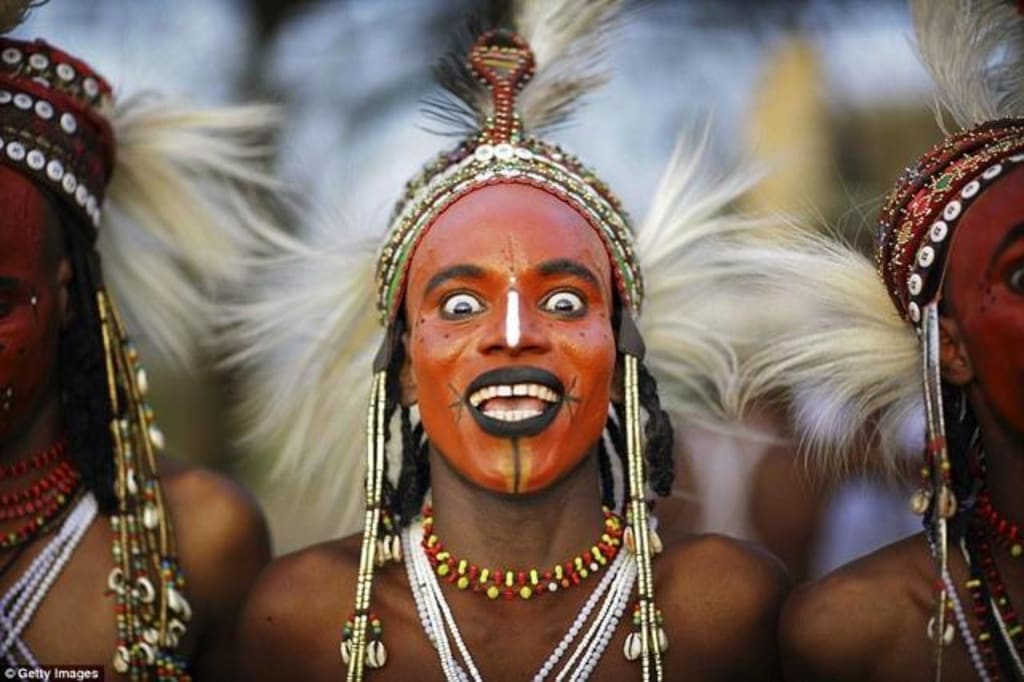
The Gerewol Festival: A Photograph, a Headline, and the Women Who Choose
In July 2015, a photographer in In-Gall, Niger, took a picture of dozens of Wodaabe men standing in a line. Their faces were covered in red ochre, their eyes outlined in black, their lips painted with a pigment made from burnt egret bone. White ostrich feathers rose from their hair. A British tabloid ran the photo under the headline "The Wife-Stealing Festival." Three days later, Chinese websites picked it up. The comments were about the makeup. Nobody asked why the men were wearing it.
The festival is called Gerewol, and it lasts seven days and seven nights after the rainy season. The Wodaabe are a branch of the Fulani, herders who move with their cattle across the Sahel from southern Niger to northern Nigeria, Cameroon, and Chad. Once a year, clans that have not seen each other for months gather in the same place to trade, argue, settle debts, and marry. The dances are the center of it.
The dance is called Yaake. Men dance; women judge. A man who wins does not win a wife the way a runner wins a medal. He wins the right to be chosen. A married woman can also choose him, leave her husband, and go with the dancer. The Wodaabe call this te‘egal, a recognized form of marriage. The word means a woman has chosen.
To understand te‘egal, follow a girl. Before she is born, her family may promise her to a boy from the same clan. This is koobgal, a contract between families. She grows up, lives with her husband until she becomes pregnant, and then returns to her mother's camp. For two or three years she is boofeydo. She cannot contact her husband. He cannot visit her or show interest in her or the child. If he does, the other men laugh at him.
After that, she is free to go to Gerewol. She walks among the dancers, watching and laughing. She comments on what she sees. If she likes a man, she taps him on the shoulder. He lifts her onto his shoulders and carries her away. Her first husband knows the rule and does not chase them. The next morning she is in another camp, with her cattle. Her relatives are not surprised. The two clans are now connected.
This is why the word "steal" does not fit. A theft requires a victim. In te‘egal, the woman starts the action. The husband loses a wife, but he does not lose property. The wife is not property. The marriage was a negotiation that could be renegotiated.
The men prepare for hours. A dancer named Bello sits in front of a small mirror for six hours. He mixes red ochre with oil and covers his face. He takes a thin stick, dips it into black pigment, and draws a line from the corner of his eye to his temple. The line must be straight, long, and steady. He draws it three times before he is satisfied. His friend watches and says, "Your nose is not proud today." Bello adds another white arrow on his nose. He pulls his lips back to check his teeth. They are white. He practices the grimace: eyes wide, teeth bare, lips pulled back. It looks frightening to an outsider. To the Wodaabe, it is beauty.
The Wodaabe ideal is tall and thin, with a long face, wide eyes, a straight nose, and white teeth. But the quality that matters most is togu: charisma, presence, the ability to hold a crowd. A man can be handsome and still lack togu. A man with togu walks into the dance and the women turn their heads. He does not need to explain why. The dance does the work.
The dance is not a performance for tourists. The Wodaabe say it is a prayer for rain. The rainy season has just ended, the grass is green, the cattle are fat, and the herds have survived another year. The dance gives thanks and asks for another year. The men stamp their feet, sing, roll their eyes, and show their teeth. The women walk among them. They are not silent; they point, whisper, and choose.
Anthropologist Mette Bovin spent years with the Wodaabe. She wrote that their art follows a rule of symmetry and order. The body becomes a sculpture. The makeup aligns the person with the universe rather than decorating the face. Red ochre is the color of blood and violence, used only on special occasions. Yellow clay is the color of magic and transformation. Black is the opposite of white, and white is the color of loss and death. When a man paints his face, he is not hiding. He is showing what he is supposed to be.
The outside world arrived with cameras. National Geographic published photos, documentaries were made, and tourists came to In-Gall. Now some Wodaabe perform for money. They put on makeup for lenses and dance for people who do not speak their language. A French tourist raises a camera. A dancer stops, looks at the lens, and continues. An elder says, "They take their pictures. We dance ours." Young men leave for cities and come back with phones. The festival continues, but the audience has changed. The women still judge, the men still dance, and the cameras still click.
On the last day, the winner receives a long staff. He walks toward the woman he wants. She can take the staff or turn away. If she takes it, they walk out of the crowd together. The sand is hot, the cattle are waiting, and the drums continue. This has happened for hundreds of years. On the Chinese internet, it is called "wife-stealing." The staff is a ceremonial object. The woman is a person who chose. The word "steal" belongs to the headline, not to the sand.
About the Creator
Jin
Writer of reamstories
https://reamstories.com/jin
Enjoyed the story? Support the Creator.
Subscribe for free to receive all their stories in your feed. You could also become a paid subscriber, letting them know you appreciate their work.
Comments
There are no comments for this story
Be the first to respond and start the conversation.