
The Whale Who Wouldn’t Let Go
Tahlequah carried her dead calf for seventeen days, 1,600 kilometers, and into the heart of the world
1. The Temperature Began to Drop to 37°C
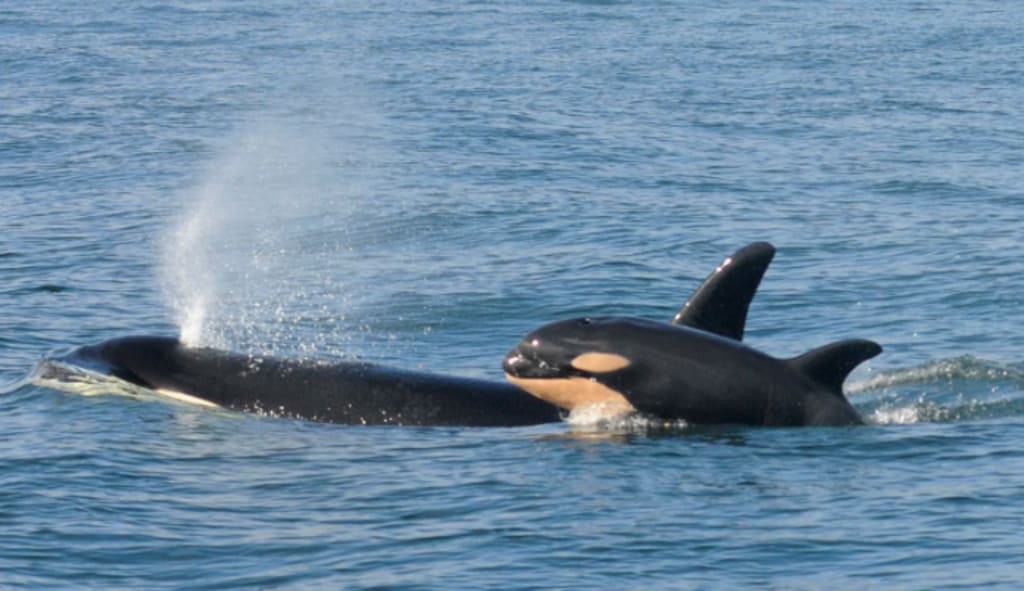
July 24, 2018. The water temperature in the Salish Sea was twelve degrees Celsius. Tahlequah gave birth to a female calf in the waters near Victoria, Canada. Researchers on shore counted through telephoto lenses: the calf was about two meters long, its skin tinged orange‑red, the color of a newborn killer whale’s vernix. It struggled to the surface, took a breath, and sank again. The mother pushed it up with her rostrum, three times. The fourth time, the calf did not move.
From birth to death: thirty minutes.
Tahlequah stopped in the water. She did not swim. Her blowhole opened and closed twice. Then she gently rested the calf’s body on her forehead, the same way she had carried it when it was alive. Other members of J pod swam past her. A few adult females slowed down, but none stopped. They moved on. Tahlequah followed at the rear.
That day, she did not feed.
2. A Weight That Should Not Have Been Let Go
A killer whale mother typically abandons a dead calf within a day or two. Tahlequah did not.
She balanced the calf’s body between her rostrum and forehead. Every few hundred meters, the body would slip slightly sideways from the current, and she would dive down and retrieve it. Through it all, her tail flukes struck the water noticeably less often: each dive burned through her fat reserves.
On the seventh day, researchers caught her image again in Haro Strait. Her torso was thinner than a week before; the “saddle patch” behind her dorsal fin had begun to show indentations. Yet she still carried that small, no longer intact body. The calf’s skin had started to slough off. Its tail flukes had turned pale from the seawater.
Deborah Giles, a biologist at the University of Washington, wrote in her field notes: “She’s not ready. None of us gets to make that decision for her.”
3. The First Time Someone Else Held It (Emotional Peak ①)
On day eleven, J pod slowed near San Juan Island.
An older female, J19, Tahlequah’s aunt, swam to her side. She rolled slowly beneath Tahlequah and gently supported the calf’s body from underneath with her own back, holding it for about four minutes. For those four minutes, Tahlequah straightened her cervical spine for the first time, lifting her forehead free of that weight. She exhaled a plume of mist, then circled beside her aunt and touched her with a pectoral fin.
Researchers picked up a high‑frequency “chattering” on their hydrophone: the kind of contact call killer whales use for reassurance.
Four minutes later, Tahlequah took the body back on her forehead. But that afternoon, two more females took turns carrying it for her. Once, she even drifted two meters away from the body and chased a salmon. She did not catch it. She turned back.
That was the only time she tried to eat all afternoon.
4. A Fear That Was Never Spoken (Precursor to the Dark Moment)
On day thirteen, her body gave a clear warning.
A killer whale’s breathing rate is about one to two breaths per minute. That afternoon, Tahlequah’s intervals stretched to six or eight seconds between blows. Her swimming speed dropped from her normal seven kilometers per hour to under four. The pod began moving southeast toward denser Chinook salmon runs. Tahlequah lagged nearly a kilometer behind.
She did not call for help.
Not because she didn’t want to. The matrilineal bond of Southern Resident killer whales is unbreakable: a mother never voluntarily leaves her calf, even after death. This bond is not learned; it is a response sequence encoded in her genes. For her, the act of letting go had no corresponding instruction.
So she kept carrying that increasingly light, increasingly fragmented body on her forehead. Her body burned through its own muscle to maintain her core temperature. Her rostrum had developed tiny scratches: the marks of repeatedly diving and scraping the calf against the sandy seafloor.
5. The Breath That Almost Was, Then Wasn’t (Emotional Peak ②: The Almost‑Kiss Interrupted)
On the evening of day sixteen, something happened that made every observer hold their breath.
Tahlequah stopped. She slowly lowered the calf’s body from her forehead to the water’s surface, then gently touched its mouth with her rostrum. The movement was identical to the first “kiss‑touch” a mother killer whale gives her newborn, using a burst of air to clear the calf’s blowhole and help it take its first breath.
She completed the motion. Then she paused.
The body did not respond.
She brought her rostrum to the calf’s blowhole again, the gesture lasted nearly ten seconds. Researchers watching the footage saw a small puff of mist escape from her own blowhole, as if she were trying to inflate a chest that no longer had a heartbeat.
Then came the boat noise.
A sightseeing vessel’s propeller noise approached from a distance, at roughly 1.5 kilohertz: right in the middle of the killer whale communication band. Tahlequah’s head jerked upward. The calf’s body slipped from her rostrum and sank about half a meter. She dove immediately and retrieved it. But that motion, the attempt to breathe life back into a dead child, was never repeated.
She turned and followed the pod into deeper water. The weight on her forehead now felt more like a stone.
6. Pushing Away Every Hand That Reached For Her (The Fracture Before the Break)
On the morning of day seventeen, researchers attempted to approach Tahlequah’s pod, hoping to retrieve the calf’s body during her next dive—to keep her from consuming herself further.
Tahlequah’s response exceeded every prediction.
When she sensed the research vessel closing the distance, she did not drift away slowly as usual. She surged forward. With her head still balancing the body, she shot in the opposite direction at twice her normal tail‑beat frequency, veering more than two kilometers off the pod’s course. Her breathing grew rapid. Her body arched. Her tail flukes slapped the water in dull, percussive cracks.
This was not avoidance: this was a stress response of active rejection. Her entire body was saying: do not come closer.
The research vessel backed off. Ken Balcomb said over the radio: “We can’t push her. If she drops the calf because of stress, it will sink, and she’ll suffer more.”
That morning, Tahlequah swam nearly ten extra kilometers in a loop, rejoining the pod only after a long detour. Her dorsal fin had taken on a slight lean—the posture of an orca running on empty.
7. Nothing on Her Forehead (The Dark Moment)
On the afternoon of day seventeen, sunlight broke through the clouds, and the sea turned a pale gold.
Tahlequah swam to the center of the pod. She slowed. She dipped her head beneath the surface. Then she lifted it slowly.
Her forehead was empty.
The calf’s body was no longer there.
No one saw exactly which dive she had taken without surfacing with the calf. Researchers scanned through their scopes repeatedly. Nothing floated on the surface. That small body, carried for seventeen days, over more than 1,600 kilometers, had finally sunk somewhere in the deep Pacific.
Tahlequah swam with the pod. Normal speed. Normal breathing rate. She even chased a passing Chinook, bit it once, spat it out, and kept moving.
But her forehead never lifted. She kept her rostrum low, nearly skimming the waterline, as if searching for something. The gesture lasted nearly two hours.
That evening, J pod lingered for a long time in a bay west of San Juan Island. Tahlequah floated on the surface. She did not sleep: orcas typically sleep while swimming. She simply floated, dorsal fin exposed, blowhole puffing mist every dozen seconds. No other orca was near her. The rest of the pod had gathered in the shallows several dozen meters away.
She floated alone in the dark water, her forehead holding nothing but air.
8. Phoenix (Emotional Peak ③: Change Proven Through Action, Not Words)
In September 2020, Tahlequah gave birth to a male calf, designated J57.
This time, the calf lived.
Researchers named him Phoenix. Tahlequah lifted him to the surface on her forehead for his first breath: the same motion as three years earlier. But this time, the calf’s tail moved on its own. Every time Phoenix flicked his flukes, Tahlequah’s pectoral fin gave a slight tremor: the micro‑muscular response of a killer whale confirming safety.
She performed no display of “happiness” for the cameras. She simply took Phoenix hunting every day, teaching him how to use echolocation to scan for salmon, how to avoid the propeller noise beneath boats. Once, when Phoenix strayed too far from the pod while chasing a school of fish, Tahlequah did not call him back. She swam to his flank and touched his tail peduncle lightly with her pectoral fin, a gesture so minute it was almost invisible, then turned and swam back to the group.
Phoenix followed.
The proof of change was not a line that said “I’ve changed.” It was that she no longer kept her calf imprisoned beneath her rostrum: she allowed him to swim back on his own.
9. Once More, But This Time She Carried It for Three Days (Grief Repeated, Yet Different)
On December 20, 2024, Tahlequah gave birth again—another female calf, designated J61.
On December 31, 2024—New Year’s Eve—J61 died.
Researchers once again observed Tahlequah carrying the calf’s body on her forehead. This time, her sister Kiki and four‑year‑old Phoenix stayed beside her. The small subgroup broke away from the main pod, swimming slower. Phoenix circled around his mother from time to time, touching the edge of the calf’s body with his own rostrum, he didn’t yet understand what it was, but he was mimicking her.
This time, she did not swim 1,600 kilometers.
On the third day, researchers observed Tahlequah dive deliberately, place the calf’s body beside a bed of kelp, then surface and swim away. She did not look back. She rejoined the pod and took her place in the feeding line. Phoenix swam at her tail flukes, maintaining about half a body length’s distance.
The entire sequence, from carrying to release, had shortened to three days.
10. The Final Gesture Contained Everything (Conclusion: Back to the Same Place, but Everything Had Shifted)
In January 2025, researchers captured a photograph in Puget Sound.
Tahlequah floated on the surface. Phoenix swam close on her left side. Across her rostrum ran a faint white scar: the mark left from repeatedly diving and scraping the calf against the seafloor in 2018. The scar had never fully faded.
In the photograph, she was gently rubbing Phoenix’s dorsal fin with her rostrum. The gesture lasted less than two seconds. Then she sank beneath the surface and began to hunt.
She did not look at the lens.
No one spoke for her—no one said “grief” or “strength.”
She was simply doing one thing: having confirmed that her child was alive, she allowed herself to leave the surface, breathe, and swim on.
About the Creator
Jin
Writer of reamstories
https://reamstories.com/jin
Enjoyed the story? Support the Creator.
Subscribe for free to receive all their stories in your feed. You could also become a paid subscriber, letting them know you appreciate their work.
Comments
There are no comments for this story
Be the first to respond and start the conversation.