
The Unexplained 17-Year Cycle: Nature’s Most Cryptic Underground Mystery
Millions of creatures, a single mathematical rhythm, and a mystery that still baffles science.

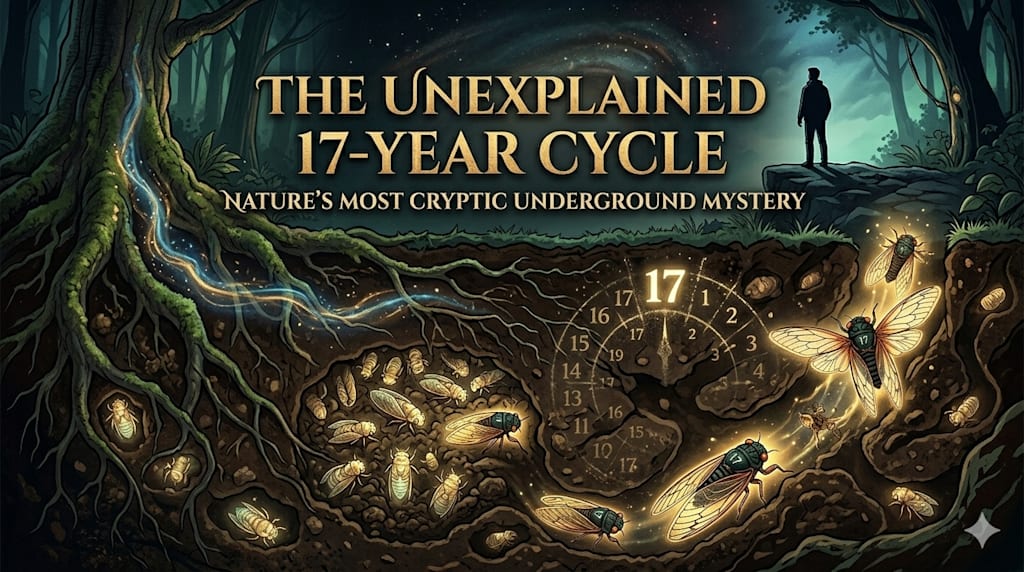
The Great Subterranean Awakening
Imagine an organism that remains buried in total darkness, silent, and untouched for nearly two decades. Above them, the human world moves at a frantic pace. Empires rise and fall, technology transforms society, and generations pass by. All the while, right beneath our feet, an ancient biological countdown is ticking away in absolute silence.
Then, on a single spring night exactly 17 years later, the ground begins to breathe. Millions of these creatures emerge from the dark earth simultaneously, crawling up tree trunks in an overwhelming, synchronized invasion. This is not a random evolutionary trait or a mere coincidence of nature; it is the haunting and beautiful reality of the Periodical Cicadas (Magicicada).
For 17 long years, these specialized insect nymphs live a solitary existence underground, feeding exclusively on the fluids of tree roots. They do not see the sun, they do not experience weather changes, and they have no contact with the outside world. Yet, their internal biological clock is sharper and more precise than any atomic timepiece created by modern human engineering. When their time is up, they rise. But the real mystery that leaves evolutionary biologists, apex predators, and mathematicians utterly baffled isn't just their incredible longevity—it is the complex mathematics behind their survival.
The Hidden Power of Prime Numbers
Why exactly 17 years? Why not a round, predictable number like 10, 15, or 20 years? Why would evolution guide a species to choose such an awkward, specific, and lengthy period to stay hidden in the dark?
The answer lies deep within the rules of mathematics. Biologists and mathematicians discovered that these specific periodical cicadas emerge strictly in cycles of prime numbers—most notably, 13 or 17 years. In pure mathematics, prime numbers are constants that cannot be divided by any other whole number except for 1 and themselves. As it turns out, this mathematical property is a matter of life and death in the animal kingdom.
By emerging strictly on a 17-year prime cycle, the cicadas have developed a flawless evolutionary strategy known as "predator satiation." Most insect predators, such as birds, spiders, and small mammals, have population life cycles that run on shorter, even numbers—typically 2, 3, 4, or 5 years. If the cicadas emerged every 12 years, for example, any predator with a 2, 3, 4, or 6-year cycle would naturally peak at the exact same time, waiting to devour them.
However, because 17 is a prime number, it rarely overlaps with the population peaks of any regular predator. A predator with a 3-year life cycle would only meet the 17-year cicadas once every 51 years! By the time the predator's population multiplies to match the prey, the cicadas have already bred, laid their eggs, and disappeared back into the soil. It is a brilliant, natural defense mechanism that keeps the species alive.
The Brain the Size of a Grain of Rice
While the evolutionary advantage of prime numbers explains why it happens, it introduces a much deeper, more chilling question: How does a creature with a brain smaller than a single grain of rice, trapped in pitch-black soil, calculate complex evolutionary mathematics?
How do these nymphs keep track of the passing years without ever seeing a single sunset or experiencing a winter breeze? Modern science suggests that the nymphs track the passage of time by detecting the seasonal changes in the fluid of the tree roots they feed on. Every spring, when the trees grow new leaves, the chemical composition of the sap changes. The cicadas, in essence, count these chemical pulses.
Yet, even if they can count to 17, what triggers the absolute synchronicity of their emergence? How do millions of separate insects across hundreds of miles decide to dig their way to the surface at the exact same hour? If they emerge too early or too late individually, they will be easily hunted and eaten. Total synchronicity is their only shield.
When they finally reach the upper world, they undergo a stunning transformation. They shed their hard nymph shells, grow wings, and fill the forests with a deafening acoustic symphony that can reach over 100 decibels—loud enough to drown out the sound of a passing motorcycle. They sing, they mate, they lay the eggs of the next generation, and within just a few weeks, they die. Their bodies decay, nourishing the very soil they crawled out of.
An Unsolved Riddle of the Cosmos
The tiny eggs left behind on the tree branches will soon hatch. The new, microscopic nymphs will drop to the forest floor and burrow deep into the earth, disappearing from human sight. They will begin a new countdown in the dark, safely tucked away until the year 2043.
We have mapped the stars, split the atom, and built artificial intelligence that can mimic human thought. Yet, the absolute precision, origin, and mathematical genius of this subterranean symphony remain one of nature’s most haunting unsolved riddles. Who truly programmed the clock inside the cicada? Is it purely genetic trial and error over millions of years, or is there a deeper, undiscovered code embedded within the fabric of our planet's biology?
What do you think? If you had to retreat from the world and sleep underground for 17 years, what era of human history would you want to wake up to? Let me know your thoughts in the comments below.
About the Creator
S.Phairat
We bring you concise summaries of fascinating articles and stories across various topics news, science, technology, culture, and everyday life.
Enjoyed the story? Support the Creator.
Subscribe for free to receive all their stories in your feed.
Comments
There are no comments for this story
Be the first to respond and start the conversation.