
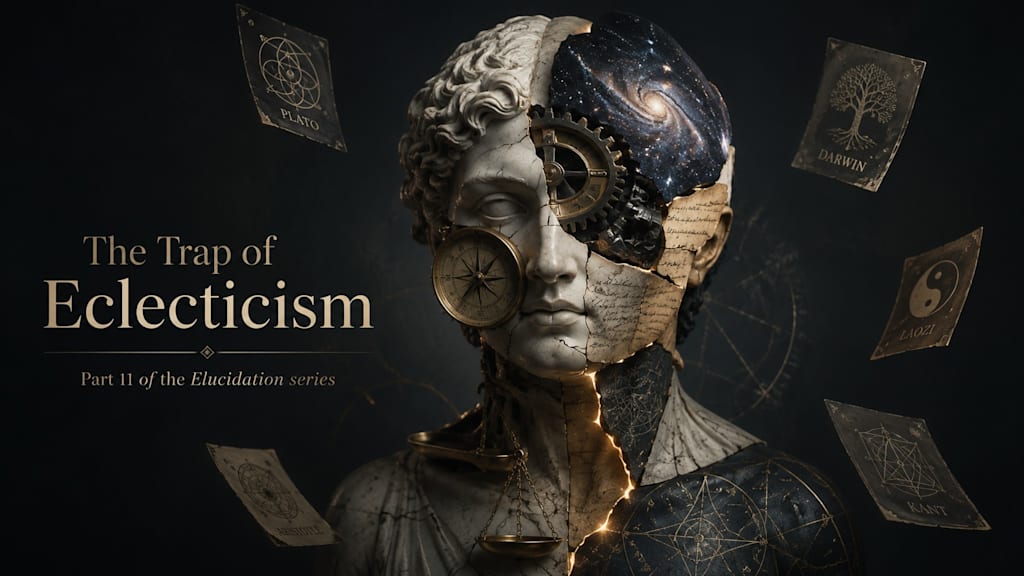
The Trap of Eclecticism
Part 11 of the Elucidation series. Previously: Why "Show Me the Evidence" Isn't Enough Either

• • •
If pure reason fails, and pure empiricism fails, why not just take the best from each? Borrow what works from rationalism. Borrow what works from empiricism. Add a little existentialism for emotional depth, a little pragmatism for practical guidance, perhaps some mysticism for spiritual richness. Blend them together. The result should be better than any single approach.
This is eclecticism. And it is a trap.
The Appeal
Eclecticism feels wise. It feels open-minded. It avoids the rigidity of committing to a single system and embraces the apparent humility of admitting that no one approach has all the answers.
In everyday life, this attitude is often sensible. There is nothing wrong with learning from multiple teachers, reading widely, or appreciating insights from different traditions. These are signs of an active and curious mind.
But there is a critical difference between learning from multiple sources and building a foundation from incompatible parts.
The Orchestra Problem
Remember the symphony orchestra from an earlier article. Its power lies in harmony, every instrument working within a shared structure. The conductor's hand ensures coherence. The result is music.
Now imagine taking the violin section from one orchestra, the drums from another, and the brass from a third, each playing a different piece in a different key at a different tempo. Each section may be excellent on its own. Together, they produce chaos.
An ideology assembled from incompatible parts works the same way. You may take a beautiful piece from Marxism, its analysis of class, perhaps. And a beautiful piece from existentialism, its emphasis on individual freedom. And a beautiful piece from traditional theology, its sense of cosmic purpose.
But if the Marxist piece assumes that history is determined by material forces, and the existentialist piece assumes that the individual is radically free, and the theological piece assumes that God directs history, then you have three answers that contradict each other at the root.
The contradiction may not be visible on the surface. Each piece may sound persuasive on its own. But put them together, and the system begins to crack. When a real decision must be made, when the three principles pull in different directions, the person is left without guidance. The eclecticist has many opinions but no framework.
Ideological Incoherence in Practice
This is not a theoretical concern. It describes the condition of millions of people today.
Consider someone who says: “I believe that only scientifically verifiable claims count as knowledge” (positivism), “I believe in God” (theism), “I believe that truth is relative to each person” (relativism), and “I believe some things are objectively just or unjust” (objective morality).
Each of these statements, taken alone, can be defended. But together, they form a system riddled with contradictions. Positivism denies the knowability of God. Theism denies that truth is merely personal. Relativism undermines the objectivity that justice requires.
Such a person is not wrong about everything. They may be right about many individual points. But they have no system. And without a system, they have no way to resolve conflicts between their own beliefs. When two principles clash, they have no clear way to decide which one should give way.
The result is confusion, paralysis, and a deep vulnerability to manipulation. Because the person without a coherent framework will shift with the wind. They will hold one position on Monday and another on Friday, not because they have learned something new, but because different borrowed principles happen to be loudest at different moments.
Why Coherence Matters More Than Comprehensiveness
The Elucidation lectures do not require a person to know everything. They demand something both simpler and harder: that what you believe should not contradict itself.
A small, coherent system is infinitely more powerful than a large, incoherent collection. Three principles that fit together, that support each other, that constrain each other, that produce consistent guidance, are worth more than a hundred borrowed insights that pull in different directions.
This is why we spend so much time on foundations. Not because secondary questions don't matter, but because no secondary question can be answered well if the foundations are in conflict.
The cure for eclecticism is not dogmatism. It is not closing one's mind to other perspectives. The cure is to build a genuine system, to start from first principles, examine them honestly, demand coherence, and let the rest follow.
In the next article, we will see what such a system looks like in practice, a method of inquiry that takes both observation and interpretation seriously, without collapsing into either extreme.
• • •
Next: A Third Way: How to Actually Investigate Reality**
Elucidation is a series of articles inspired by philosophical lectures given around 50 years ago. New articles are published weekly.
This article is part of the Elucidation series. The articles have been written and reviewed by the author with the assistance of AI.
About the Creator
Han Elucidation
Why do we exist? A searcher. Exploring existence, meaning, and what it means to be human through the Elucidation series.
Enjoyed the story? Support the Creator.
Subscribe for free to receive all their stories in your feed.
Comments
There are no comments for this story
Be the first to respond and start the conversation.